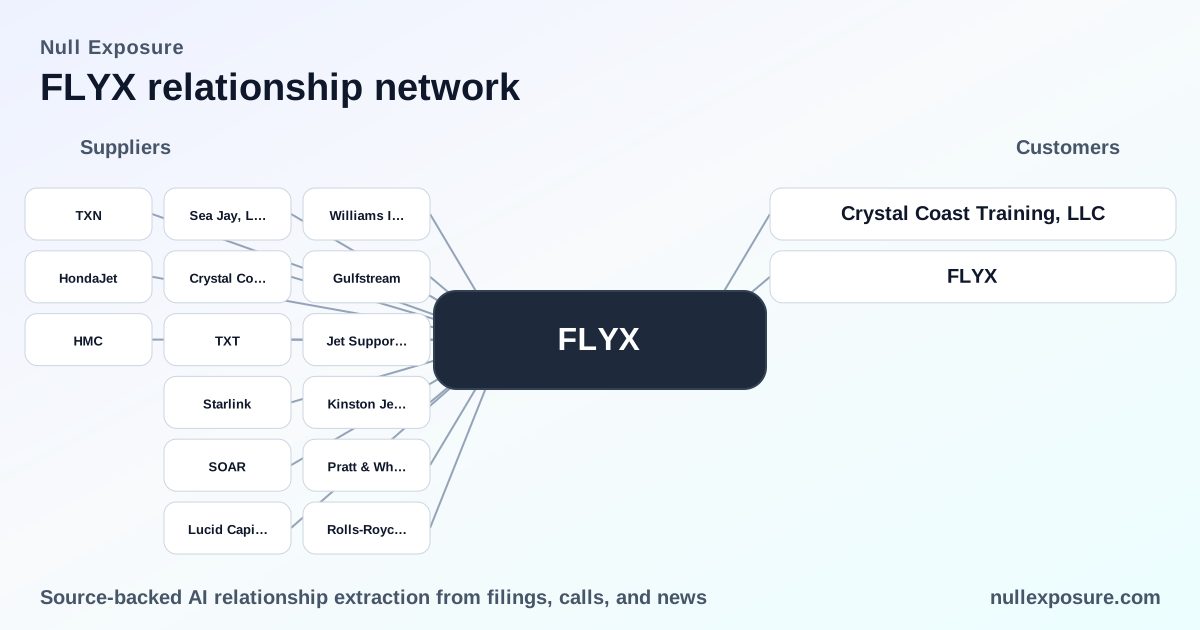
flyExclusive (FLYX) — customer relationships and commercial implications for investors
flyExclusive operates a vertically integrated private aviation business that monetizes through a mix of charter flights, membership subscriptions (Jet Club), fractional ownership sales, aircraft management and MRO services, while also transacting aircraft and ancillary assets. The company generates recurring cash from membership and fractional contracts, transaction-based revenue from ad hoc charters and MRO, and occasional one‑time gains from asset sales; trailing revenue is roughly $376 million and market capitalization is approximately $230 million. For a compact diligence steer, see more at https://nullexposure.com/.
How flyExclusive monetizes and what that implies for investors
flyExclusive’s commercial model combines long‑term contracted cashflows (fractional ownership and some management agreements) with subscription-style recurring fees (Jet Club) and usage‑based charter revenues, producing a blended revenue profile. This structure gives the company a degree of revenue visibility from membership deposits and fractional amortization, while exposing it to cyclical demand in ad hoc charter and international flying. Key operating attributes are concentration on North America with selective international routes, a predominantly service‑oriented segment structure, and material customer contract tenors that create both predictable receipts and exit liabilities.
- Revenue mix: recurring (memberships, fractional amortization) + variable (hourly charter) + transactional (aircraft sales, MRO).
- Contract posture: evidence of long‑term and subscription agreements alongside usage‑based hourly billing.
- Risk profile: high customer concentration in premium spend bands, exposure to program terminations (GRP historical example), and reliance on owned/leased fleet economics.
Learn more about how null exposure maps customer relationships at https://nullexposure.com/.
Contracting posture and other company-level signals
The company’s filings and disclosures collectively signal a mixed but structured business model:
- Long‑term contracts are material to the model. Multiple excerpts reference multi‑year terms (up to five years for fractional ownership and multi‑month minimums for other agreements), which supports revenue amortization practices and creates deferred revenue liabilities.
- Subscription and membership revenue is significant. Jet Club programs operate on monthly/annual terms with deposits and minimum membership windows that provide recurring cashflow.
- Usage‑based revenue remains core. Many customers are charged hourly rates and minimum hours, keeping revenue tied to utilization.
- Primary geography is North America with international operations. Substantially all long‑lived assets and most revenues are U.S.‑centric, yet the fleet services international flying as required.
- Services focus and vertical integration. flyExclusive reports a single segment—private aviation services—including charters, fractional, Jet Club, MRO and management—creating cross‑sell opportunities but also operational concentration.
- Spend bands vary from sub‑$100k deposits to multi‑million aircraft transactions. Membership deposits sit in low six figures while aircraft trades fall into the $1M–$10M band.
- Relationship stages are mixed. The company maintains active management contracts (for example, Volato) while historically terminating programs (such as GRP), the latter having produced a material accounting impact.
These constraints frame both revenue stability and downside: long‑term memberships cushion churn, but program termination or fleet idling can create material swings to reported revenue and cash flow.
Customer and partner relationships every investor should know
Crystal Coast Training, LLC — aircraft sale to an affiliated entity
On September 28, 2023, flyExclusive sold five trainer aircraft to Crystal Coast Training, LLC (a wholly owned subsidiary of LGMV) for $2,481,840, reflecting the company’s practice of transacting aircraft within its corporate family for fleet optimization and capital redeployment. Source: flyExclusive 10‑K, FY2024.
OTH (dealer incentive program references) — dealer partners tied to performance incentives
Recent press coverage cites an OTH dealer program that allows eligible dealers to earn private aviation flight hours with flyExclusive as a performance‑based incentive, indicating the company leverages flight hours as a non‑cash reward to strengthen B2B channels. The coverage was reported in Barchart (March 2026). Source: Barchart news reports, March 2026.
OTH (second mention) — repeat coverage of the same dealer incentive arrangement
A second Barchart article reiterates the OTH program mechanics—dealer partners may earn flyExclusive flight hours tied to sales performance—underscoring media attention on marketing partnerships used to extend commercial reach. Source: Barchart news reports, March 2026.
flyExclusive (internal leasing with LGM Auto, FY2024 disclosure) — related‑party vehicle leases
flyExclusive discloses that LGM Auto, LLC (a wholly‑owned subsidiary of LGMV) leases multiple automobiles to the company, with lease payments of $189,704 in 2024 and $173,838 in 2023, demonstrating routine related‑party operational arrangements for non‑flight assets. Source: flyExclusive 10‑K, FY2024.
FLYX (duplicate 10‑K entry reflecting the same auto lease disclosure)
The filing also lists this relationship under the company name or ticker variant, repeating that LGM Auto provides leased vehicles and received the same aggregate payments in 2024 and 2023, confirming the leasing arrangement is reported consistently in the FY2024 SEC filing. Source: flyExclusive 10‑K, FY2024.
Volato Group — exclusive aircraft management services agreement
On September 2, 2024, flyExclusive entered into a 12‑month Aircraft Management Services Agreement with Volato Group, Inc., under which flyExclusive is the exclusive provider of aircraft management services to Volato, a contract that positions flyExclusive as an outsourced operator and revenue partner. This relationship is also referenced in a May 2026 press release about asset acquisitions tied to Volato. Source: press release coverage in The Globe and Mail / company announcement, September 2024 / May 2026.
Financial and strategic takeaways for investors
- Predictability from contracted members: Subscription and fractional contracts deliver contractual revenue recognition patterns and deposits that support liquidity in the near term.
- Operational concentration: One reportable segment centered on private aviation services is an efficiency driver but increases single‑industry exposure.
- Materiality of program changes: Historical termination of the GRP program drove a material accounting impact, demonstrating that program-level changes can move reported revenue materially.
- Asset and related‑party transactions: Aircraft sales and related‑party leases (e.g., Crystal Coast and LGM Auto) are part of the company’s capital strategy and should be monitored for their effect on cash flow and balance sheet composition.
- Distribution strategy leverages incentives: Dealer incentive programs (OTH) and exclusive management agreements (Volato) show the company uses creative commercial partnerships to scale utilization and management revenue.
Final view
For investors and operators evaluating flyExclusive’s customer relationships, the company runs a diversified monetization model built on long‑term contracts, subscription membership economics and usage‑based charters, tempered by fleet and program concentration risks. Monitor membership deposit trends, fractional sales amortization, and the company’s management of asset transactions and related‑party arrangements to assess earnings quality and balance‑sheet risk.
For a deeper review of relationship signals and mapping methodology, visit https://nullexposure.com/.