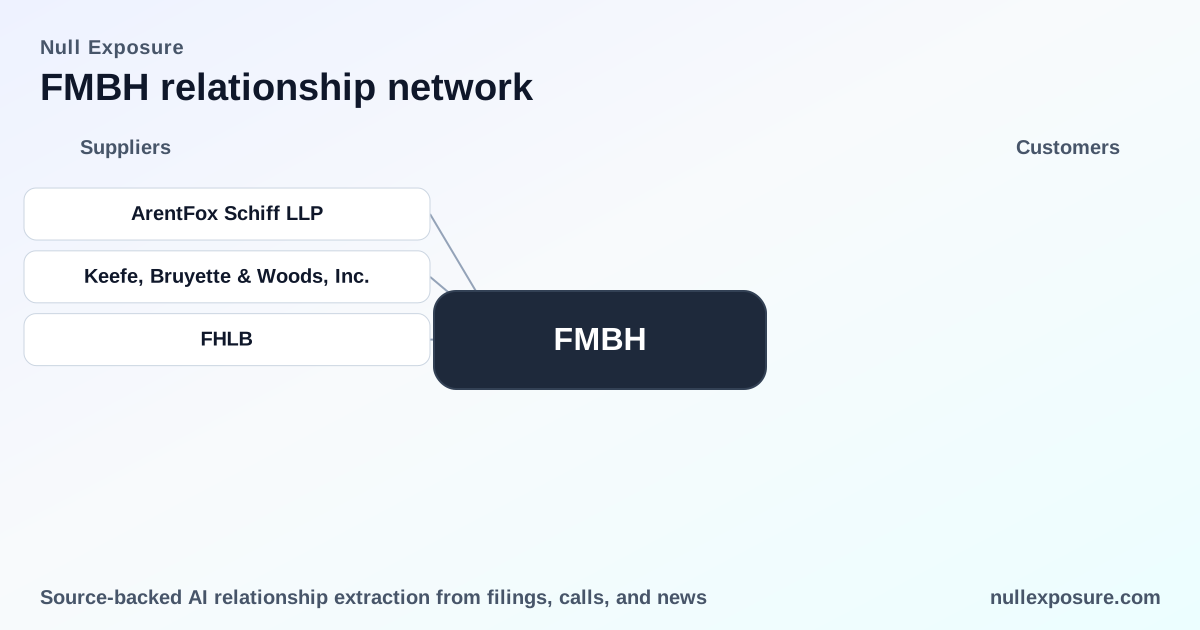
First Mid (FMBH): Customer Relationships and Operational Signals investors should price in
First Mid Bancshares operates as a regional community bank holding company that monetizes through net interest income on a large, loan-heavy balance sheet and fee income from wealth management and insurance services. The franchise is funded primarily by retail core deposits and notable public-entity relationships, while growth comes from targeted acquisitions and cross-selling of trust, brokerage and insurance products. For investors tracking customer-level risk and franchise durability, the company’s deposits, loan maturities, and recent acquisitions are the primary drivers of near-term earnings and long-term franchise value.
For additional relationship intelligence see https://nullexposure.com/ (do-follow).
How First Mid makes money and where the leverage lives
First Mid is a classic community bank whose earnings profile is driven by the loan portfolio as the largest category of earning assets, complemented by fee-generating services. Interest spreads on fixed- and variable-rate loans produce the bulk of recurring revenue, while wealth management and insurance subsidiaries supply higher-margin fee income that dampens interest-rate volatility. The company’s commercial and agricultural lending orientation ties earnings to regional economic cycles, particularly in east central Illinois.
Key operating model characteristics that matter to investors:
- Contracting posture: The balance sheet exhibits a mix of long-term loan commitments (substantial fixed- and variable-rate loans extending beyond one year) alongside short-term contingent instruments such as standby letters of credit that generally expire within a year, creating different liquidity and repricing horizons. Company filings as of December 31, 2024 show approximately $2.7 billion of fixed-rate loans and $1.9 billion of variable-rate loans with maturities over one year, and standby letters of credit that typically expire in one year or less.
- Concentration and geography: Operations are geographically concentrated in east central Illinois with branches across numerous Illinois counties and limited footprints in Missouri, Wisconsin and Texas, signaling regional concentration risk tied to agriculture and local commercial activity.
- Counterparty mix and criticality: The bank maintains meaningful public-entity deposit relationships—public entities held roughly $261.2 million in various checking and time deposits as of year-end 2024—so municipal and government balances are material to funding. The loan portfolio remains the most critical earning asset.
- Business model maturity and role: First Mid operates as a full-service community franchise and acts both as lender and service provider, leveraging wholly owned subsidiaries to deliver trust, investment and insurance services that broaden revenue streams while deepening customer relationships.
Customer relationships: the complete list in scope
This section covers every customer relationship flagged in the available results.
Two Rivers Financial Group, Inc.
First Mid completed the acquisition of Two Rivers Financial Group, Inc., and formally welcomed Two Rivers’ customers and employees into the franchise as part of its growth strategy. A GlobeNewswire press release on March 2, 2026 announced the transaction and quoted CEO Joe Dively on the integration of Two Rivers’ relationships into First Mid’s service platform.
What the relationship signals mean for credit and deposit dynamics
The Two Rivers acquisition is an example of First Mid’s inorganic growth approach to expand deposit and customer footprint in adjacent markets. The deal enhances the company’s retail deposit base and cross-sell opportunities for wealth and insurance services, while incrementally spreading fixed-costs across a larger revenue base. The acquisition cadence also increases integration risk and requires monitoring of deposit retention post-close.
Concentration, criticality and contract maturity — reading the constraints as investment signals
The company-level constraints and disclosures illuminate how management runs the franchise and where investor attention should focus:
- Long-term loan book dominance: The sizeable pool of loans maturing beyond one year — roughly $2.7 billion fixed and $1.9 billion variable as of year-end 2024 — underscores a long-duration earning asset profile with sensitivity to credit cycles and the level of interest rates over multi-year horizons.
- Short-term contingent exposures: The routine issuance of standby letters of credit that generally expire within a year introduces short-term off-balance-sheet obligations tied to customer financing needs and trade facilitation.
- Public-entity deposit concentration: The bank’s account relationships with governmental entities are quantitatively meaningful—$261.2 million in public balances in 2024—creating both a stable low-cost funding source and a potential concentration vulnerability if municipal deposit behavior shifts.
- Service-provider role and revenue diversification: First Mid’s ownership of wealth management and insurance subsidiaries indicates a deliberate strategy to diversify fee income beyond interest spread, and to position the bank as a multi-product provider to businesses and individuals.
- Asset-concentration guardrails: Management reports that commercial real estate exposure is below federal regulatory thresholds for concentration, which is a signal of conservative underwriting within CRE even as the bank grows its loan book.
Risks and watchlists for investors
Investors should explicitly track the following items because they directly affect earnings and franchise valuation:
- Deposit composition and retention, especially public-entity balances and acquired deposit roll-off after deals like Two Rivers.
- Loan portfolio seasoning and credit trends, with attention to agricultural and regional commercial credits given geographic concentration.
- Maturity ladder and repricing gaps between long-term fixed-rate loans and shorter-term liabilities or contingent commitments.
- Fee-income trajectories from wealth and insurance subsidiaries as indicators of successful cross-sell and non-interest revenue resilience.
- Acquisition integration metrics including cost saves, customer retention, and branch rationalization.
Why this matters to a valuation or credit thesis
First Mid’s valuation benefits from stable net interest income supported by a large loan book and incremental margin uplift from fee-generating subsidiaries. The combination of regional concentration and meaningful public deposits creates a profile that is both resilient in steady-state and vulnerable to localized economic stress or deposit migration. The company’s use of acquisitions to scale core deposit and fee bases is positive for long-run ROE if integration executes, but raises short-term execution risk.
For investors who want to monitor evolving customer-level exposures and how they translate into franchise value, Null Exposure offers targeted relationship intelligence and monitoring tools at https://nullexposure.com/ (do-follow).
Conclusion: First Mid is a regional, deposit-funded franchise with a loan-centric earning base and growing fee income streams. The balance between long-dated lending, municipal deposit relationships, and acquisition-led growth will determine near-term earnings volatility and long-term franchise value, and these are the dimensions investors must watch closely.