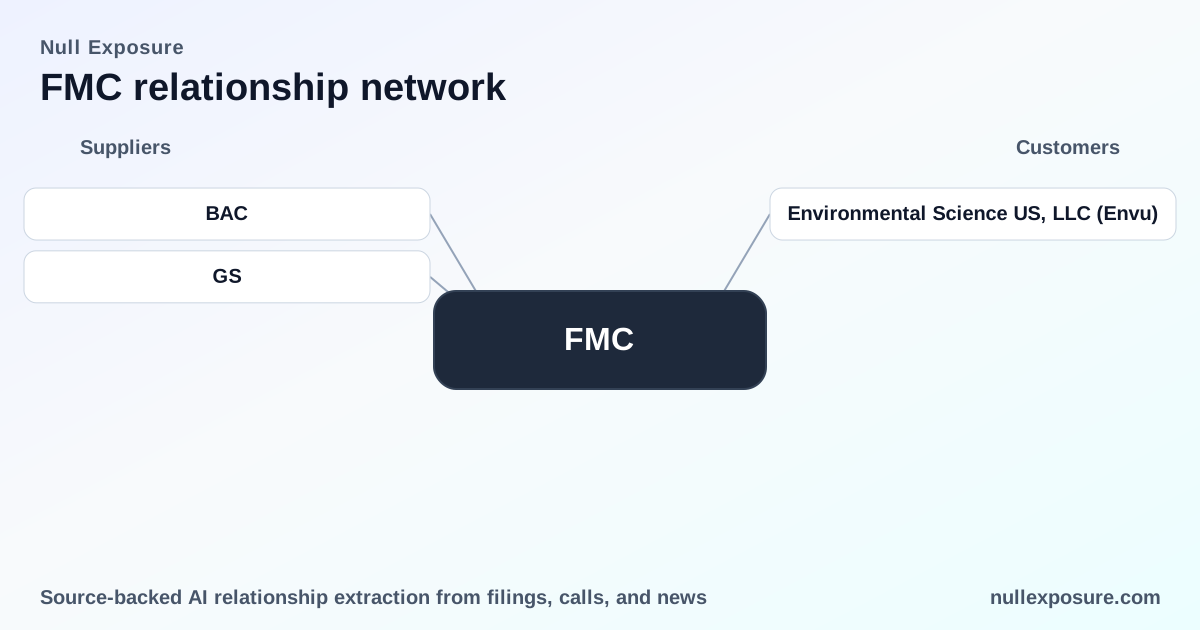
FMC Corporation — customer relationships and what the Envu deal means for investors
FMC Corporation operates as a global agricultural sciences company that develops and sells crop protection chemicals, biologicals, seed treatments and digital agronomy tools, monetizing primarily through product sales and regional distribution channels (distributors, retailers, co‑ops) while also selling directly to large growers in select countries. Revenue is geographically diversified across North America, Latin America, EMEA and Asia, and management continues to reshape the portfolio through targeted divestitures to concentrate on higher‑margin plant‑health businesses. For a concise tracker of FMC’s commercial footprint and disclosed customer ties, visit https://nullexposure.com/.
One-line deal: FMC sold its Global Specialty Solutions unit to Envu
FMC finalized an agreement to sell its Global Specialty Solutions (GSS) business to Environmental Science US, LLC (doing business as Envu) in a strategic divestiture that removes a non‑core specialty unit from FMC’s commercial scope. A news report dated March 9, 2026, covered the transaction and identified Envu as the buyer. (Chemanalyst, March 9, 2026).
Relationship listing: the customer / counterparty roster disclosed
- Environmental Science US, LLC (Envu) — FMC agreed to sell its Global Specialty Solutions unit to Envu under a definitive agreement announced in early March 2026; this transaction transfers ownership of the GSS operations and associated customer relationships to Envu. (Chemanalyst report, March 9, 2026).
How the Envu transaction reshapes FMC’s customer posture
The GSS sale reduces FMC’s exposure to specialty-environmental product lines and consolidates the company’s commercial focus on core crop‑protection and plant‑health offerings. Removing GSS simplifies FMC’s channel footprint and concentrates management resources on the core product portfolio and key distributor relationships. The divestiture is consistent with a strategic posture of portfolio pruning to prioritize scale markets and higher margin categories.
Company-level customer signals and what they reveal about the business model
The company disclosures and excerpts provide a consistent signal set about FMC’s operating model and customer dynamics:
- Sells through a hybrid channel network: FMC operates through its own sales organization and a mixture of distributors, retailers and co‑ops, while also selling directly to large growers in select countries such as Brazil, indicating a layered contracting posture that blends volume distribution with selective direct contracting (Company filing, Year Ended December 31, 2024).
- Geographically diversified revenue base: North America ($1,173.4M), Latin America ($1,389.5M), Asia ($848.4M) and Europe/Middle East/Africa ($834.8M) create a balanced regional footprint that reduces single‑market dependency and shifts commercial risk across continents (Company filing, 2024 revenue by region table).
- Counterparty profile skews large enterprise: The product mix and direct sales to large growers are consistent with large‑enterprise counterparties that transact for high volumes and multi‑season supply agreements, which raises negotiation leverage but also concentrates revenue behind a smaller number of large accounts (Company filing excerpts).
- Seller role and transaction maturity: FMC consistently describes itself as a global seller of the three major classes of crop‑protection chemicals plus plant‑health solutions; this positioning reflects a mature commercial operation with established channel partners and multi‑year product cycles (Company filing).
Together, these signals describe a company with a stable, institutional customer base, multi‑regional exposure that cushions local crop cycles, and a contracting posture that combines predictable distributor flows with selective direct relationships for large growers.
For investors who want a dashboard of FMC’s commercial disclosures and transaction history, consult https://nullexposure.com/ for deeper context.
Investor implications — concentration, criticality and margin dynamics
- Concentration and counterparty risk: The direct sale relationships with large growers and reliance on major distributors imply concentrated revenue pockets—large counterparties can shift demand quickly season to season, which requires active commercial management and product differentiation.
- Criticality of products: FMC’s products are mission‑critical to growers’ seasonal yields, giving FMC pricing leverage in constrained supply cycles but also exposing the company to regulatory and input‑cost volatility.
- Margin and profitability context: FMC reported sizeable revenue and gross profit in the trailing twelve months but faces pressure on operating metrics; investors should weigh portfolio simplification (like the GSS divestiture) against persistent margin compression in commoditized crop‑protection segments. The company’s forward valuation multiples imply expectations of near‑term operating improvement, but operational execution and crop demand both drive realized outcomes.
What the Envu sale signals for future customer relationships
Divesting GSS to Envu clarifies FMC’s customer focus: less emphasis on specialty environmental solutions and more capital to scale core crop‑protection and plant‑health products. For buyers and distributors, this reduces the number of FMC product lines requiring specialized support, while for large growers it concentrates negotiation around fewer, higher‑volume product categories. The transaction also shifts certain customer relationships to Envu, meaning counterparties formerly managed by FMC’s GSS organization will now be part of Envu’s commercial portfolio (Chemanalyst, March 9, 2026).
Bottom line — what investors should watch next
- Watch whether portfolio simplification translates into margin expansion and whether the proceeds and cost base reduction from the GSS sale are redeployed into R&D or commercial scale for core plant‑health offerings.
- Monitor top‑customer dynamics in Latin America and North America where revenue concentration is highest; negotiating outcomes with large growers will materially affect top‑line volatility.
- Regulatory and input‑cost trends remain the dominant external drivers of short‑term performance; FMC’s diversified regional revenue profile moderates but does not eliminate cyclical exposure.
For a practical monitoring feed on FMC’s commercial relationships and transaction activity, visit https://nullexposure.com/ and review the curated timelines and deal entries.