Fresenius Medical Care (FMS): Customer Relationships and Commercial Signals Investors Should Track
Fresenius Medical Care operates and monetizes through a two‑pronged model: delivery of dialysis services and sale of dialysis equipment, disposables and related clinical services. The company earns recurring, contract‑anchored revenue from in‑center treatment and care management while capturing higher‑margin product and solution revenue from machines, consumables and distribution agreements that extend into home dialysis markets. Investors should price Fresenius for stable cash flow from chronic care, structural growth in home dialysis, and incremental margin upside from strategic distribution and partner deals. For deeper customer intelligence, see https://nullexposure.com/.
How to think about Fresenius’ customer posture and contract economics
Fresenius is a service‑heavy, capital‑intensive healthcare operator where relationships with providers, payers and distributors determine utilization and equipment replacement cycles. Key business model signals for investors:
- High criticality: Dialysis is life‑sustaining care, which creates durable demand and predictable treatment volumes.
- Contracting posture: Revenue mixes include long‑running treatment contracts, payer agreements and commercial distribution deals for equipment; these create stickiness and recurring revenue.
- Concentration: North America is a large and strategically important market, so regional reimbursement and partner performance materially affect results.
- Maturity and cash generation: The company exhibits mature margins and steady EBITDA conversion characteristic of established clinical operators; product distribution offers incremental growth levers.
These signals combine to make Fresenius a defensive healthcare operator with operational leverage to product and distribution partnerships that expand its addressable market.
The on‑the‑record partner and customer relationships you should know
Below I review every relationship captured in the available customer results and deliver a concise investor‑oriented read on each.
Quest Diagnostics (DGX) — FY2026
Trading commentary notes that Quest Diagnostics purchased select clinical testing assets from Fresenius Medical Care, broadening Quest’s lab testing footprint across U.S. dialysis centers and indicating Fresenius is divesting some in‑house testing assets while sharpening core clinical and equipment focus. This transaction signals strategic reallocation rather than a retreat from clinical service provision. (TradingView, Zacks commentary, May 2, 2026.)
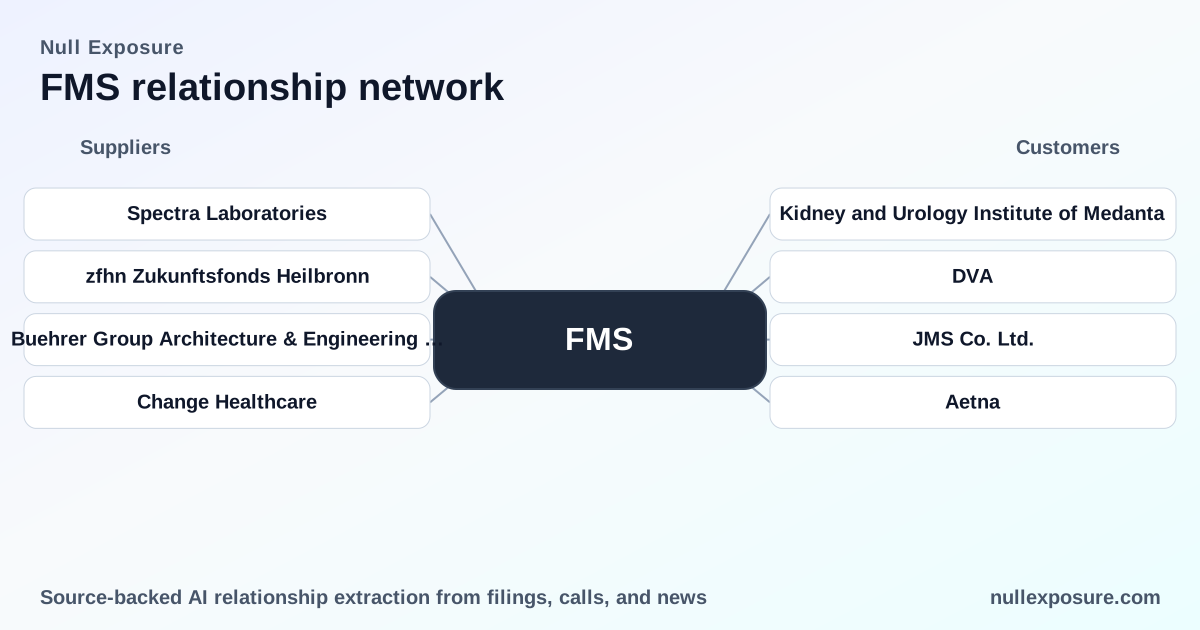
Kidney and Urology Institute of Medanta — FY2019
Fresenius introduced the 4008A dialysis machine into India and one of the earliest clinical users is Dr. Vijay Kher at the Kidney and Urology Institute of Medanta in Gurugram, demonstrating adoption of Fresenius equipment in tertiary care centers outside Europe and North America. This is evidence of product penetration in emerging‑market hospital partners. (GlobeNewswire, Jan 18, 2019.)
DaVita (DVA) — FY2025
Public reporting and analyst notes document that Fresenius extended agreements with DaVita to enhance patient access to home hemodialysis and value‑based care, signaling cooperation with one of the largest U.S. dialysis operators to scale home treatments and shared clinical pathways. The relationship supports volume growth in home offerings and aligns incentives on patient outcomes. (Sharewise republishing Zacks, June 4, 2025.)
JMS Co. Ltd. — FY2025
Fresenius expanded its home dialysis market through a distribution deal with JMS Co. Ltd. in Japan, reflecting a targeted international partnership to commercialize home‑use machines and consumables in a major APAC market. This kind of local distributor arrangement accelerates adoption without duplicative sales infrastructure. (Sharewise republishing Zacks, June 4, 2025.)
Aetna — FY2025
Analyst coverage records that Fresenius extended agreements with Aetna to support broader patient access to home hemodialysis and value‑based care, strengthening payer partnerships that help de‑risk reimbursement for home modalities and create shared savings incentives. These payer ties underwrite utilization economics for Fresenius’ home solutions. (Sharewise republishing Zacks, June 4, 2025.)
What these relationships collectively tell investors
Across these customer and partner signals, three strategic themes emerge:
- Portfolio focus and monetization shift: The Quest deal indicates Fresenius is actively optimizing what it operates versus what it sells or outsources; this refines capital allocation and concentrates the company on core service and device economics.
- Acceleration of home dialysis: Partnerships with DaVita, JMS and Aetna explicitly target scaling home hemodialysis—this is the primary growth vector for product and services revenue outside in‑center treatments.
- Global product placement: The Medanta adoption example underscores that Fresenius’ devices are competitive in tertiary hospitals in growth markets, supporting incremental product sales and replacement cycles.
Risk and reward implications for investors
- Reward: Scaling home dialysis via distributors and provider/payer agreements creates a higher‑margin revenue stream that can expand EBITDA without proportional increases in in‑center operational cost.
- Risk: Outsourcing of ancillary clinical assets (e.g., lab testing) transfers recurring revenue to buyers such as Quest but can also reduce operating leverage if not offset by faster equipment and home‑care revenue growth.
- Operational sensitivity: Because dialysis is life‑critical, regulatory, reimbursement and payer contract changes in North America will continue to exert outsized influence on Fresenius’ performance.
Read the signals, size the position
Fresenius is a hybrid operator: service continuity provides defensive cash flow while distribution and partnership deals create optionality for margin expansion. Investors should weight exposure to FMS based on their view of reimbursement stability in North America and the company’s ability to convert partnership-driven home dialysis volumes into sustainable margin expansion.
For ongoing, structured monitoring of partner and customer event flow, visit https://nullexposure.com/ for signal tracking and archival context.
Bottom line: what to watch next quarter
- Quarterly commentary for updates on the Quest Diagnostics transaction carve‑outs and how freed‑up capital is redeployed.
- Volume progression in home dialysis tied to the JMS distribution rollout in Japan and expanded U.S. home programs with DaVita and payers such as Aetna.
- Any incremental divestitures or partnerships that alter the balance between services and product revenue.
Bold takeaway: Fresenius converts durable, contract‑anchored treatment demand into stable cash flow while using targeted partner deals to scale higher‑margin home dialysis—investors should watch partner execution and payer dynamics as the decisive drivers of upside.