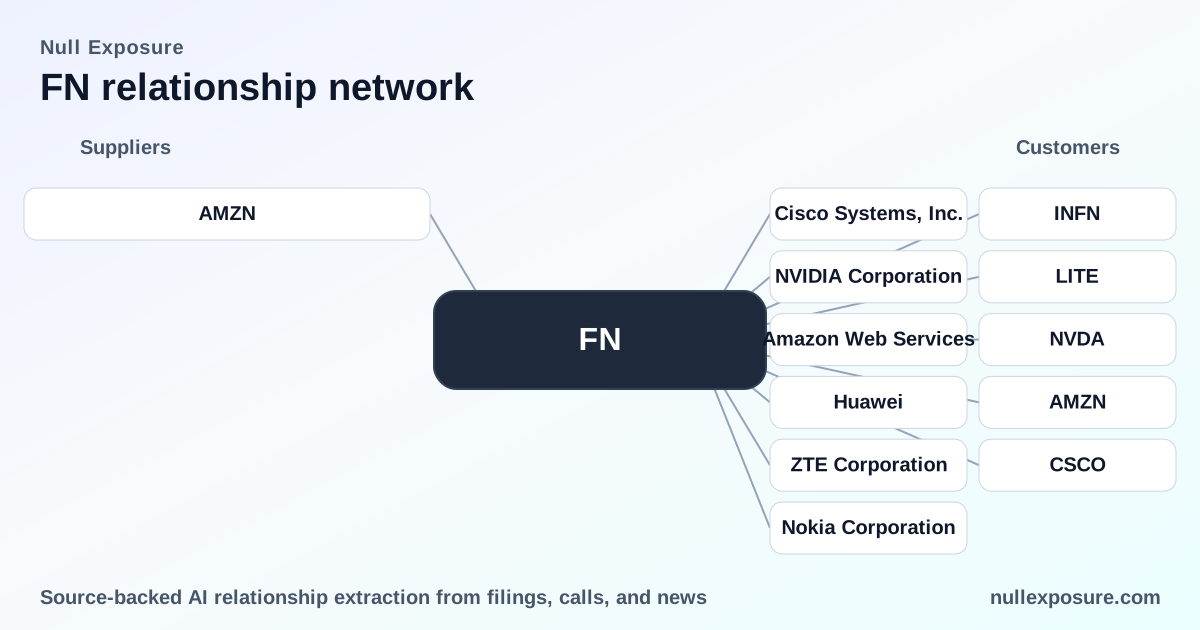
Fabrinet (FN): Customer Map, Concentration Risks and the AI‑Optics Opportunity
Fabrinet is a contract manufacturer that monetizes by delivering high‑precision optical and electronic packaging and assembly services to OEMs and hyperscalers; it signs multi‑year supply agreements and executes project‑by‑project production under master frameworks while collecting revenues as manufacturing deliverables ship. Revenue is highly concentrated around a handful of hyperscale and networking customers, even as recent wins with AWS and silicon‑photonics partners broaden the addressable market. For the full research platform, visit https://nullexposure.com/.
How Fabrinet actually contracts and where value comes from
Fabrinet operates as a classic contract manufacturer with a hybrid posture: longer initial terms on master supply agreements combined with non‑guaranteed, project‑by‑project awards under those frameworks. The company tells investors that supply agreements “generally have an initial term of up to three years, subject to automatic renewals,” while also noting master agreements do not guarantee volumes — revenue is won per project. That contracting posture creates both stability (multi‑year relationships) and variability (order timing and mix). Fabrinet’s manufacturing base is global but concentrated operationally in Thailand, with revenues materially split across APAC, North America and EMEA; management disclosed that bill‑to locations outside North America fell from 63.5% in FY2024 to 56.6% in FY2025 as North American demand accelerated (FY2025 10‑K).
The net result: high customer concentration, long but flexible commercial commitments, and operational centralization around specialized plants — an attractive margin mix when volumes are steady, and a pronounced vulnerability if major buyers throttle orders or insource capacity.
What investors should read into the constraints
- Contracting posture: Master supply agreements provide shelf space and renewal mechanics, but volumes are negotiated project by project, which produces lumpy revenue even under “long‑term” engagements (company disclosures in FY2025).
- Concentration & materiality: Fabrinet discloses a small number of customers contribute a significant percentage of revenue; the company warns that reductions or losses could have a material adverse effect (FY2025 10‑K).
- Geography and operations: Principal manufacturing facilities in Thailand support a globally billed client base, with APAC historically the largest region but North America growing in FY2025.
- Relationship maturity and role: Fabrinet positions itself as a mature manufacturing partner to OEMs and hyperscalers, providing both advanced manufacturing and supply‑chain services that make it a critical supplier for complex optical and co‑packaged optics components.
If you want crisp dashboards and deeper primary‑source links, see our research home: https://nullexposure.com/.
Customer roster: a plain‑English walk through every named relationship
NVIDIA / NVDA / NVIDIA Corporation
Fabrinet’s single largest customer: NVIDIA accounted for 27.6% of revenues in FY2025 and is described by management as the primary buyer of transceivers and co‑packaged optics modules (FY2025 10‑K; FY2025 Q4 earnings call, Mar 2026). This relationship is both a growth engine and a concentration risk for FN.
Cisco Systems / CSCO / Cisco
Cisco represented 18.2% of revenue in FY2025 and is cited repeatedly as a blue‑chip networking customer for optical transceivers and modules (FY2025 10‑K; FY2025 Q4 earnings call; industry coverage March 2026). Cisco is a core strategic account and a second source of significant revenue intensity.
Amazon Web Services / Amazon / AMZN / AWS
Fabrinet established a direct, multi‑year commercial relationship with AWS that management says will be a meaningful revenue driver into FY2026 as Fabrinet supplies advanced manufacturing services for high‑performance computing optical components (Fabrinet Q3 FY2025 earnings call; MarketMinute/FinancialContent coverage April–May 2026). The AWS link is an important diversification vector away from pure telecom cyclicality.
iPronics
iPronics deepened a partnership with Fabrinet to add a dedicated silicon‑photonics packaging and assembly line for AI optical circuit switches, with a press release announcing the expansion in March 2026 (GlobeNewswire Mar 17, 2026; multiple industry writeups). This is an incremental content opportunity tied to next‑generation SiPh systems.
Lumentum (LITE)
Lumentum is named among long‑term optical clients for which Fabrinet manufactures key transceivers and modules (industry coverage, optics.org and related March 2026 articles). Lumentum represents an established OEM relationship within the optical components ecosystem.
Infinera (INFN)
Infinera is likewise cited as a long‑term customer for optical modules and transceivers in industry reporting; Fabrinet supplies components for blue‑chip networking customers that include Infinera (optics.org, Mar 2026). This reinforces Fabrinet’s role in telecom and datacenter optical supply chains.
Nokia Corporation
Nokia shows up in Fabrinet’s receivables concentration table — 12.0% of accounts receivable as of June 27, 2025 — indicating material outstanding exposure even where revenue share is not singled out as >10% (FY2025 10‑K). That receivable concentration is operationally relevant for working capital risk.
ZTE Corporation
Fabrinet’s FY2025 filings reference export restrictions by the U.S. Department of Commerce affecting ZTE, noting ZTE is a customer of certain customers in Fabrinet’s supply chain, which introduces geopolitical and compliance risk to indirect exposures (FY2025 10‑K).
Huawei
The FY2025 10‑K likewise references Huawei in the context of export and service restrictions imposed by U.S. authorities, highlighting downstream policy risk where Fabrinet’s customers or their customers overlap with sanctioned entities (FY2025 10‑K).
Innoviz (INVZ / INVZW / INVZ variants)
Multiple investor and company statements indicate Innoviz is using Fabrinet’s high‑volume lines to ship LiDAR units, with capacity ramps described as 3x–4x year‑over‑year to meet automotive and non‑automotive demand (Innoviz earnings call transcripts and Finviz / InsiderMonkey coverage March 2026). This is an example of Fabrinet’s automotive and sensor manufacturing content.
NNOX
NNOX (earnings call excerpts) describes strengthening production capabilities via a partnership with Fabrinet to manufacture hundreds of systems, showing that Fabrinet also serves smaller, system‑level OEMs beyond hyperscalers (NNOX earnings call, 2025Q3).
AEVA
AEVA upgraded a high‑precision production line at Fabrinet to prepare for increased volumes, a signal that Fabrinet’s facilities are actively being used by multiple LiDAR and sensor suppliers (press reporting, The Globe and Mail / March 2026).
(If a name appeared in multiple sources above, the summary pulls the most material disclosure; each relationship noted is supported by Fabrinet’s FY2025 S‑K filings, earnings transcripts and the March–May 2026 market coverage cited.)
Investment implications: read the balance of power
- Growth catalyst: wins with NVIDIA and AWS plus silicon‑photonics partnerships (iPronics) create meaningful revenue upside into FY2026.
- Concentration risk: two customers accounted for ~46% of FY2025 revenue (NVIDIA ~28%, Cisco ~18%), which amplifies sensitivity to order swings.
- Operational leverage: Thailand‑based manufacturing and specialized lines mean high operating leverage when demand is sustained; conversely, supply‑chain bottlenecks or customer order reductions will compress margins quickly.
Bottom line for operators and allocators
Fabrinet is a specialized, high‑mix, high‑precision contract manufacturer positioned at the intersection of AI datacenter optics and automotive sensing, with clear upside from hyperscaler and SiPh mandates but meaningful counterparty concentration and geopolitical exposure embedded in the revenue base. Key data points are drawn from Fabrinet’s FY2025 10‑K (filed June 27, 2025), company earnings calls in early 2026, and press releases and industry coverage March–May 2026.
If you want to track primary filings, earnings transcripts and curated market intelligence on these relationships, explore our coverage at https://nullexposure.com/.
Key takeaway: Fabrinet offers a compelling leverage play on AI optics and hyperscaler capex — but its valuation must price both the upside from hyperscaler wins and the outsized concentration and compliance risks embedded in its customer book.