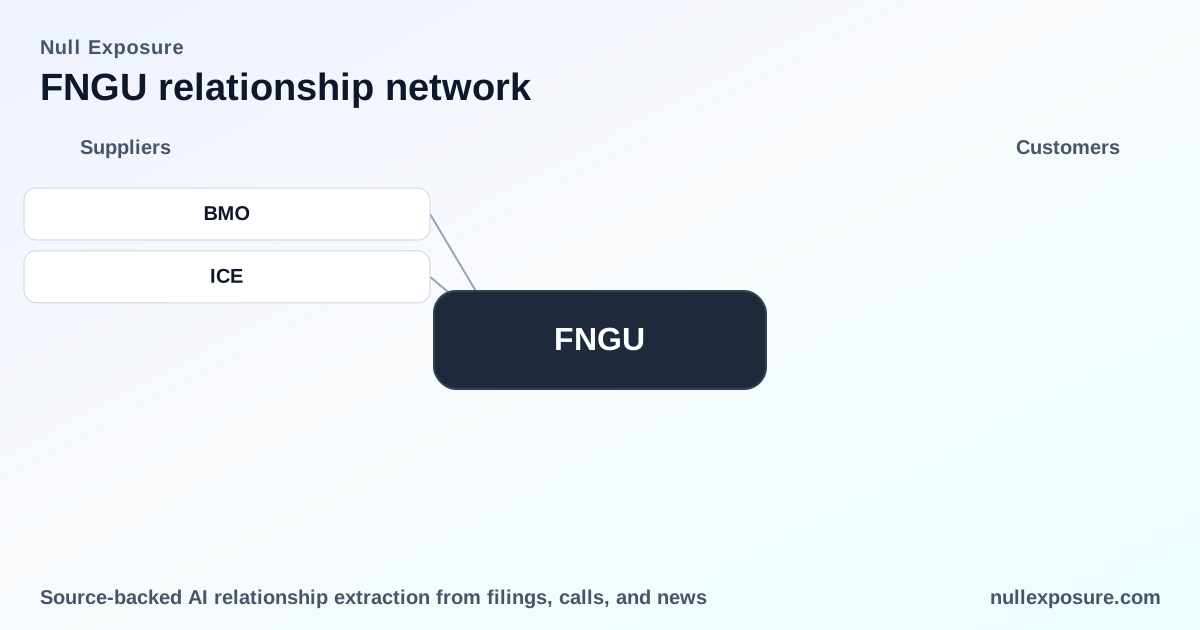
FNGU Customer Relationships: What investors need to know
FNGU operates as a leveraged exchange-traded product whose economics depend on fund flows, trading spreads, and placement with market intermediaries; it monetizes through investor fees and the liquidity it facilitates between creators and end investors. The customer relationships recorded against FNGU in our coverage are narrow but revealing: they tie FNGU into the same leveraged-ETN ecosystem that includes sector-focused 3x products, highlighting peer concentration and market-channel dependencies that investors should price into holdings or operations. For a concise commercial view and tracking on this coverage, visit https://nullexposure.com/.
How the evidence maps to commercial reality
FNGU’s recorded customer links in our dataset are limited in number and limited in breadth. This concentrated record signals a transactional, market-facing operating model rather than a broad-suite commercial platform: revenues and distribution are tightly coupled to a small set of product-level relationships and market narratives, not to a diversified roster of enterprise customers. That structure increases sensitivity to flows in the leveraged-ETN segment and to the distribution/visibility that peer products receive in financial press and aggregator channels.
The relationships we observed — concise, sourced notes
- FLYU (MicroSectors Travel 3x Leveraged ETN) — ETFdb listed FLYU among the top-performing leveraged ETNs on March 23, 2025, noting that FLYU tracks 3x daily price moves of a travel-related index; this placement signals active product-level visibility for sector 3x ETNs linked to FNGU’s coverage set (ETFdb, March 23, 2025).
- FLYU (MicroSectors Travel 3x Leveraged ETN) — ETF Trends featured FLYU on a top-performing leveraged-etf list on March 24, 2024, again calling out its 3x travel-sector exposure and market relevance; that earlier mention demonstrates recurring press attention to 3x sector ETNs within the same investable universe as FNGU (ETF Trends, March 24, 2024).
Each entry above corresponds to a discrete mention in public market commentary; both references concern the same counterparty/product (FLYU) and confirm recurring coverage of sector-leveraged ETNs in sources that also cite FNGU in our relationship mapping.
What those links mean for investors and operators
- Concentration of peer visibility: The two relationship hits both reference the same counterparty-product, which signals limited publicly recorded customer relationships and concentrated exposure to a small number of visible peers in the leveraged-ETN space. Concentration amplifies market-flow risk and creates a dependency on how this narrow cohort is perceived by market commentators and principal investors.
- Channel and distribution sensitivity: Mentions come from market publications that curate “top-performing” leveraged products. That pattern reflects an operating model where media and gatekeepers (ETF-focused sites and newsletters) materially influence product flows, and where favorable placement can translate into meaningful short-term inflows.
- Product-level affinity not contractual intimacy: The sources document market attention, not contractual terms. Treat these relationships as commercial signals rather than evidence of exclusive or long-term contracts; revenue and liquidity for FNGU will therefore track market sentiment and flow dynamics rather than locked-in enterprise agreements.
For an updated monitoring dashboard on how press placement and listed peers affect product flow, see https://nullexposure.com/.
Company-level constraints and what their absence signals
Our coverage did not surface any explicit contractual constraints or binding terms tied to these relationships. That absence is itself an informative company-level signal: no disclosed contractual constraints implies a flexible, market-driven contracting posture rather than concentrated contractual dependencies. Translating that into practical contours:
- Contracting posture: Open and transactional, aligned to exchange listing and creation/redemption mechanics rather than bespoke long-term commercial deals.
- Concentration: High at the relationship-record level (few publicized customer links), which increases revenue and liquidity sensitivity to a small set of market narratives.
- Criticality: Relationships documented are market-facing and channel-critical — press and aggregator mentions materially affect flows, but they are not the same as infrastructure or counterparty-critical contracts.
- Maturity: Public signals reflect an established product segment (3x leveraged ETNs have mature mechanics and market participants), but public relationship disclosure is thin, implying either standard market arrangements or limited public disclosure practices.
These are company-level signals derived from the absence of constraint excerpts; none of these constraints are attributed to any specific relationship because no constraint excerpts explicitly name a counterparty.
Risk implications for investors and operators
- Flow volatility risk: With concentrated public relationships and heavy reliance on market commentary, FNGU’s performance and fee capture can swing with short-term sentiment and listing-level attention. Investors should model higher short-term volatility in fund flows.
- Reputational and channel risk: Peer upward or downward movement in coverage (for example, positive listings for FLYU) can create either tailwinds or headwinds to distribution for related leveraged products. Operators should prioritize proactive placement and gating strategies with ETF-focused media and platform distributors.
- Limited contractual insulation: The lack of disclosed contractual constraints suggests limited long-term revenue insulation; risk management should focus on liquidity provisioning and hedging rather than assuming stable contracted revenue streams.
Tactical takeaways — what to watch next
- Monitor recurring press coverage of sector 3x ETNs, especially listings in ETFdb and ETF Trends, as a near-real-time leading indicator of potential fund flows into the cohort that includes FNGU. High-frequency media placement correlates with short-term inflows.
- Track concentration metrics among visible peer mentions; increased diversity of named counterparties would reduce single-peer sensitivity.
- For operators, prioritize relationships with distribution platforms and market-makers that can absorb flow volatility — press coverage alone does not guarantee durable distribution.
Bottom line
The recorded customer relationships for FNGU are narrow and centered on a peer sector product, FLYU, with repeated public mentions in ETF-focused outlets. That evidence translates into a commercial profile of high market-channel dependence, concentrated visibility, and operationally standard contracting rather than broad enterprise-level customer diversification. Investors and operators should underwrite FNGU exposure with an emphasis on flow volatility, distribution-channel strategy, and active media monitoring.
For ongoing tracking and to see how these relationship signals evolve, visit https://nullexposure.com/.