Funko (FNKO) customer map: where products sell, who drives demand, and what that implies for investors
Funko designs, licenses and sells pop‑culture merchandise—principally its Core Collectible Pop! figures—through a mix of wholesale accounts, mass‑market retail exclusives, direct‑to‑consumer channels and licensed stores. The company monetizes via product sales, licensing fees and curated exclusives that generate short, repeatable purchase cycles; complementary commercial agreements (including a preferred secondary‑market relationship) extend brand control and aftermarket value capture. For investors, the critical questions are channel concentration, geographic diversification, and the working‑capital sensitivity driven by short payment and distribution cycles.
Explore more structured relationship intelligence at https://nullexposure.com/.
How Funko’s operating model shapes revenue and risk
Funko’s revenue base is retail‑led and wholesale‑oriented, with approximately 77% of sales from Core Collectible products and about 35% of net sales generated outside the U.S. (FY2024 filing). Payment terms to customers typically range 30–90 days (average ~57 days), which creates predictable but inventory‑sensitive cash conversion dynamics. The company sells both to institutional customers (mass retailers, specialty retailers, distributors) and directly to consumers through e‑commerce and flagship stores; the DTC channel is meaningful but still secondary to wholesale volume.
Customer concentration is moderate: the top ten wholesale customers represented approximately 31% of sales in 2024, and no single customer exceeded 10%—a diversification signal that reduces single‑counterparty tail risk while leaving top‑10 concentration relevant for bargaining leverage. Contracting posture is short‑term and transactional, reflecting trade sales rather than long‑duration service contracts; this pushes emphasis onto SKU velocity, promotional cadence and retail exclusives to drive incremental unit demand.
The partner map — what each relationship contributes
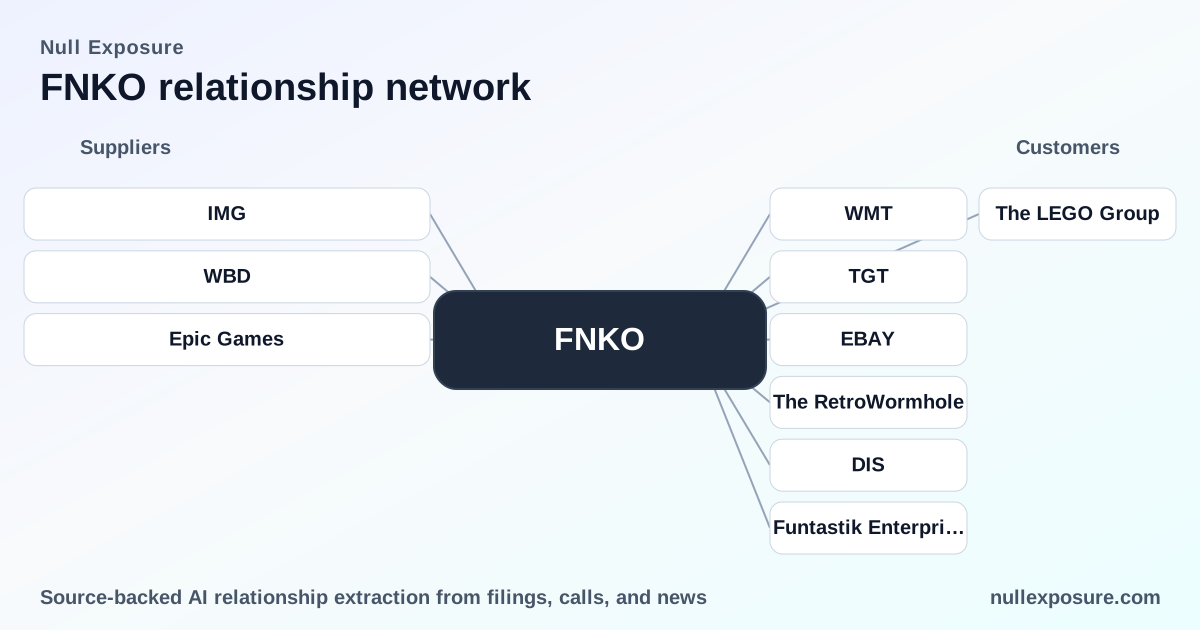
Below are the relationships captured in recent public sources, with a concise investor‑oriented take for each.
AENTW (AENTW) — distributor relationship established in earnings commentary (2024 Q4)
AENTW lists Funko among several suppliers it distributes for in the toys and collectibles category, indicating Funko products move through third‑party distribution networks alongside major toy brands. This highlights Funko’s reliance on broad distributor channels for shelf presence and mass distribution (AENTW earnings call, Q4 2024).
Target (TGT) — retail exclusives and channel partner (examples from FY2020 and FY2022)
Target has hosted retailer‑exclusive Funko SKUs (metallic Mystique, Target exclusive Pop! Rides), demonstrating Funko’s strategy of driving store traffic and variant premiums via retailer exclusives. These exclusives support sell‑through velocity and create short, high‑margin windows at mass retailers (Bleeding Cool, FY2020; Bleeding Cool, FY2022).
Walmart (WMT) — large‑scale national distribution and product rollouts (FY2020, FY2022, FY2026)
Walmart has been a destination for exclusives (e.g., a 3‑pack Stranger Things set) and broader rollouts (Bitty Pop! expanded to all Walmart stores in FY2026), underscoring Walmart’s role as a major national channel for scaled distribution and mainstream penetration. Mass retail placement supports unit volumes but tends to compress promotional margin (Bleeding Cool, FY2020 & FY2022; IndexBox blog, FY2026).
eBay Inc. (EBAY) — preferred secondary marketplace and co‑marketing (FY2022)
As part of a strategic investment consortium deal, Funko and eBay agreed that eBay would be the preferred secondary marketplace for Funko and would partner on exclusive product releases, giving Funko a controlled aftermarket outlet and amplified visibility for collectibles that command premium secondary prices (eBay press release, FY2022).
The RetroWormhole — specialty hobby store stocking Funko Pop! (FY2021)
Local hobby retailers such as The RetroWormhole stock Funko Pop! and related collectibles, representing the specialty retail channel that sustains collector demand and grassroots community engagement for limited editions and convention exclusives (KTVL, FY2021).
Disney (DIS) — IP/retailer exclusive collaborations (FY2022)
Disney‑exclusive Funko Star Wars variants (e.g., Concept Series Vader) show active licensing collaborations that drive franchise‑specific demand and premium variants; these licensed exclusives reinforce intellectual‑property synergies central to Funko’s product strategy (KUTV, FY2022).
The LEGO Group — co‑branded product partnership (FY2018)
The LEGO Group partnered with Funko to produce vinyl figures and bobbleheads of LEGO minifigures, reflecting co‑brand licensing that extends Funko’s product set and taps adjacent fanbases to broaden collectible appeal (The Brick Fan, FY2018).
Funtastik Enterprises Corp — licensed store expansion in Southeast Asia (Philippines, FY2025)
Funko announced a first Southeast Asia licensed store to be operated by Funtastik Enterprises in the Philippines (planned June 2025), signaling a retail licensing push to scale physical brand presence in APAC via local partners rather than wholly owned retail exposure (Philstar, Apr 15, 2025).
What these relationships imply for investors
- Channel mix drives volatility and margin profile. Mass‑market partners (Walmart, Target) provide scale but compress promotional margin; specialty retailers and exclusives enable higher ASPs and secondary‑market premiums. The eBay partnership is strategically important for preserving aftermarket value and managing collector liquidity.
- Geographic diversification is real but incomplete. Funko generates roughly 35% of sales internationally; EMEA and APAC expansion through licensed stores and distribution partnerships reduces single‑market exposure, but the U.S. remains the dominant revenue engine (FY2024 filing).
- Working capital sensitivity is material. Short payment terms and wholesale shipping patterns mean inventory turns and retail sell‑through directly affect cash flow; investors should track receivables days and channel inventory levels.
- Customer concentration is manageable but present. No single customer exceeds 10% of sales, yet the top‑10 wholesale concentration (~31% in 2024) creates meaningful counterparties whose buying patterns influence quarterly revenue variability.
- Brand and IP monetization is core. The LEGO and Disney collaborations, retailer exclusives, and licensed store program reinforce that Funko’s unit economics depend more on IP‑driven demand and limited‑edition scarcity than on commodity toy margins.
For a structured view of these partner relationships and how they affect counterparty risk, explore our relationship intelligence hub at https://nullexposure.com/.
Bottom line
Funko’s customer footprint is a balanced mix of mass distribution for scale and collector‑oriented exclusives for margin, anchored by short‑term wholesale contracts and a geographically diversifying retail strategy. Investors should monitor sell‑through at major retail partners, international rollout execution, and working‑capital metrics to judge whether Funko can convert brand enthusiasm into sustainable, profitable growth.