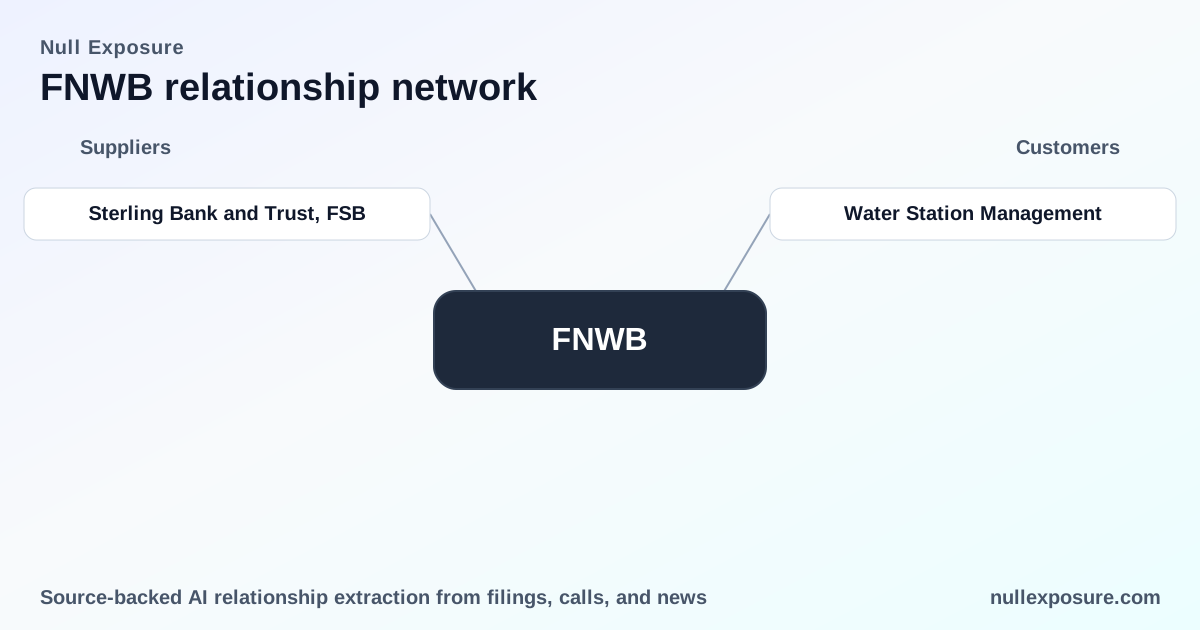
First Northwest Bancorp (FNWB) — customer relationships and operational posture
First Northwest Bancorp operates as the holding company for First Federal Savings and Loan Association of Port Angeles, a community-focused regional bank that monetizes through traditional banking channels: interest spread on loans, fees on deposit and transaction services, and targeted lending to individuals, small businesses, non-profits and public entities in western Washington. The company’s revenue is concentrated in deposit gathering and lending operations, with earnings driven by net interest income and fee income from local commercial and consumer customers. Investors should view FNWB as a small-cap regional bank with a community deposit franchise and modest profitability metrics.
For further context on customer signals and relationship risk, see NullExposure’s research hub: https://nullexposure.com/.
Snapshot for investors: balance of franchise and local concentration
First Northwest is a deliberately local operator: twelve full-service branches and six business centers across Clallam, Jefferson, Kitsap, King, Snohomish and Whatcom counties. The balance sheet and public disclosures through December 31, 2024 emphasize deposit-led funding and a diversified retail deposit mix. Key financial context: market capitalization barely under $90 million and a price-to-book below 1.0 (PriceToBookRatio 0.576), underscoring constrained capital scale but a tangible local earnings stream. According to company disclosures and fiscal-period data through March 31, 2026, FNWB’s strategy is focused on incremental, deposit-funded lending and fee services rather than scale-driven wholesale activities.
How the operating model affects customer risk and contractual posture
First Fed’s customer relationships show characteristics typical of community banks, and these have direct implications for counterparty risk, contract maturity and systemic exposure:
- Contracting posture — short-term liquidity orientation. The bank holds a significant volume of customer certificates of deposit maturing within one year — $426.6 million, or 65.9% of total CDs as of December 31, 2024 — which creates a recurring roll-over requirement and sensitivity to local rate competition and deposit flight.
- Concentration — broadly diversified at customer level, but locally concentrated geographically. Management discloses that no single customer accounts for more than 10% of revenue, signaling low single-counterparty concentration, even as the franchise is geographically concentrated in western Washington.
- Criticality — high to local stakeholders. Public fund deposits and relationships with municipalities are material to deposit funding (public fund deposits were $100.8 million at December 31, 2024), making the bank an important local service provider whose stable operation underpins community liquidity needs.
- Maturity and stability — established, performing portfolio with active relationships. Filings note that restructured loans have returned to accrual and the bank’s customer base spans individuals, small businesses, mid-market commercial borrowers and non-profits, indicating a mature community banking book and active customer servicing.
These characteristics combine into a working capital-style operating model: recurring short-term liabilities (CDs and deposits), local lending assets, and earnings that are sensitive to rate resets and borrower performance within a confined geographic footprint.
What to watch in risk terms: concentration and borrower credit
The filings show both reassuring diversification signals and genuine credit caveats. No single customer exceeds 10% of revenue, a clear deconcentration signal. At the same time, management discloses that the inability of one or more significant borrowers to service debt could have a material adverse impact, which flags potential exposure to concentrated loan credits within the commercial portfolio. Monitor quarterly loan performance metrics and any large-outstanding commercial credits disclosed in periodic reports.
Customer relationships — the full list from available signals
Below I cover every customer-related relationship referenced in the source materials.
Water Station Management — news-linked customer relationship and bankruptcy linkage
A local news report documented that First Fed had conducted business with a company called Water Station Management, and that a U.S. Bankruptcy Court decision in the Eastern District of Washington found that the counterparty operated a Ponzi scheme; this context surfaced when the bank announced a senior hire. The article links the bank’s prior business dealings to that bankruptcy ruling. Source: Peninsula Daily News, March 9, 2026 (news story on executive hire and bankruptcy decision) — https://www.peninsuladailynews.com/news/first-fed-hires-new-executive/.
(That is the only named customer entity in the available results; the bank’s other customer types are described in the company disclosures summarized below.)
Customer segments described in filings — who actually pays the bills
Company disclosures explicitly identify the composition of the customer base and product offerings:
- Individuals and consumers. The bank emphasizes traditional consumer banking products — transaction accounts, savings, money markets and CDs — and positions retail deposits as the majority of balances. This is the primary revenue base for deposit-funded lending.
- Small businesses and mid-market commercial borrowers. First Fed’s lending and business banking services focus on small business and local commercial clients across its service counties; management highlights a strategy of building sustainable earnings by serving these segments.
- Non-profit and public fund depositors. The bank carries meaningful public fund deposits (about $100.8 million at year-end 2024), and public funds form a non-trivial share of total deposits.
- Brokered deposits (ancillary). Brokered deposits account for a smaller portion (approximately 11%) of overall deposits, used episodically to manage liquidity.
These segment descriptions are derived from company filings through December 31, 2024 and operational commentary in the latest reporting periods.
Materiality and service role — how important are customers to FNWB’s model?
Two company-level signals deserve special attention:
- Materiality mix: Management stresses that no single customer generates more than 10% of revenue, a restraint on customer concentration; yet the disclosure that certain borrowers could produce a material loss if they fail signals pockets of credit concentration in the loan book. Treat these as countervailing forces: overall revenue deconcentration but localized credit risk.
- Service provider role: First Fed’s core identity is that of a community service provider—deposits, lending and money movement for local households, businesses and public entities—making customer relationships operationally critical for local economic flows.
Investment takeaways and near-term monitoring items
- Positive: Local deposit franchise, diversified retail deposit base, and a stable community footprint support predictable net interest income. Price-to-book below 1.0 suggests market pricing reflective of regional bank risks but also potential upside if credit remains stable.
- Watchlist: Heavy short-term CD repricing risk (65.9% of CDs due within one year at 12/31/2024), meaningful public-fund exposure, and specific credit concentrations that management says could be material if distressed.
- Operational risk note: The publicized association with a bankruptcy-linked counterparty (Water Station Management) is reputational and underscores the importance of counterparty diligence in a community bank context (Peninsula Daily News, March 9, 2026).
If you want a consolidated view of FNWB’s customer risk signals and how they map to credit and liquidity exposure, visit NullExposure’s portfolio page for this issuer: https://nullexposure.com/.
Final read
First Northwest Bancorp is a classic community bank: locally entrenched, deposit-funded and credit-exposed. The balance between a retail-diversified deposit book and pockets of borrower concentration defines the risk-return profile. For investors and operators, the focal points are the bank’s short-term funding cycle, credit concentration monitoring, and preservation of public fund relationships that materially support liquidity.