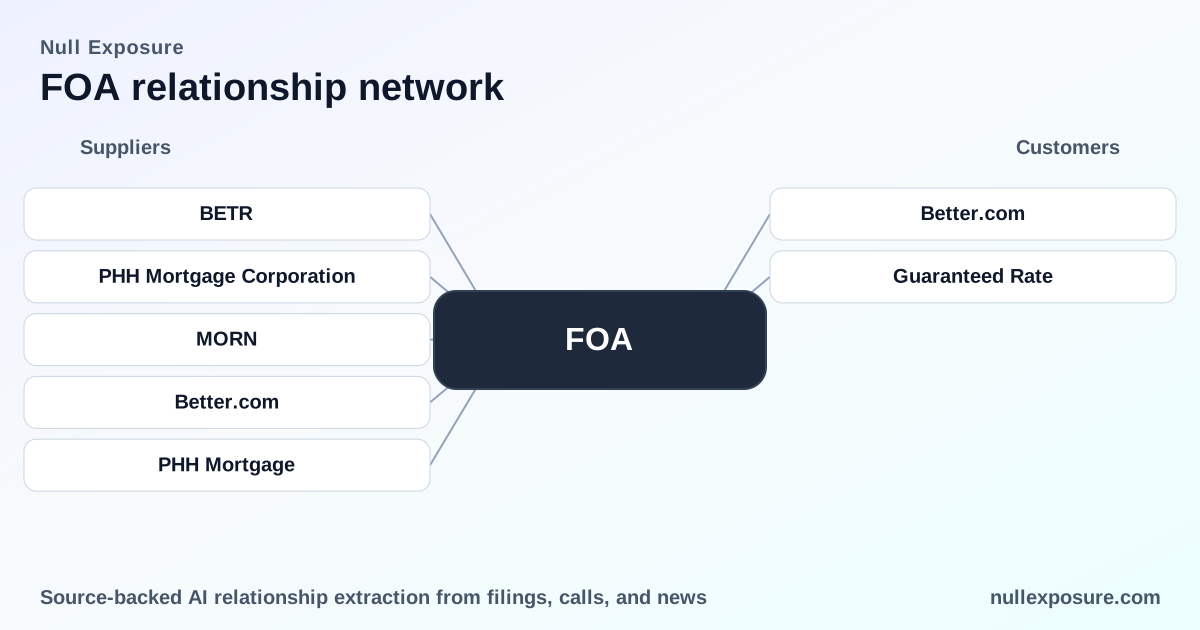
Finance of America (FOA): Customer relationships that move capital and risk
Finance of America operates a home-equity-focused consumer finance platform that originates, acquires and services reverse mortgages and non‑agency home‑equity loans. The company monetizes through origination fees and initial net origination gains, securitization and whole‑loan sales, and recurring income from retained servicing rights; a material portion of its business is under master servicing arrangements that create both fee income and concentration risk. For investors and operators, understanding FOA’s external partnerships and counterparty exposures is essential to forecasting capital needs, servicing economics, and downside scenarios.
For deeper relationship profiling visit our homepage: https://nullexposure.com/
What to watch: the commercial links that shape FOA’s originations and servicing economics
Better.com — a strategic distribution and technology partner
In its 2025 Q3 earnings call the company announced a strategic partnership with Better.com in October to expand product offerings and enhance FOA’s technology backbone to reach its core demographic. This partnership positions FOA to augment digital origination channels and broaden broker and borrower access to its retirement‑focused products (FOA 2025 Q3 earnings call).
Guaranteed Rate — a terminated sale discussion from FY2022
Industry reporting on FY2022 indicates FOA ended discussions to sell its retail mortgage division to Guaranteed Rate, signaling a strategic decision to retain or restructure retail origination assets rather than exit them via that counterparty (National Mortgage Professional, FY2022 reporting).
ONIT — transaction and partnership with Finance of America Reverse (FAR)
ONIT’s 2025 Q4 earnings call documented the closing sale of reverse mortgage servicing rights (MSRs) to Finance of America Reverse and described a strategic partnership that repositions ONIT’s participation in the reverse mortgage market, reflecting FOA’s active reorganization of capital and servicing arrangements in the HECM space (ONIT 2025 Q4 earnings call).
Why these relationships matter to FOA’s financial profile
The Better.com tie speaks directly to FOA’s stated goal of building a digital channel: distribution scale and lower per‑origination costs matter for restoring origination volumes after cyclical downturns. The ended transaction with Guaranteed Rate is a clear signal that FOA retained control of its retail footprint rather than executing that specific divestiture, which affects short‑term capital and strategic optionality. The ONIT disclosures confirm FOA’s broader programmatic activity around MSR transfers and partnerships—transactions that materially free capital (ONIT cited ~$100 million of capital benefit in related commentary) and reallocate servicing economics.
Across these relationships the common threads are distribution, servicing economics, and capital redeployment—three levers that investors must model when assessing FOA’s path to margin improvement and balance sheet flexibility.
Operating model constraints and what they signal about risk and execution
FOA’s public filings and disclosures surface a compact set of structural constraints that define its operating posture:
-
Framework contracting with government counterparties. FOA services a substantial volume of HECM that are securitized with and guaranteed by Ginnie Mae, and its master servicing agreements give Ginnie Mae the contractual right to terminate FOA as servicer and to transfer MSRs at any time. This is a company‑level contractual posture that creates execution risk tied to regulatory/counterparty decisions.
-
Government counterparty exposure. FOA securitized or sold roughly $1.0 billion (2024) and $1.1 billion (2023) of HECM with Ginnie Mae, establishing an explicit government‑backed channel in the company’s capital stack.
-
Customer base is individual retirees. FOA’s core addressable market is homeowners aged 55+, with efforts underway to scale digital origination to improve borrower and broker acquisition economics.
-
Geographic concentration. As of December 31, 2024, 44% of FOA’s reverse mortgage unpaid principal balance is secured by properties in California, a level of concentration the company identifies as material and a clear single‑state macro risk to portfolio performance.
-
Roles and transaction patterns. FOA functions as an originator, acquirer, seller, and servicer: it originates and acquires HECM and non‑agency reverse loans, securitizes into HMBS (Ginnie Mae‑guaranteed) or non‑agency MBS, sells whole loans or securities to investors, and retains servicing rights to generate recurring revenue.
-
Business stage and segment focus. FOA’s Retirement Solutions segment is the active engine of origination and fee revenue; the company is in a stage of active redeployment of capital (sales of MSRs, strategic partnerships) rather than passive wind‑down.
These constraints shape FOA’s bargaining leverage, capital volatility, and the valuation sensitivity of MSRs and servicing income in stressed scenarios.
How operators and investors should translate relationships into decisions
FOA’s external relationships and stated constraints drive a handful of actionable priorities for investment and operational planning:
-
Monitor servicing termination risk and MSR valuation under Ginnie Mae agreements; servicing transfer rights create low‑probability but high‑impact downside scenarios that affect capital and liquidity planning.
-
Track execution of the Better.com partnership and digital channel KPIs: conversion rates, originations per channel, and cost per funded loan will determine whether the partnership improves margin and mix.
-
Use the Guaranteed Rate negotiation history as a signal of FOA’s retained optionality on retail assets and the company’s preferred path for redeploying capital versus sale.
-
Quantify geographic concentration in California as a key stress test: a localized real‑estate downturn or regulatory change in California will disproportionally affect portfolio loss severity and recoveries.
-
Factor in FOA’s active MSR transactions (illustrated by the ONIT/FAR disclosures) when modeling capital release and servicing income volatility; MSR sales can free capital but reduce recurring fee income.
For valuation context, FOA reports ~$497 million in revenue (TTM), EBITDA of ~$634 million, and a market capitalization near $173 million, with a trailing P/E of about 5.1, highlighting a valuation profile that prices significant execution and capital risks into the equity multiple.
Bottom line: concentrated exposure, active capital management, and partnership‑led distribution
FOA operates a focused home‑equity franchise that generates origination and servicing economics while running meaningful concentration and counterparty constraints. Key relationships with Better.com, discussions (now ended) with Guaranteed Rate, and MSR work linked to Finance of America Reverse/ONIT are concrete levers that change distribution capacity, capital intensity, and recurring earnings. Investors should prioritize servicing contract analysis, geographic stress testing, and the operational rollout metrics from digital partnerships when assessing FOA’s path to sustainable profitability.
For a concise relationship and constraint dossier tailored to investment memos, visit our homepage: https://nullexposure.com/