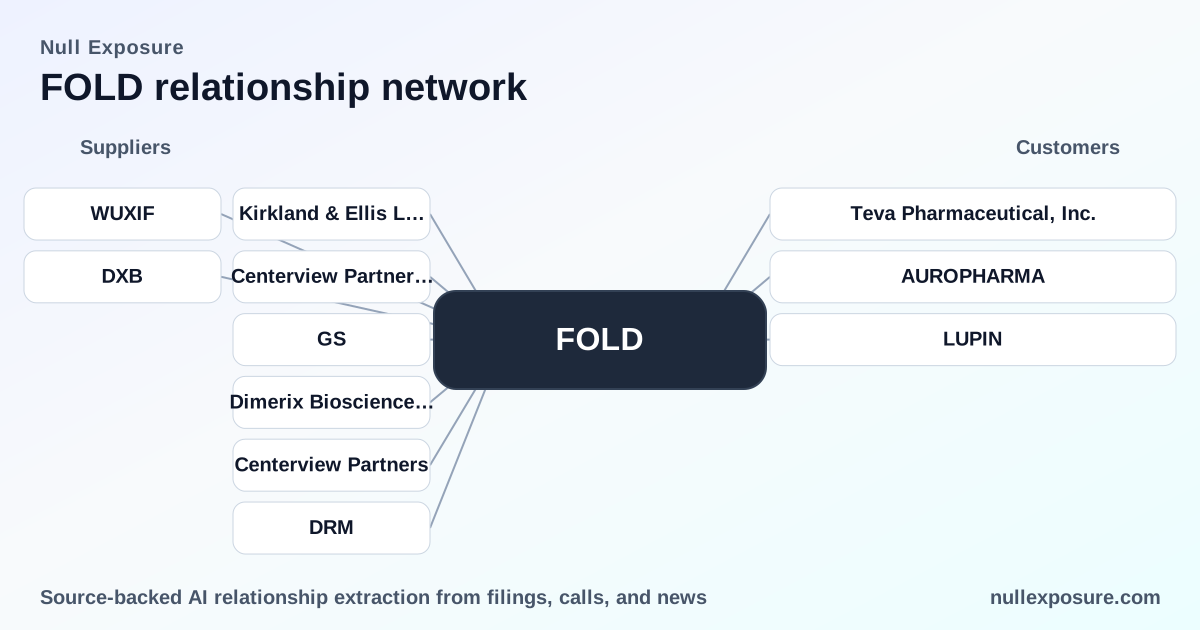
FOLD customer relationships: who pays, who competes, and what it means for revenue durability
Thesis: Amicus Therapeutics (ticker FOLD) commercializes rare-disease therapies—most importantly Galafold (migalastat) and a two-component regimen for late‑onset Pompe disease—and monetizes through product sales to distributors, pharmacies and institutional payors with reimbursement-driven pricing across North America, EMEA and APAC. Investors should evaluate revenue durability through the lens of distribution dependence, government payor exposure, and long-term generic pathways that are already being documented in partner agreements. Learn more at https://nullexposure.com/.
How FOLD makes money and why channel structure matters
Amicus is a specialty biopharma that sells proprietary therapies for genetic enzyme disorders. Revenue is recognized at the point control passes to pharmacies or distributors, meaning the company’s top line is driven by product orders placed into the wholesale channel rather than direct episodic services. Because payors are frequently government authorities, pricing and access are subject to reimbursement negotiations and country-level coverage decisions, which introduces multi-year sales cycles and revenue lumpiness.
Contracting posture is distributor-centric: product flows through wholesalers and pharmacies before reaching patients, so commercial success depends on third‑party distribution, payer contracts, and national reimbursement agreements rather than solely on prescriber uptake. Geographic reach — approved in 40+ countries including the U.S., E.U., U.K., and Japan — gives the company diversification benefits, but that breadth also creates exposure to heterogeneous pricing regimes across EMEA, APAC and North America.
Relationship map: counterparties and deal highlights
Teva Pharmaceutical, Inc.
FOLD disclosed a license agreement with Teva on October 15, 2024 intended to resolve ANDA litigation, signaling a negotiated path to address generic challenge risk through licensing rather than prolonged litigation. According to Amicus’s FY2024 10‑K filing, that October 15, 2024 agreement was executed to resolve Teva’s ANDA litigation (FY2024 10‑K).
Aurobindo
A CityBiz report (March 9, 2026) states Amicus will grant Aurobindo a license to market generic versions of Galafold in the United States beginning January 30, 2037, subject to FDA approval and customary conditions. This creates a clear, dated pathway for potential generic entry into the U.S. market (CityBiz, Mar 9, 2026).
AUROPHARMA (duplicate listing)
The dataset also includes a separate AUROPHARMA entry with the same CityBiz excerpt and timing; both records identify the same license terms for marketing generics from January 30, 2037 if approved by the FDA. The record duplicates the CityBiz reporting (Mar 9, 2026) and effectively underscores that Aurobindo/AUROPHARMA are named licensees under the described agreements.
Lupin
Lupin is named alongside Aurobindo in the CityBiz coverage as a licensed manufacturer that would be authorized to market generic Galafold in the U.S. beginning January 30, 2037, conditional on FDA approval and usual carve‑outs. This public reporting establishes Lupin as an explicit future generic pathway participant (CityBiz, Mar 9, 2026).
BioMarin Therapeutics (BMRN)
A Globenewswire release (Feb 20, 2026) reports that Amicus entered into a definitive agreement to be acquired by BioMarin Therapeutics in December 2025 for $14.50 per share, valuing the deal at approximately $4.8 billion. This transaction-level disclosure ties Amicus’s product portfolio and its customer contracts into a larger strategic consolidation narrative (GlobeNewswire, Feb 20, 2026).
BioMarin Pharmaceutical (separate coverage)
Independent coverage from Sahm Capital (Feb 26, 2026) likewise reports BioMarin’s definitive agreement to acquire Amicus, reiterating the deal as a strategic reshaping of Amicus’s growth outlook and portfolio under BioMarin’s ownership. Multiple outlets documenting the same acquisition provide corroboration of the transaction details (Sahm Capital, Feb 26, 2026).
What the constraints tell investors about operating risk and resilience
The collected operating constraints read as company-level signals about Amicus’s commercial model. Key implications:
- Government payor exposure: Product orders are routed through distributors and pharmacies, but the ultimate payor is frequently a government authority. That structure creates reimbursement-driven revenue volatility and reinforces the importance of national pricing strategies.
- Global footprint with regional complexity: Galafold is approved in 40+ countries across NA, EMEA and APAC, giving geographic diversification while introducing regulatory and pricing heterogeneity that affects margin and inventory planning.
- Distributor-dependent contracting posture: The firm sells primarily into the distributor/pharmacy channel, so distribution relationships are commercially critical; manufacturing, fulfillment and channel logistics are strategic levers for revenue stability.
- Core-product concentration: The company’s marketed revenues rest on two therapies — Galafold and the Pombiliti + Opfolda regimen — indicating product concentration risk but also clinical specialization that can support premium pricing in rare-disease segments.
- Relationship roles: The company’s customers are predominantly buyers through distributors, not direct-to-employer or payor contracts, so cash flow timing and collection dynamics are mediated by wholesalers and national reimbursement processes.
Investment risks and opportunities — concise takeaways
- Risk: manufacturing or distributor disruption is consequential because FOLD recognizes revenue at the distributor/pharmacy handoff; any channel bottleneck could suppress near‑term reported sales.
- Risk: reimbursement negotiation outcomes in EMEA and APAC matter materially; approvals do not translate instantly into realized revenue without country‑level pricing/access agreements.
- Opportunity: defined generic timelines improve visibility — public license agreements with Aurobindo and Lupin that set U.S. generic marketing dates (Jan 30, 2037) provide clarity on the competitive horizon and allow modeling of revenue erosion scenarios.
- Opportunity: acquisition by BioMarin changes strategic optionality — the BioMarin deal consolidates product portfolios and may accelerate scale advantages in commercialization and payer negotiations, which could improve pricing leverage in some markets.
For a deeper, structured view of counterparty exposure and to benchmark relationship risk across portfolios, visit https://nullexposure.com/ for our comparative coverage and tools.
Final read: what to watch next
Monitor reimbursement outcomes in key E.U. markets and Japan, track distributor order patterns as reported in sequential financials, and watch for any amendments to the Teva license or the announced 2037 generic license dates that would accelerate or delay generic entry. The combination of distributor reliance, government payor exposure, contractual license pathways for generics, and the BioMarin acquisition are the primary drivers of FOLD’s revenue durability and valuation risk.
Bold signals: government payors control pricing, distribution channels set cadence, and explicit license timelines (2026–2037 reporting) give horizon visibility that investors can model confidently.