FONAR’s customer map: where revenues, payers, and legal history shape value
FONAR Corporation designs, manufactures and services MRI scanners and operates diagnostic imaging centers through its Health Management Company of America (HMCA) unit. The company monetizes through direct equipment sales, recurring service and upgrade contracts on its installed base, and management agreements that drive facility-level revenue, concentrated geographically in the United States (notably New York and Florida). This mix produces a hybrid business with hardware margins supported by annuity-like service income and facility management cash flows. Learn more about how vendor and payer relationships affect valuation at https://nullexposure.com/.
What investors need to know about the operating model and commercial constraints
FONAR is not a pure capital-equipment vendor. The company runs a two-sided model: manufacturing and direct sales of MRI hardware plus services and management contracts that generate recurring revenue. The FY2025 disclosures show service and upgrade revenues and HMCA management receipts meaningfully supporting total revenues — this structure creates predictable aftermarket cash flows but also concentrates exposure to payers and regional site performance.
Key company-level signals:
- Contracting posture: Management agreements are described as long-term, while scanner service contracts are commonly annual and recognized on a straight-line basis, indicating a mix of durable management revenue and shorter service commitments.
- Counterparty mix: Much of cash collection involves third‑party payers (Medicare, Medicaid, managed care and commercial insurers), making reimbursement and collection cycles an operational lever.
- Geography and concentration: Operations are principally U.S.-based; as of June 30, 2025, HMCA managed 44 scanners with 26 in New York and 18 in Florida, concentrating regional operational risk.
- Materiality and maturity: HMCA-generated revenue is material to consolidated results (FY2025 revenues from managed MRI facilities increased to $95.4 million within total revenues of roughly $104.4 million), signaling that management services are core to near-term earnings.
- Segment mix: The company clearly splits into hardware/manufacturing and services/management, with the installed base contributing steady service revenues (service and maintenance from external installed base ~ $8.4M in fiscal 2025).
These characteristics create a company with scalable aftermarket economics but heightened sensitivity to payer behavior, collection timing, and regional facility performance.
How individual customer and counterparty relationships matter today
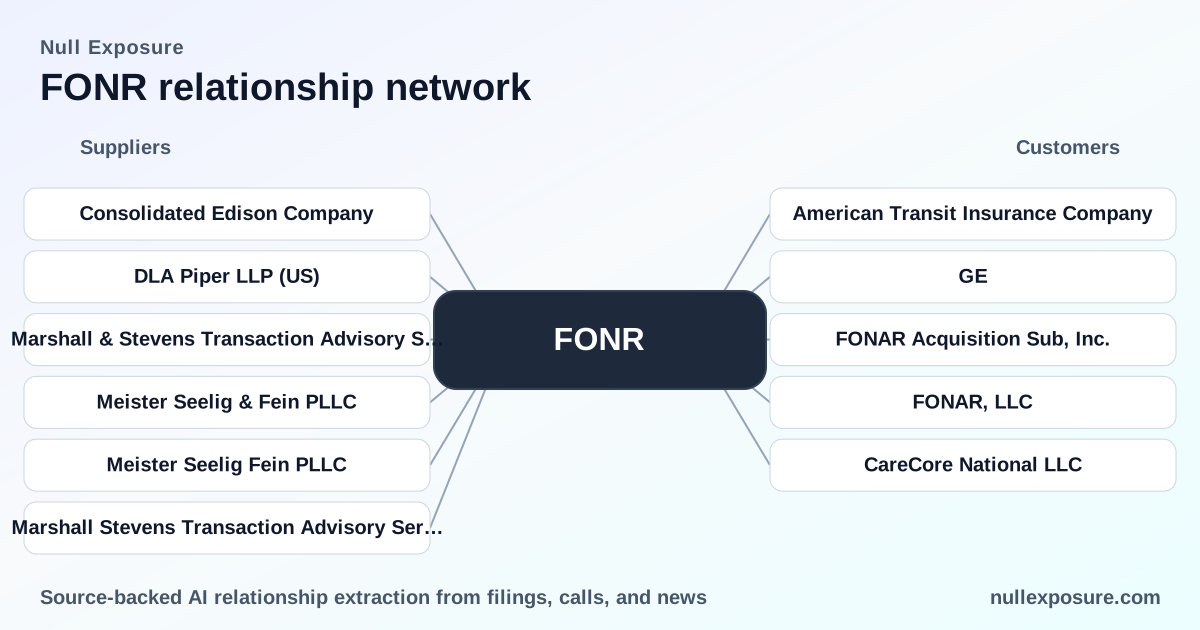
Below are every customer- or counterparty-related relationship found in FONAR’s disclosures and press history, with a concise practical takeaway for investors.
American Transit Insurance Company
FONAR’s FY2025 Form 10‑K records a $2.3 million increase in reserves for credit losses tied to a single payer, American Transit Insurance Company, reflecting collection stress from that counterparty and an active credit reserve posture. According to FONAR’s FY2025 10‑K, the reserve increase materially affected SG&A expense in the year.
General Electric (GE)
FONAR has precedent litigation history with General Electric that resulted in substantial patent settlement payments in the 1990s; GE paid roughly $46.4 million for a cancer-detection patent and $82.3 million for multi-angle oblique imaging rights, creating a historic cash inflow and confirming the value of FONAR’s IP. This litigation outcome is documented in a company press release and public coverage recalling the 1997 resolution (GlobeNewswire, July 2017).
FONAR Acquisition Sub, Inc.
A January 2026 market report outlines a corporate transaction in which FONAR Acquisition Sub, Inc. is identified as a buyer in a proposed all-cash acquisition at $19.00 per share, indicating a strategic recapitalization or take-private structure affecting minority shareholders. The terms and buyer identity were disclosed in a shareholder update reported by FinancialContent/markets.financialcontent.com (January 2026).
FONAR, LLC
Alongside FONAR Acquisition Sub, Inc., FONAR, LLC is presented as a co‑buyer in the same $19.00 per share acquisition agreement, pointing to an internal buyer group or controlled buyout that would consolidate ownership and remove public float under the proposed terms. That transaction detail was reported in the same January 2026 market communication.
CareCore National LLC
Historical litigation with CareCore National demonstrates FONAR’s willingness to litigate distribution and referral denials; a Newsday report covering a past antitrust victory said CareCore had wrongfully denied patients access to FONAR’s MRI systems, underscoring how payor or benefits manager policies can materially affect access to FONAR’s products and services (Newsday coverage, circa FY2010).
What this customer map implies for valuation and risk
- Revenue resilience comes from HMCA and services, but that resilience depends on payer reimbursement behavior and local facility utilization; HMCA’s contribution to FY2025 revenue (≈$95.4M) makes management performance a valuation driver.
- Collection and credit risk are live concerns. The FY2025 reserve for credit losses tied to a single payer shows FONAR reserves proactively against concentrated counterparty risk; investors should model potential variability in working capital and allowance levels.
- Legal and IP history matters for competitive positioning. Past litigation against large incumbents yielded substantial settlements, validating FONAR’s IP franchise and providing episodic cash inflection.
- M&A and recapitalization activity can change investor return profiles quickly. The January 2026 reported acquisition at $19.00 per share signals a liquidity event that sets a clear near-term floor for public equity, subject to deal completion risk.
Bold takeaway: FONAR couples durable installed‑base service cash flows with the cyclicality and credit exposure of healthcare payers; valuation should be driven by HMCA facility performance, service-margin stability, and counterparty collection trends.
For a deeper read into how these customer and payer dynamics map to balance-sheet risk and recurring revenue forecasts, visit https://nullexposure.com/ for structured analysis and comparable company context.
Bottom line for investors and operators
FONAR is a small-cap healthcare-equipment manufacturer that has deliberately built a services-and-management annuity alongside hardware sales. That mixed model reduces headline volatility from equipment cycles but introduces payer concentration and regional operational risk that deserve active monitoring. The FY2025 disclosures, historic legal outcomes, and the reported January 2026 acquisition proposal together create a clear near-term framework for valuation: model the HMCA earnings power, stress collections on major payers, and incorporate deal terms into any investment thesis.
If you are evaluating FONAR for exposure to imaging services or assessing counterparty risk for portfolio construction, focus on HMCA utilization trends, service-margin trajectories, and developments around the announced acquisition.