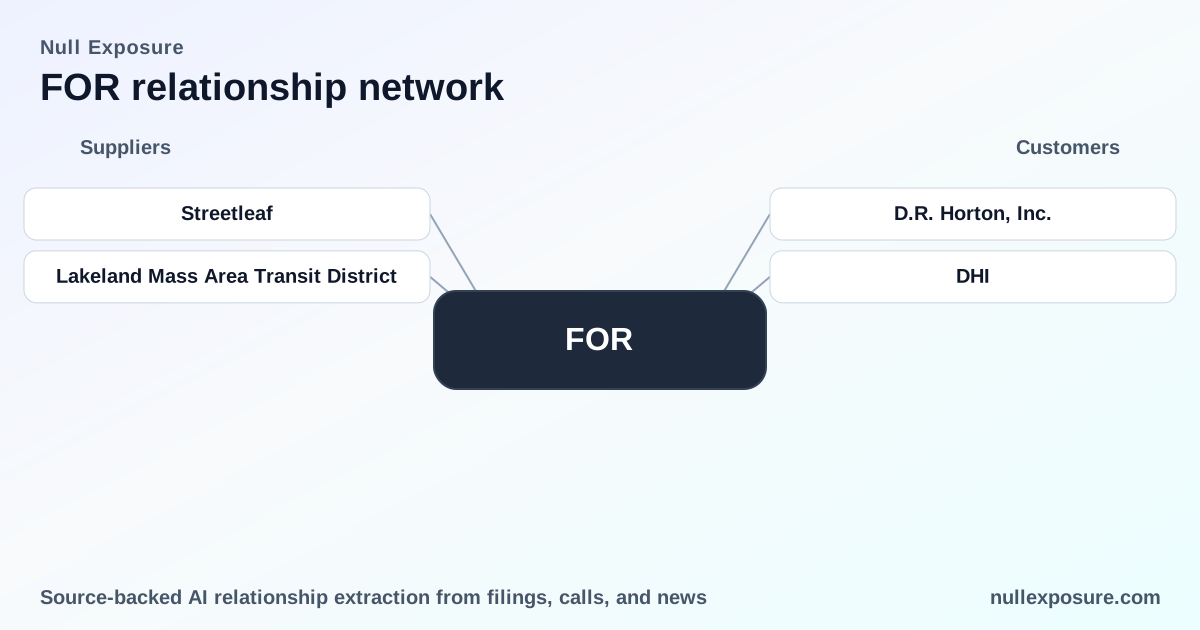
Forestar (FOR) — Customer Map and What the D.R. Horton Relationship Means for Investors
Thesis: Forestar monetizes a capital-efficient lot-development platform by acquiring, developing and selling finished single‑family lots to large homebuilders and occasional public buyers; the business generates cash from lot sales and tract dispositions, with a concentrated revenue profile anchored by D.R. Horton, whose purchases and contractual rights materially shape Forestar’s near‑term cash flow and capital allocation. Learn how Forestar’s customer mix, contract patterns and commercial constraints translate into upside and concentration risk for investors.
For a concise company overview and data feed, visit https://nullexposure.com/.
How Forestar runs and gets paid: the business in plain English
Forestar is a national residential lot‑developer that buys raw land, invests in infrastructure and sells finished single‑family lots to homebuilders and municipal or institutional buyers. Revenue is realized at lot closing, typically within three to eighteen months of contract signing, which creates an earnings cadence tied to development cycles and builder demand. The company sells at scale to large homebuilders while preserving optionality to sell tracts or municipal sites, creating a model that is highly cash flow dependent on conversion of owned lots to closed sales.
The anchor customer: D.R. Horton and why it matters
- Forestar sold 11,751 residential lots to D.R. Horton in FY2025 and generated roughly $1.278 billion in lot sales revenue to D.R. Horton that fiscal year, making D.R. Horton Forestar’s largest single buyer; this is documented in Forestar’s FY2025 10‑K filing (filed September 30, 2025).
- Forestar describes D.R. Horton as “our largest and most important customer” on earnings calls and multiple investor transcripts (Q4 FY2025 / Q1–Q2 FY2026 earnings call transcripts, March–May 2026).
- The companies operate under a Master Supply Agreement that establishes a framework for identifying development opportunities and prioritizing lot supply; Forestar’s disclosures reference this agreement explicitly in its filings.
- At September 30, 2025, approximately 22,800 lots were under contract to be sold to D.R. Horton, and another 17,600–18,100 owned lots were subject to rights of first offer to D.R. Horton based on executed purchase and sale agreements, indicating high contractual exposure and embedded near‑term demand (FY2025 10‑K and FY2026 reporting commentary).
- D.R. Horton also reported purchasing $280 million of finished lots from Forestar during Q2 2026, underscoring active throughput between the two firms (D.R. Horton Q2 2026 earnings reporting, Benzinga / D.R. Horton call transcript).
Why it matters for investors: D.R. Horton is both a demand engine and a concentration risk — its contracted pipeline and rights of first offer materially de‑risk lot disposition timing, but they also concentrate Forestar’s revenue and bargaining dynamics around one large buyer.
Other customer relationships you need to know
Medina Valley Independent School District
- Forestar sold land to Medina Valley ISD, which is scheduled to break ground on a new elementary school in mid‑ to late‑2026, demonstrating Forestar’s willingness and capability to transact with public entities for tract or municipal site sales (BuilderOnline report, May 2026).
Robert Elliott Custom Homes
- Forestar closed on land and completed lot development that Robert Elliott Custom Homes agreed to buy at the end of summer 2024 to build luxury custom homes, illustrating Forestar’s role as a lot developer that serves both national builders and local/high‑end homebuilders (CandyDirt news release, January 2024 / reported 2026).
These relationships show Forestar’s commercial breadth beyond national builders: the company sells to municipal buyers for public‑use sites and to regional/custom builders that demand finished lots at smaller scales.
Operating constraints and what they signal for strategy
Forestar’s disclosures and excerpts surface several persistent constraints that define how management runs the business:
- Contracting posture — short‑term cash realization with framework agreements. Lot contracts typically close within three to eighteen months, creating short horizon revenue recognition per parcel, while the Master Supply Agreement with D.R. Horton imposes a framework for deal flow and portfolio expansion. The combination produces predictable near‑term turnover but requires continuous land reinvestment to replace sold lots (company 10‑K, FY2025).
- Concentration and materiality. D.R. Horton accounts for a material portion of owned lots under contract and lot sale revenues, making Forestar’s cash generation highly correlated with one counterparty’s purchasing cadence (FY2025 10‑K).
- Counterparty profile and geography. Customers are large enterprise homebuilders and regional builders across 64 markets in 23 states, giving Forestar geographic diversification but persistent customer concentration at the top (FY2025 10‑K).
- Relationship maturity and stage. The D.R. Horton relationship is mature and operationally active, reflected in recurring lot sales, executed purchase agreements and rights of first offer that span multi‑year inventories (FY2025 10‑K).
- Commercial economics. Average lot sale price (~$108,400 in FY2025) places most transactions in a $100k–$1M spend band per lot, but aggregate annual revenues to D.R. Horton are in a $100M+ band, indicating both high per‑unit volume and material single‑counterparty spend (FY2025 10‑K).
Investment implications: upside levers and concentration risks
Forestar’s model offers highly visible near‑term cash flow when lots under contract convert to closings, supported by the D.R. Horton master agreement and large contracted pipelines. The core investment thesis is therefore centered on Forestar’s ability to turn contracted demand into durable cash generation, reinvest efficiently, and avoid margin dilution in slower homebuilding cycles.
Key investment tradeoffs:
- Upside: structured demand from D.R. Horton, rights of first offer that reduce disposition uncertainty, and the option to sell to municipal or local builders at attractive tract‑level prices.
- Risk: customer concentration and revenue dependence on D.R. Horton’s land purchase cadence; an abrupt change in D.R. Horton demand would materially impact near‑term earnings and lot inventory economics.
Considerations for financial models:
- Model lot conversion timing conservatively given the 3–18 month closing window.
- Weight scenario analyses toward changes in D.R. Horton purchase behavior and the likelihood of converting lots subject to right of first offer.
Bottom line and next steps
Forestar runs a capital‑efficient lot development platform with material, contractually framed exposure to D.R. Horton, supplemented by municipal and regional builder sales that broaden optionality. For investors focused on cash generation and exposure to the U.S. housing cycle, the D.R. Horton relationship is simultaneously the company’s greatest operational strength and its primary concentration risk.
Explore Forestar’s customer intelligence and related reporting at https://nullexposure.com/ for deeper relationship maps and source‑level documents.