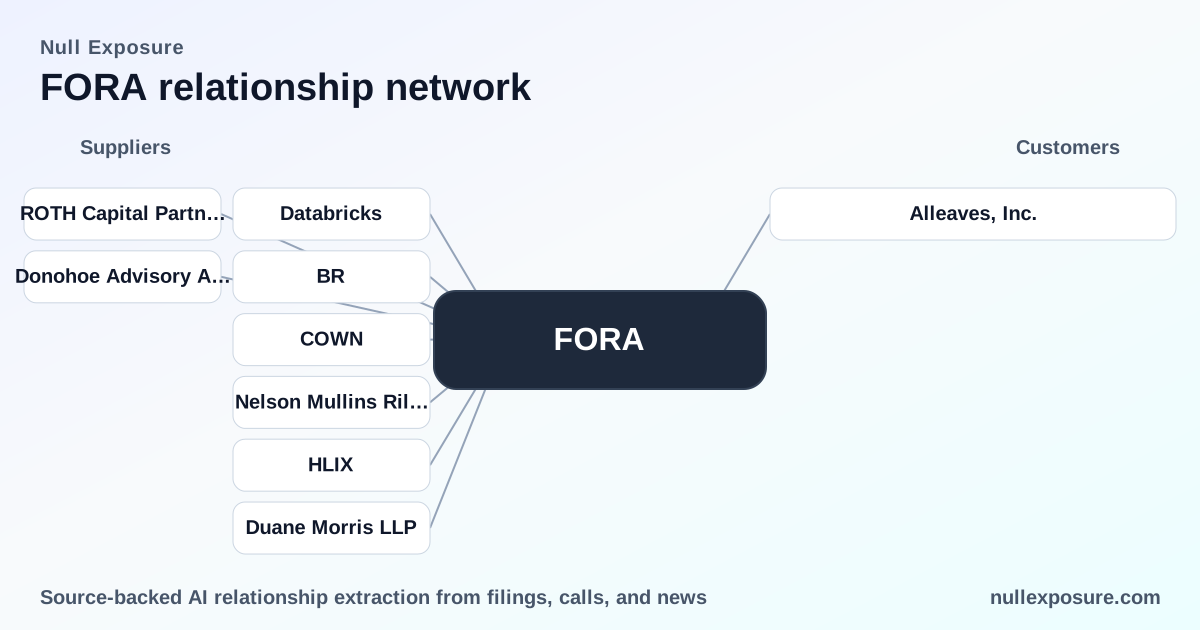
Forian Inc (FORA): Customer relationships and what they reveal about revenue durability
Forian monetizes a suite of subscription-based information and analytics products and project services sold to healthcare, life sciences and financial services customers, supplemented by bespoke professional services. Revenue is driven by multi‑year contracts and recurring invoices, with a concentrated customer base that creates both predictable cash flow and single‑client exposure. Investors should evaluate contract terms, customer concentration and the strategic impact of non-core divestitures to assess revenue durability and margin recovery.
Learn more about relationship intelligence at https://nullexposure.com/ (link).
The single customer event every investor needs to know: the BioTrack sale to Alleaves
Forian completed a strategic divestiture of its cannabis software unit, Bio-Tech Medical Software (doing business as BioTrack), to Alleaves, Inc. for a total cash consideration of $30 million — $20 million at closing and $10 million paid in twelve equal monthly installments; the sale closed effective February 10, 2023. The transaction represented Forian’s exit from the cannabis vertical and a movement of capital out of a non‑core business back into the corporate balance sheet. Source: New Cannabis Ventures coverage of the transaction (report published March 9, 2026; effective date Feb 10, 2023).
All customer relationships in the record — concise investor summaries
- Alleaves, Inc.: Alleaves acquired Forian’s cannabis software subsidiary BioTrack for $30 million in cash, a deal structured as $20 million at closing and $10 million in twelve monthly installments, concluding Forian’s direct involvement in cannabis software operations (effective February 10, 2023). Source: New Cannabis Ventures (March 9, 2026).
This dataset contains a single relationship record; the Alleaves transaction is the material customer/transaction event disclosed.
How Forian contracts and who it sells to — company‑level signals investors should price in
Forian’s public disclosures and filings describe a subscription-heavy, multi‑year contracting posture: information products are sold under monthly-to‑five‑year contracts and invoiced monthly, quarterly or annually. The company specifically states its information products are “largely subscription based, multiyear contracts” tailored to healthcare and life sciences clients and institutional investors. This creates recurring revenue with identifiable renewal cycles supporting revenue visibility. Source: company filings for the year ended December 31, 2024.
- Contracting posture: Predominantly subscription, multi‑year engagements that favor renewal economics and predictable ASC 606 recognition patterns.
- Customer type and scale: Contracts are sold to large enterprises (healthcare systems, life sciences companies and institutional investors) and to service providers; Forian functions as both seller and service provider, delivering productized platforms plus professional services.
- Geographic concentration: Forian’s revenue is heavily North America‑centric — 90% of 2024 sales were U.S., with Australia at 8% and Canada/other at 2% — implying regulatory and market exposure is primarily domestic. Source: company filings for the year ended December 31, 2024.
- Spend and concentration: The company reports that in 2024 two customers represented 16.9% and 11.6% of revenue, and reported customer contracts with minimum billings (for one director‑controlled counterparty) of $1.2 million over three years. These figures signal mid‑market to large enterprise spend bands (roughly $1M–$10M) and meaningful single‑customer concentration risk. Source: company filings (2024 disclosures).
- Relationship stage: Active multi‑year agreements are in force, including a three‑year customer agreement entered September 4, 2024, with minimum aggregated billings and partial revenue already recognized through year‑end 2024. Source: company filings (2024).
What those commercial features imply for revenue quality and investor risk
The mix of recurring subscription revenue and concentrated customer exposures creates a classic small‑cap SaaS tradeoff: high predictability from committed invoices but outsized sensitivity to churn or downgrades from a handful of large customers. With Forian’s operating margins negative and EPS slightly below breakeven, the company needs to convert renewals and new mid‑market deals into scale before operating leverage returns. Key investor considerations:
- Predictability: Multi‑year subscription contracts and recurring invoicing support revenue visibility and easier cash forecasting.
- Concentration risk: Two customers accounted for ~28.5% of revenue in 2024, a material level for a $30M revenue base that elevates downside in the event of non‑renewal.
- Geography: U.S. concentration reduces foreign‑market diversification but simplifies regulatory exposure and go‑to‑market focus.
- Client mix: Serving large healthcare and institutional clients increases contract size and stickiness, but procurement cycles and negotiation leverage can prolong sales and compress near‑term growth.
Financial context: as of the latest reported quarter (2025‑12‑31), Forian’s trailing‑12‑month revenue was approximately $30.3 million with gross profit of $16.1 million, but net margins were negative and EBITDA showed a loss — underscoring the imperative to scale recurring revenue and control operating costs to reach profitability. Source: Forian public financials (latest quarter 2025).
Strategic consequences of the BioTrack divestiture
The sale of BioTrack to Alleaves materially reduces Forian’s operational footprint in the cannabis vertical and crystallizes proceeds that the company can redeploy into its core healthcare and life sciences analytics business. This transaction clarifies corporate focus: Forian is positioning itself as a healthcare information and analytics provider, not a cannabis software platform operator. For investors, that means future growth will be evaluated against healthcare market dynamics rather than the cannabis ERP market. Source: New Cannabis Ventures report and Forian disclosures.
Risks, opportunities and what to watch next
- Watch renewal cadence and retention of top customers. Given revenue concentration, retention or expansion of the two largest customers is the primary lever on short‑term revenue stability.
- Monitor contract book depth. Multi‑year minimum billings and contract lengths will determine near‑term cash flow; the investor should look for increased average contract values or new enterprise wins to reduce concentration risk.
- Margin trajectory. Forian’s negative operating margin requires revenue scale or efficiency gains to justify the current valuation; investors should track gross‑to‑operating margin conversion over the next four quarters.
- Capital deployment post‑divestiture. How Forian uses the BioTrack sale proceeds—debt reduction, R&D, M&A or working capital—will influence growth trajectory and balance sheet resilience.
If you want a deeper relationship map and risk scoring for Forian’s customer book, explore the methodology and full coverage at https://nullexposure.com/ (link).
Bottom line for investors
Forian operates a subscription‑oriented, service‑augmented business with clear revenue visibility but material customer concentration. The BioTrack sale to Alleaves eliminated a non‑core unit and returned capital, sharpening the enterprise’s focus on healthcare analytics — a strategic positive — while leaving the core challenge intact: scale recurring revenue to convert negative operating leverage into profitability. Track renewals, new enterprise bookings, and how redeployed capital supports sales and product expansion.