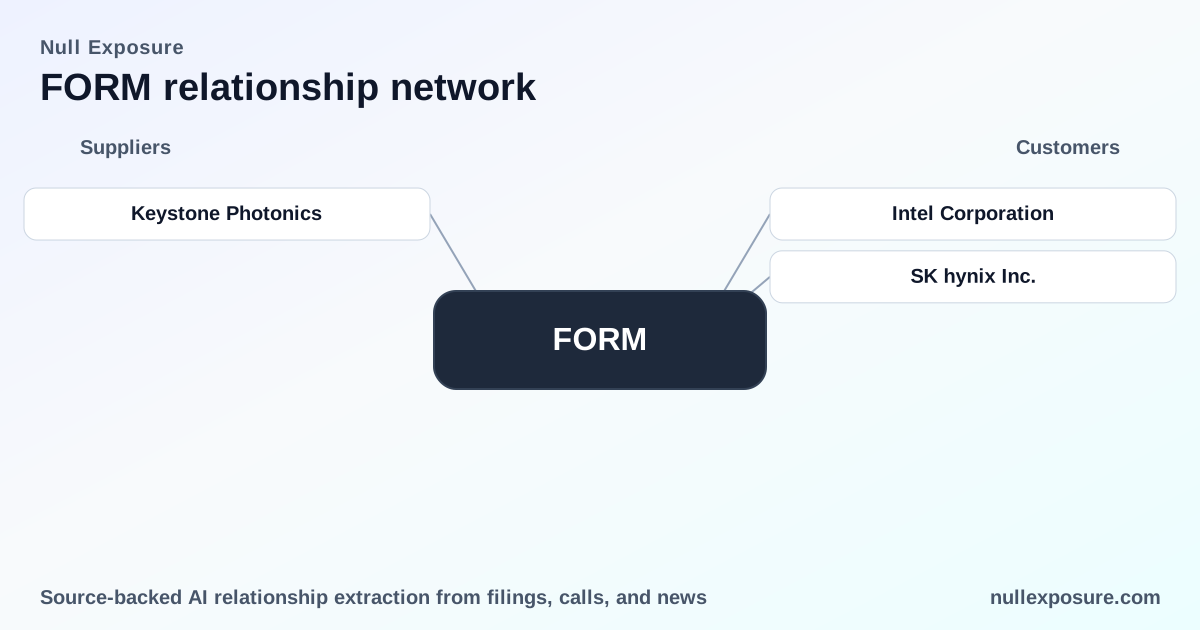
FormFactor (FORM): Customer Concentration, Criticality, and the Path from Lab to Fab
FormFactor designs and sells probe cards, analytical probes, probe stations, metrology and thermal systems to semiconductor manufacturers and research institutions, monetizing through product sales and short-term service contracts (1–3 year maintenance and warranty agreements) that attach recurring revenue to hardware. The company's go‑to‑market is global and concentrated among the world’s largest chipmakers, producing high gross margins but exposing valuation to a small number of large counterparties and to the timing of fab ramps and product cycles.
Why the customer base defines FormFactor’s upside and risk
FormFactor’s economics are driven by a compact set of high-value customers that buy capital equipment and attach services. Several company-level signals shape the operating model and what investors should expect from cash flow and contract behavior:
- Short-term service contracts (recognized over one to three years) mean recurring revenue exists but is not long-duration; product sales drive headline revenue and volatility.
- The majority of accounts receivable come from large multinational semiconductor manufacturers, so counterparty credit and order timing are materially relevant.
- Research and academic customers are present alongside commercial fabs, giving the business a mixed buyer profile that includes non‑profit institutions.
- Sales are global, executed via a direct sales force plus reps and distributors, embedding geographic diversification but also exposure to regional fab cycles.
- Customers view FormFactor’s products as critical to high‑volume manufacturing and ramp success, creating stickiness once a probe solution is qualified.
- The company is transitioning pilots with some customers—most notably in co‑packaged optics—from lab prototypes to fab-ready systems, an early-stage revenue pathway that is strategically important for future growth.
For a deeper look at how these customer signals translate into portfolio risk and opportunity, visit the Null Exposure homepage: https://nullexposure.com/.
Customer map — the firms that move FormFactor’s revenue needle
Below I lay out each customer relationship found in the public record and in press coverage, with a concise, source‑specific note for investors.
Intel Corporation
FormFactor lists Intel among its top customers in its FY2024 10‑K, with Intel’s share appearing as a material percentage of revenue across reported periods; public transcripts also highlight Intel awarding FormFactor an Epic Supplier Award for supplier performance. According to FormFactor’s FY2024 10‑K and Q1 2026 earnings‑call coverage, Intel is a large, strategic buyer and recognition recipient (FY2024 10‑K; InsiderMonkey Q1 2026 transcript).
SK hynix Inc.
SK hynix is explicitly cited in the FY2024 10‑K as a material customer, accounting for a meaningful revenue percentage across reporting periods. The company’s disclosure positions SK hynix as a large enterprise buyer in the memory segment that contributes materially to accounts receivable (FormFactor FY2024 10‑K).
TSMC / Taiwan Semiconductor Manufacturing Company
TSMC is named repeatedly in industry coverage as one of the handful of fabs that concentrate FormFactor’s revenue; media analysts emphasize TSMC’s role in advanced-node testing and HBM4-era demand drivers. FinancialContent and subsequent market reports list TSMC among FormFactor’s key customers, underscoring its strategic importance to wafer‑level probe demand (FinancialContent, March 2026).
Samsung Electronics
Samsung appears in market commentary as a core customer alongside TSMC and Intel, representing another top-tier foundry and memory buyer whose product roadmaps directly influence FormFactor order cadence. TradingView/Zacks coverage identifies Samsung among the significant customers that underpin FormFactor’s addressable market (TradingView / Zacks coverage, 2026).
Micron Technology
Micron is referenced in trading-coverage lists of FormFactor customers as a major memory customer whose testing requirements for DRAM and next‑generation memory will influence equipment demand. Market write‑ups group Micron with the other large memory customers that concentrate FormFactor’s commercial exposure (TradingView analyst piece, 2026).
NVIDIA
NVIDIA is discussed in earnings‑call transcripts and market commentary as a distinct customer line item—specifically called out relative to TSMC revenue grouping—reflecting high‑value, chip‑designer demand for validated test solutions used in GPU and accelerator production. The Q1 2026 earnings‑call transcript records questions about why NVIDIA is broken out separately from TSMC, implying a discrete revenue relationship (InsiderMonkey Q1 2026 transcript).
How those relationships translate into investable signals
FormFactor’s customer roster creates a set of clear investment signals:
- Concentration + criticality = high operating leverage. When a major customer ramps, FormFactor benefits disproportionately; when a major customer pauses, revenue swings materially. The FY2024 disclosures and market coverage both underline concentration among top chipmakers.
- Short contract horizons moderate recurring revenue. The one‑to‑three year service contract profile creates predictable but limited-duration revenue streams; product sales remain the primary driver of margin expansion.
- Global sales footprint reduces single‑market risk but raises cycle correlation risk. Exposure across foundries and geographies diversifies political risk but preserves sensitivity to global semiconductor cycles.
- Upstream pilot work positions FormFactor for future upside. Early-stage collaborations to move co‑packaged optics from lab to fab represent a valuable pipeline; these relationships are currently in pilot or early commercialization stages, so revenue is prospective but strategically material.
Risk checklist for portfolio construction
- Order timing risk from a small number of very large customers is the dominant near‑term valuation risk.
- Limited duration of service contracts constrains visibility into recurring revenue beyond immediate contract periods.
- Technological shift execution (e.g., co‑packaged optics) is a growth catalyst but requires successful pilot-to-fab transitions before it meaningfully alters revenue baselines.
For investors needing an actionable, customer‑level intelligence view on FormFactor, Null Exposure maintains curated relationship coverage and signal-driven commentary at https://nullexposure.com/.
Bottom line
FormFactor is a high‑margin, capital‑equipment supplier whose value hinges on a concentrated book of large semiconductor customers and the company’s ability to convert pilot engagements into sustained fab deployments. The FY2024 SEC filing confirms the customer concentration and the short-term nature of attached service contracts; contemporary market coverage reiterates the strategic customer list—Intel, TSMC, Samsung, SK hynix, Micron and select design houses such as NVIDIA—as the principal drivers of the next phase of revenue growth. Investors should underwrite both the upside from successful transitions to new architectures and the downside from timing shocks in a concentrated customer base.