Forrester Research (FORR): Customer Relationships That Drive Recurring Revenue
Forrester Research builds a subscription-first advisory business that monetizes through annual research subscriptions, short-term consulting projects, licensing of interactive tools, and event ticketing/sponsorships. Its operating model prioritizes renewals and cross-sell from consulting into its core subscription base, generating predictable recurring cash flow while supplementing growth with one‑off engagements and event revenues. For investors and operators evaluating customer relationships, the company presents a highly service-oriented commercial posture with clear revenue mix diversification across recurring and spot contracts. For a concise company-level view, see more at https://nullexposure.com/.
How Forrester sells: the contract mix and go‑to‑market posture
Forrester’s revenue architecture is straightforward and investor-friendly: subscription research is the primary engine, consulting projects are short-duration, and events provide single‑occurrence monetization. The company defines its subscription ("CV") products as year-long, renewably contracted services that include analyst access, peer programs, and webinars, reflecting a multi-product subscription offering sold as a package. Consulting engagements are fixed‑fee and completed over two weeks to three months, and certain content projects include time-limited licensing of interactive tools (typically 12–24 months). Events are recognized at completion, creating discrete spot revenue spikes.
These contract types translate into observable business characteristics:
- Contracting posture: subscription-centric with complementary short-term consulting and licensing, supporting strong renewal economics.
- Concentration: a two-tiered customer base from premier global clients to emerging and mid‑market vendors; the U.S. accounts for roughly 77% of revenues, but the firm operates globally across Research, Consulting, and Events.
- Criticality: Forrester positions itself as a strategic advisor—clients use research to validate technology and organizational decisions—so engagements have high decision-making influence, particularly for AI and digital transformation work.
- Maturity and predictability: Annual subscription cycles and repeat consulting cross-sells support predictable renewal dynamics, while events and commissioned studies introduce variability.
What public mentions reveal about client relationships
Below I summarize every customer relationship result in the dataset, with one- to two‑sentence plain-English takeaways and source citations.
TriNet (TNET)
TriNet commissioned a Forrester Consulting Total Economic Impact™ study; TriNet’s marketing materials quote January 2026 results showing customer value findings aggregated from four client interviews. This relationship is a classic commissioned-study engagement that Forrester uses to validate product value for a client’s go-to-market narrative (TriNet insights, May 4, 2026: https://www.trinet.com/insights/small-business-growth-factors-scale-200-percent).
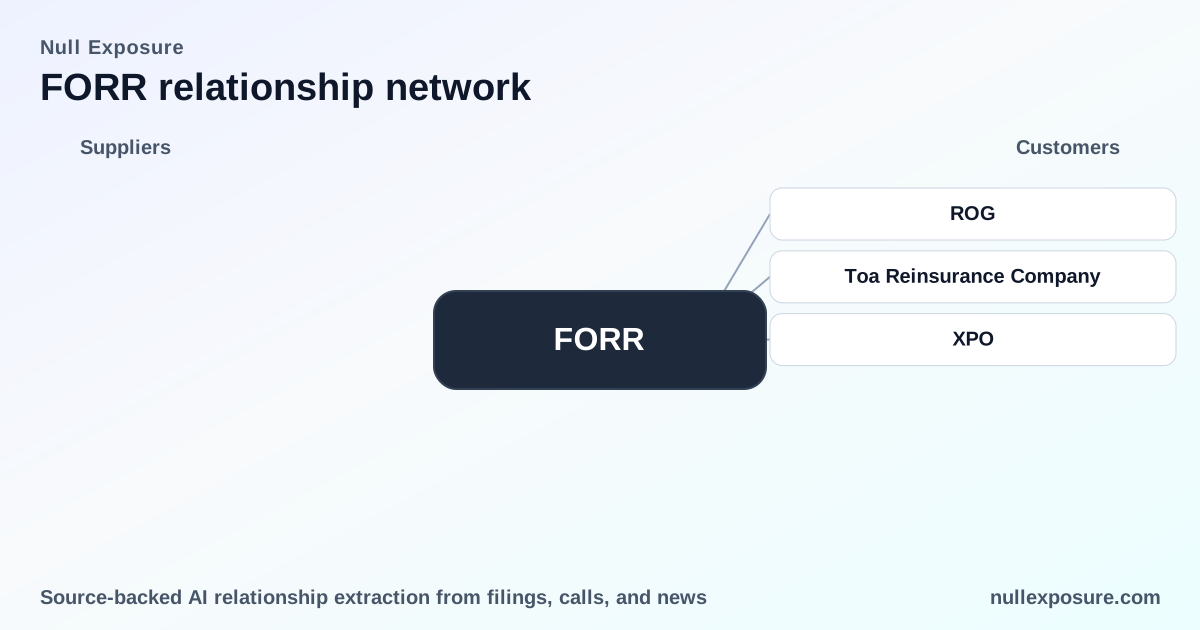
Roche (ROG)
Roche credits its Forrester relationship with building a foundation to upskill its workforce on generative AI and to transform business-critical operations, signaling Forrester’s role as a strategic advisor on enterprise AI capabilities. The endorsement comes from Forrester’s own blog, which quotes Roche’s enterprise architect describing the practical impact on training and transformation (Forrester blog, March 9, 2026: https://www.forrester.com/blogs/why-ai-makes-trusted-research-more-valuable/).
Toa Reinsurance Company
Toa Reinsurance’s CIO stated he relies on Forrester for guidance and validation in a fast-moving AI environment, illustrating Forrester’s role as a trusted external validator for risk‑sensitive, highly technical insurance decisions. The quote is published on Forrester’s site and underscores advisory influence in regulated industries (Forrester blog, March 9, 2026: https://www.forrester.com/blogs/why-ai-makes-trusted-research-more-valuable/).
XPO (XPO)
XPO’s VP of sales operations described Forrester’s help in aligning disparate teams around customer-centric goals, reflecting Forrester’s consulting and research capabilities to drive internal alignment and go-to-market coherence. The remark is part of Forrester’s commentary on AI and trusted research (Forrester blog, March 9, 2026: https://www.forrester.com/blogs/why-ai-makes-trusted-research-more-valuable/).
TransUnion (TRU)
TransUnion referenced a commissioned Forrester study showing that 42% of financial services and insurance executives rely on basic segmentation, using those findings to frame a new prescreen tool and to justify product positioning to lenders in 2026. Forrester’s commissioned research supports TransUnion’s product messaging and industry analysis (TransUnion newsroom and related coverage, May 4, 2026: https://newsroom.transunion.com/truiqcreditstrategystudio/; additional reporting in Cutoday and HousingWire on May 4, 2026).
Waystar (WAY)
Waystar announced results of a commissioned Forrester Consulting study in June 2026, indicating it uses Forrester research to validate claims and support customer communications. This is another example of a vendor commissioning Forrester to produce market or value evidence for public release (news coverage, June 24, 2026: reported on SimplyWallSt and Waystar press mentions).
Microsoft (MSFT)
Forrester launched an AI agent integrated into Microsoft 365 Copilot and made it available at no additional cost to existing license holders, demonstrating a product-level integration that extends Forrester’s research into daily workflows and amplifies client access and stickiness. This integration positions Forrester research directly inside enterprise productivity tools (industry coverage, May 2, 2026: Intellectia.ai report).
What these relationships mean for risk and upside
Collectively, the documented relationships illustrate Forrester’s dual role as research vendor and strategic consultant. Commissioned studies for vendors (TriNet, Waystar) and product integrations (Microsoft) demonstrate a commercial model that monetizes both advisory credibility and branded research outputs. Enterprise endorsements from Roche, Toa Reinsurance, and XPO indicate high criticality in transformation and AI agendas, which supports premium pricing and renewal stickiness for enterprise CV contracts. TransUnion’s repeated use of commissioned Forrester research for go‑to‑market messaging underscores the firm’s influence in regulated, data‑driven industries.
Key investor implications:
- Recurring revenue strength: Subscription research underpins the business and is reinforced by consulting cross-sell that improves renewal rates.
- Revenue diversification: Licensing and events add one‑time revenue that can amplify quarter-to-quarter volatility but also expand total addressable spend per client.
- Client mix and geographic exposure: Heavy U.S. concentration (77%) makes Forrester vulnerable to domestic economic cycles but benefits from large U.S. enterprise budgets for advisory services.
- Brand and influence: High-profile client quotes and integrations with Microsoft increase reach and could accelerate adoption across enterprise workflows.
For a deeper analysis of Forrester’s revenue mix and customer contract signals, visit https://nullexposure.com/ for structured investor intelligence and relationship mapping.