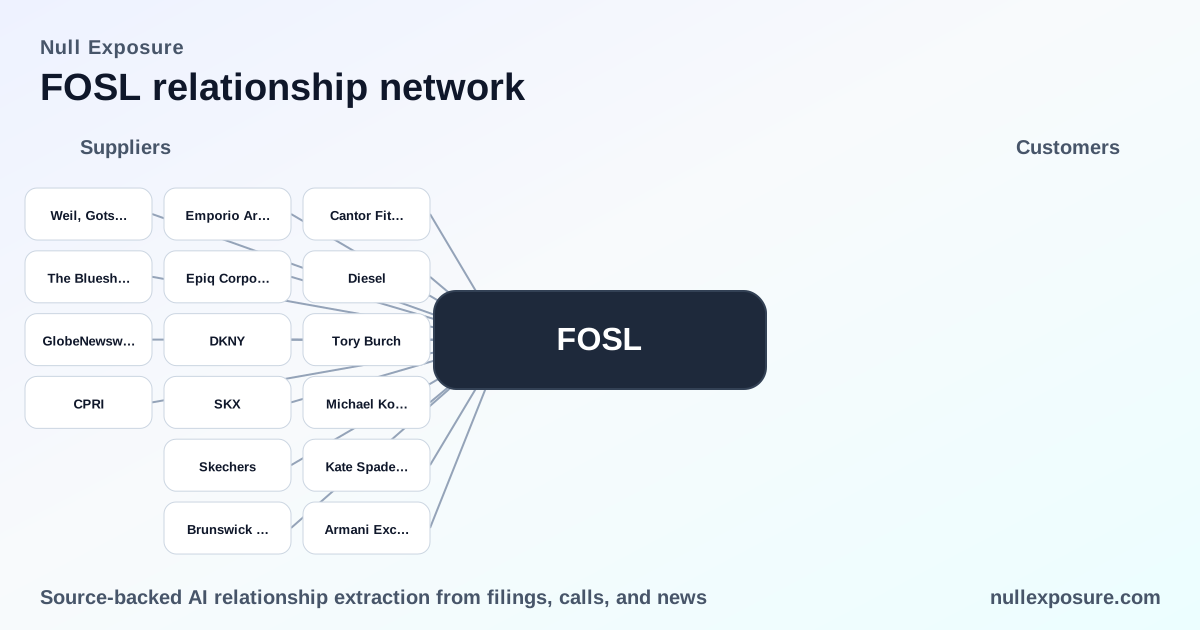
Fossil Group (FOSL) — Customer Relationships Drive Scale in a License-Heavy Model
Fossil Group operates as a design-to-distribution fashion accessories company that monetizes through direct sales of its FOSSIL-branded products and by producing licensed merchandise for established fashion labels, distributing via wholesale partners, company-owned retail and e-commerce, and a global network of independent distributors. Investors should value Fossil not only as a watch-and-accessory retailer but as a licensing and distribution engine that leverages brand partnerships to diversify channels and price points. For a concise dashboard of related coverage and downstream customer exposure, visit https://nullexposure.com/.
How Fossil's operating model translates to revenue and risk
Fossil’s economics are concentrated around watch sales and amplified by licensing relationships. Watches generated roughly 78% of consolidated net sales in recent fiscal years, making the category the company’s core monetization engine while licensed brands broaden assortment and geographies. According to Fossil’s FY2024 filing, the firm sells across wholesale, company stores and e-commerce, and through a network of 22 company-owned sales subsidiaries plus 72 independent distributors, enabling reach into roughly 130 countries.
Key operating traits for investors:
- Contracting posture: Fossil operates as both a seller (company-owned retail and e-commerce) and a license manufacturer/partner, relying on agreements that govern branded product production and distribution rather than controlling all retail endpoints.
- Geographic diversification with concentration: Americas accounted for about 45% of consolidated net sales, Europe 31%, and Asia 24% as of fiscal 2024, reflecting a global footprint but material exposure to the Americas and Europe.
- Product criticality and maturity: Watches are a critical, mature revenue base—stable but sensitive to fashion cycles and pricing pressure—while brand licenses act as growth levers and margin differentiators.
- Distribution complexity: The mix of company-owned stores (110 retail and 138 outlet stores as of Dec 28, 2024) and a large independent distributor network reduces single-counterparty concentration but raises operational complexity and working-capital needs. (All company-level figures cited from Fossil’s FY2024 filing.)
Brand partners and what each relationship signals for investors
The following relationships were referenced together in market coverage highlighting Fossil’s licensing partnerships; each entry below summarizes the role and cites the underlying market report.
Kate Spade
Fossil sells merchandise under a Kate Spade license arrangement, using the brand to access a distinct price and demographic segment outside core Fossil assortments. Source: MarketBeat instant alert summarizing Wall Street Zen coverage (April 18, 2026).
Burberry
Fossil manufactures and distributes Burberry-labeled accessories under licensing agreements that extend Fossil’s presence in premium European channels. Source: MarketBeat instant alert summarizing Wall Street Zen coverage (April 18, 2026).
Michael Kors
Fossil produces licensed Michael Kors merchandise in certain markets, leveraging the brand’s global recognition to supplement Fossil’s own product stacks. Source: MarketBeat instant alert summarizing Wall Street Zen coverage (April 18, 2026).
Diesel
Fossil’s relationship with Diesel positions the company within a fashion-forward segment, enabling cross-market penetration through licensed accessory collections. Source: MarketBeat instant alert summarizing Wall Street Zen coverage (April 18, 2026).
DKNY
Fossil sells DKNY-branded accessories under license arrangements that allow the company to participate in urban and lifestyle segments complementary to its core watch business. Source: MarketBeat instant alert summarizing Wall Street Zen coverage (April 18, 2026).
Armani Exchange
Armani Exchange licensing gives Fossil exposure into higher fashion price bands and international wholesale channels where the Armani name drives distribution capability. Source: MarketBeat instant alert summarizing Wall Street Zen coverage (April 18, 2026).
Tory Burch
Fossil’s licensed production for Tory Burch adds an aspirational lifestyle label to its portfolio, broadening channel access and customer demographics beyond Fossil-branded shoppers. Source: MarketBeat instant alert summarizing Wall Street Zen coverage (April 18, 2026).
Why these particular partnerships matter
These license relationships are strategic multipliers for Fossil: they increase shelf space with department stores and specialty retailers, enable penetration into fashion segments where Fossil’s own brand has lower pull, and provide margin variety across product families. At the same time, the model transfers some margin and brand-control risk to contractual terms; the economic value depends on renewal cadence, minimum purchase obligations, and territory rights embedded in licensing agreements.
From an investor perspective, monitor:
- Renewal and pricing terms in major licenses, because these determine margin capture and forward revenue visibility.
- Channel mix shifts (wholesale vs. DTC) since higher direct-to-consumer sales tend to yield better gross margins but require greater capital and marketing investment.
- Geographic sales composition—with about 45% Americas, 31% Europe, and 24% Asia, performance in the Americas and Europe disproportionately drives consolidated results (per Fossil’s FY2024 filing).
If you want a structured view of how these brand partnerships interact with Fossil’s distribution model and capital profile, explore our research hub at https://nullexposure.com/.
Risks, constraints, and how they affect premium finance considerations
- Concentration on watches amplifies product-cycle risk; an adverse trend in watch demand compresses overall revenue rapidly given watches account for the bulk of sales.
- Global distribution complexity reduces single-counterparty concentration but raises currency, logistics, and receivables risks across 130 countries; this matters for funding terms and working-capital underwriting.
- License dependency creates contract renewal and reputation risk: loss or non-renewal of a major license can compress top-line growth in regions where Fossil relies on those labels to access retailers.
- Maturity of channels: company-owned retail provides control but also fixed-cost exposure; a shift toward wholesale or third-party e-commerce affects margins and capital intensity.
These constraints are company-level signals drawn from Fossil’s public filings (FY2024), and they define the company’s contracting posture, concentration profile, and the criticality of its product mix for creditors and investors.
Bottom line for investors
- Fossil is a hybrid operator: a retailer with a dominant watch business and a second-order licensing and distribution model that expands reach and pricing tiers.
- Licenses (Kate Spade, Burberry, Michael Kors, Diesel, DKNY, Armani Exchange, Tory Burch) materially broaden cadence and channels but also introduce contract and brand renewal risk; MarketBeat coverage quoted Fossil’s suite of international license partners (April 18, 2026).
- Geographic and channel diversification mitigate single-market shocks, yet the Americas and watches remain the largest revenue drivers, shaping credit and growth sensitivity.
For a deeper breakdown of counterparties and scenario modeling on license renewals and channel shifts, see our platform at https://nullexposure.com/ and request a tailored exposure note.