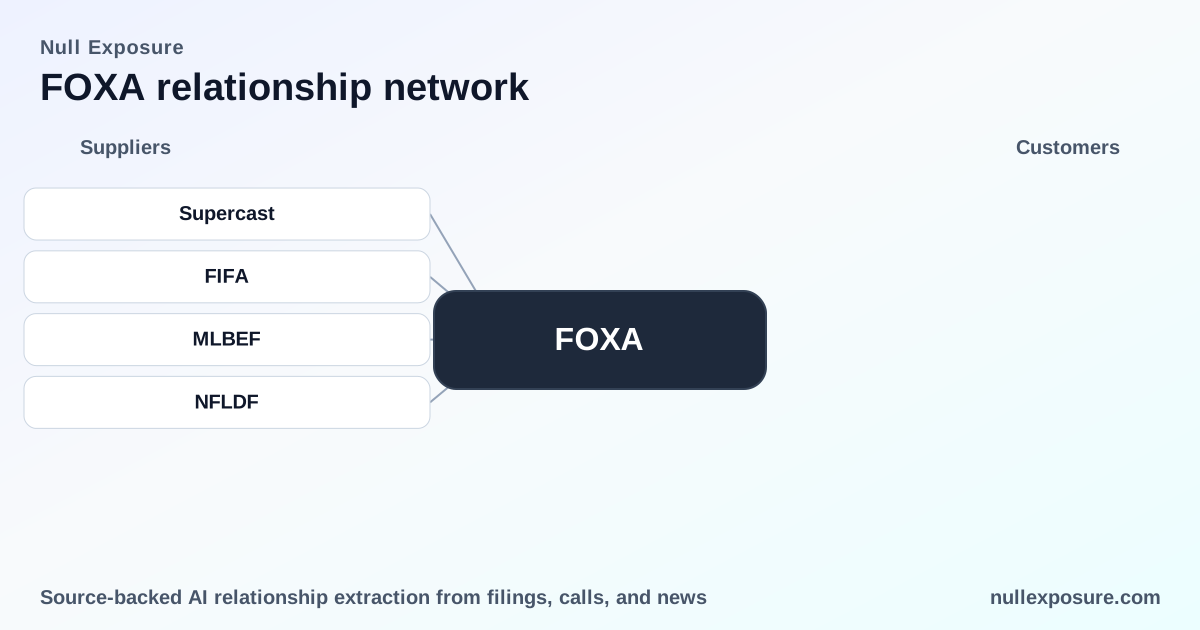
FOXA Customer Map: Affiliate Deals, Ad Partners, and Content Licensing that Drive Cash Flow
Fox Corporation operates a dual-anchored media business: monetizing premium news and sports content through affiliate fees, advertising, and growing subscription/FAST services (Tubi, FOX Nation). Affiliate agreements with cable and broadcast distributors generate recurring, largely predictable cash flows, while advertising and sponsored programming deliver higher-volatility, short-term revenue. Investors should value FOXA as a hybrid content licensor and platform operator whose revenue mix concentrates on affiliate fees (stable) and advertising (cyclical). Learn more at https://nullexposure.com/.
How Fox monetizes relationships — the core mechanics
Fox’s economics are driven by three clear levers: subscriber-based affiliate fees, spot and sponsorship advertising, and content licensing / subscription monetization. Affiliate deals are typically multi-year licenses paid monthly and create the company’s most significant remaining performance obligations; advertising is short-term and seasonal; licensing and SVOD/FAST products are growing but smaller in absolute scale today. This structure produces stable base revenue (affiliate fees) with upside and downside from ad cycles and event-driven sports revenue.
Key operating constraints and what they signal for customers
- Contract tenor and billing posture: Affiliation agreements and many content licenses are multi-year, staggered contracts billed monthly, exposing FOX to predictable cash receipts but locking in carriage economics for extended periods; advertising contracts are short-term, billed and collected monthly, adding cyclical revenue exposure. Company filings as of June 30, 2025 disclose that roughly $5.4 billion of revenue is expected to be recognized primarily over the next one to three years, concentrated in affiliate and licensing obligations.
- Revenue mix concentration: Nearly 47% of FY2025 revenue came from affiliate fees and 42% from advertising, making Fox both materially dependent on distributor carriage and highly sensitive to U.S. advertising markets.
- Geographic focus and counterparty profile: Distribution and monetization are primarily North America with counterparties spanning large enterprises (MVPDs, virtual MVPDs) and individual consumers (FOX Nation subscribers) — a dual B2B/B2C posture that demands both enterprise contracting discipline and consumer product execution.
- Materiality signal: No single customer exceeded 10% of revenues in recent years, indicating customer concentration is low at the single-counterparty level, but reliance on categories (distributors, advertisers, sports partners) is high.
- Relationship role: Fox functions largely as a licensor and content provider to distributors and a seller of advertising inventory to brands and sponsors; it also operates direct-to-consumer services as an expanding revenue stream.
These company-level signals affect counterparty risk, renewal leverage, and cash-flow predictability for operators and investors evaluating FOXA.
Customer relationships: the full list investors need to know
Below are the relationships surfaced in public reporting and press coverage; each entry includes a concise business-summary and the source.
-
Charter (CHTR) — Fox sells channel carriage and advertising reach to Charter as part of its U.S. affiliate ecosystem; coverage notes Fox’s exposure to affiliate deals with major providers like Charter. Source: Ad-hoc News overview on Q3 FY2026 earnings release (May 2, 2026).
-
Sinclair Broadcast Group (SBGI) — FY2024 renewal — Sinclair reported a multi‑year renewal of all Fox affiliations in Sinclair markets, reinforcing Fox’s strategy of locking long-term station carriage across local markets. Source: Sinclair press release reporting FY2024 results (January, referenced in SBGI materials).
-
Comcast (CMCSA) — Comcast is identified alongside other major distributors in coverage of Fox’s affiliate exposure, indicating Comcast remains a core carriage partner for Fox networks and related advertising distribution. Source: Ad-hoc News overview on Q3 FY2026 earnings release (May 2, 2026).
-
IGC (IGC) — sponsored programming — IGC Pharma engaged in a national broadcast sponsorship program that includes long-form interviews and sponsored programming on Fox Business, signaling Fox’s role as a platform for paid sponsor content. Source: TradingView/press reporting on the advertising campaign (May 3, 2026) and AccessNewswire (May 3, 2026).
-
Gray Television (GTN-A) — FY2025 affiliation renewal — Gray renewed its affiliation agreements for 27 Fox markets for an additional two years, demonstrating Fox’s continued reliance on local station affiliates to sustain network reach. Source: Earnings transcript reported on Investing.com and TVNewsCheck (FY2025/Q3 reporting).
-
New to The Street / RDZN (RDZN) — syndicated sponsored series — RDZN’s 12‑part media campaign includes weekly sponsored programming broadcast on Fox Business Network, representing Fox’s monetization of sponsor-driven content across its business channels. Source: Newswire press release (May 3, 2026).
-
Acurx Pharmaceuticals (ACXP) — sponsored broadcasts — Acurx renewed national broadcasts as sponsored programming on Fox Business, underlining Fox’s active commercial marketplace for paid interview and sponsor slots. Source: Newswire press release (May 2, 2026).
-
DSP / Viant Technology (DSP) — premium publisher program — Viant identified Fox as a hosting provider within its Direct Access Premium Publisher program for marquee sports events, signaling Fox’s premium inventory value during global sports rights windows. Source: The Globe and Mail coverage of Viant Q4 2025 commentary (May 2, 2026).
-
Sinclair Broadcast Group (SBGI) — FY2021 agreement — Historical reporting notes a December 2020 multi-year agreement that renewed FOX network affiliations for stations in 25 markets reaching ~11% of U.S. TV households, setting groundwork for later renewals and local distribution scale. Source: Sinclair FY2020 results press release (reported in SBGI communications).
-
Apple TV / Apple (AAPL) — Tubi partnerships — Tubi announced exclusive free F1 alternate broadcasts in the U.S. with Apple TV among other high-profile partnerships, illustrating Fox’s distribution and promotional tie-ups for Tubi content and sports-adjacent programming. Source: Sahm Capital coverage of Tubi’s NewFronts announcement (March 2026, reported May 2, 2026).
-
IGC (IGC) — amplification across Fox Business and Bloomberg — A second IGC item documents cross-platform sponsorship and digital amplification, reinforcing the recurring use of Fox Business as a national sponsor platform. Source: AccessNewswire (May 3, 2026).
-
NeOnc / NTHI (NTHI) — 12‑part national broadcast series — NeOnc contracted a national series with exclusive monthly interviews airing on Fox Business Network, an example of how clinical and small-cap issuers buy reach via Fox’s business channels. Source: HeraldMailMedia press release (May 3, 2026).
-
Altice USA / Optimum (OPTU) — sports bundle distribution context — Coverage mentions a new sports streaming bundle involving Fox that Altice is preparing to distribute, highlighting Fox’s role in evolving direct-to-consumer and bundled sports distribution agreements. Source: LightReading (FY2024 context).
What these relationships mean for investors
- Predictability: Multi‑year affiliate and licensing deals create a predictable revenue floor; Fox’s disclosure of multi-year obligations (~$5.4bn recognized over 1–3 years) supports cash-flow modeling.
- Cyclicality and upside: Short-term advertising and sponsored programming deliver performance sensitivity to ad cycles and events (e.g., sports rights), offering upside in strong ad markets and downside in weak ones.
- Diversified monetization channels: Fox’s mix of large distributor contracts, sponsored programming, and Tubi/FOX Nation subscriptions reduces single-counterparty concentration risk while preserving category exposure to distributors and advertisers.
- Operational risk: Renewals with local broadcasters and MVPDs are strategically important; sustained carriage and favorable retransmission consent terms are critical to revenue stability.
Investors and operators: action checklist
- Monitor renewal cadence and terms for major carriage partners (Comcast, Charter, regional groups such as Gray and Sinclair).
- Track ad revenue trends seasonally and around marquee sports windows.
- Watch Tubi partnership announcements (e.g., Apple collaboration) as a barometer of DTC distribution leverage.
For a structured map of Fox’s customer relationships and how they affect contract duration, revenue recognition, and renewal risk, see more at https://nullexposure.com/.
Bold takeaway: FOXA is a content licensor with a predictable affiliate fee base and high ad-driven volatility; the customer ecosystem — distributors, local broadcasters, and sponsor clients — collectively determines near-term cash flow and long-term growth optionality.