FOXX customer relationships: carrier distribution, concentration risk, and what investors need to know
Foxx Development Holdings sells Foxx-branded electronic devices through wholesale distributors and direct e-commerce channels, and it captures additional revenue from app-installation services and ad-revenue share. The company monetizes primarily by hardware sales into U.S. retail and carrier channels, supplemented by software/service commissions, a business mix that drives high unit sales volume but leaves gross margin and profitability sensitive to channel terms and a small number of large buyers. For readers evaluating FOXX customer exposure, the key takeaways are concentration in U.S. channels, distribution-led contracting posture, and strategic dependence on major wireless carriers and wholesale partners. Learn more about our broader coverage at https://nullexposure.com/.
The investment thesis in one line
Foxx is a small-cap, distribution-focused device merchant with modest revenue scale (roughly $62.3M TTM) and persistent losses; value depends on channel stability and whether the company can diversify away from a concentrated buyer base while improving margins.
How the company sells and who pays
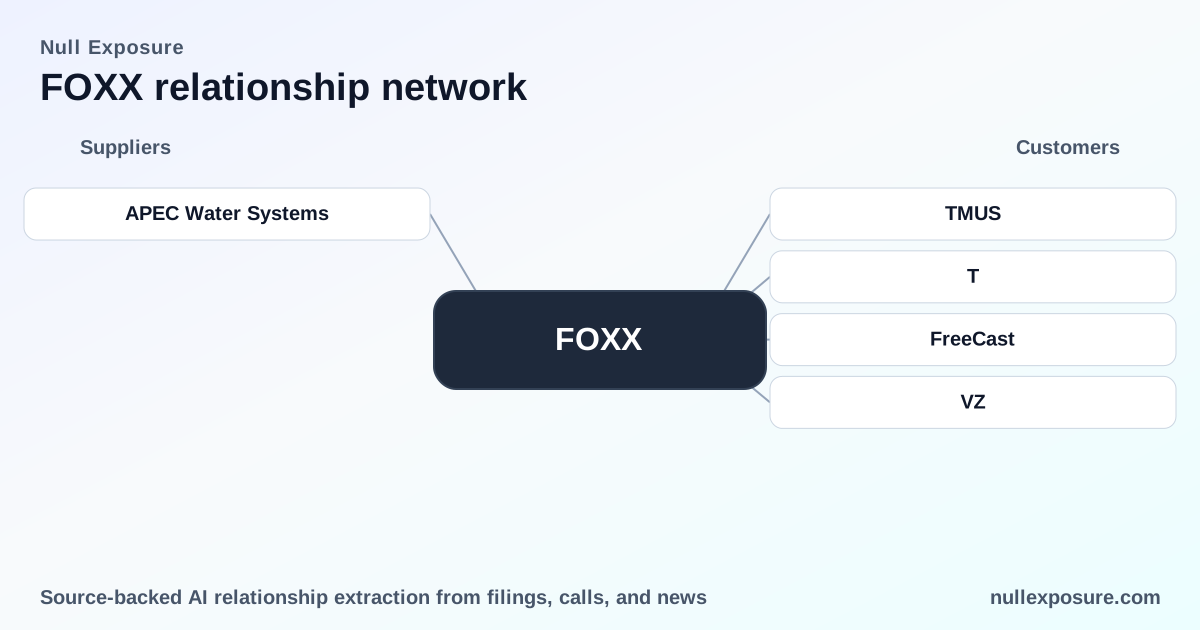
Foxx’s 10‑K states the company’s customers are primarily wholesale distributors who sell Foxx-branded products into U.S. public channels and to major carriers such as T‑Mobile, AT&T, and Verizon, with direct e‑commerce and app-service revenue as secondary streams. According to the company’s Form 10‑K for fiscal 2025, all revenues and long‑lived assets are U.S.-based, reinforcing a single‑market operating posture that amplifies domestic macro and carrier-channel risk.
Relationship-by-relationship readout
T‑Mobile / TMUS (dual mentions in filings)
Foxx explicitly names T‑Mobile among the major carriers that receive Foxx‑branded products through its distributor channels; the 10‑K lists T‑Mobile/TMUS alongside AT&T and Verizon as key carrier partners for U.S. public channels. According to Foxx’s fiscal 2025 Form 10‑K, distributors sell Foxx products into major carrier channels including T‑Mobile (FY2025 10‑K).
Source: Foxx Development Holdings, Form 10‑K for fiscal year ended June 30, 2025.
AT&T (T)
AT&T is called out in the same disclosure as a major carrier customer reached via Foxx’s distributor network, indicating Foxx targets national wireless carriers as part of its channel strategy. This reference is contained in the company’s FY2025 Form 10‑K customer description.
Source: Foxx Development Holdings, Form 10‑K for fiscal year ended June 30, 2025.
Verizon (VZ)
Verizon is listed alongside other national carriers as a recipient channel for Foxx-branded devices sold through wholesale distributors, underscoring Foxx’s reliance on national carrier retail and service channels for scale. The mention appears in the FY2025 Form 10‑K.
Source: Foxx Development Holdings, Form 10‑K for fiscal year ended June 30, 2025.
FreeCast (distribution agreement reported in media)
Foxx announced a distribution agreement with FreeCast in February 2025, signaling a non-carrier channel partnership to broaden distribution for Foxx products; the arrangement was reported in media outlets and surfaced in news sentiment feeds in early 2025. This was covered in press reporting on February 10, 2025.
Source: Business Insider coverage as aggregated in FOXX news sentiment (Feb 10, 2025).
What the contract and counterparty signals imply for operators and investors
- Contracting posture: Foxx operates largely through wholesale distributor contracts rather than direct national-carrier procurement, which positions the company as a supplier to intermediaries rather than as a primary carrier vendor. That structure reduces direct procurement negotiation leverage but enables broader retail reach. Evidence: FY2025 10‑K description of distributor-led sales.
- Concentration and counterparty mix: The company discloses that three third‑party customers collectively accounted for 27%, 25% and 25% of revenue for the year ended June 30, 2025 (total revenues ~$65.9M), an acute concentration signal that elevates revenue volatility should one major partner reduce purchases. This is a company-level disclosure from the FY2025 reporting.
Key risk: losing or renegotiating a top customer would materially impair near‑term revenue. - Geographic footprint: All revenue and long‑lived assets are U.S.-based, concentrating economic exposure in a single national market and tying performance to U.S. carrier dynamics and retail cycles (company disclosure, FY2025 10‑K).
- Counterparty types and roles: The firm serves both individual e‑commerce buyers and wholesale distributors; it also reports app-service and ad-revenue share as ancillary services, implying a hybrid hardware-plus-services revenue stream that is not yet mature enough to offset hardware margin pressure.
- Segment exposure: The company’s primary economic engine is hardware sales, with services (app installation commissions and ad/revenue shares) as a secondary component, per the FY2025 narrative.
If you want a concise portfolio view of FOXX’s commercial links and risk posture, visit https://nullexposure.com/ for the full analytical product.
Operational maturity and criticality
Foxx is commercially established but financially immature: revenue scale is material for a microcap (~$62.3M TTM) but profitability metrics remain negative (EBITDA of -$8.7M and diluted EPS of -$2.26 TTM). The carrier and distributor relationships are operationally critical—distribution access to national carriers drives unit sales and visibility in the retail channel—yet the firm’s negotiating position is constrained by its small size relative to national carriers and by high insider ownership (~80%), which concentrates control but limits institutional investor presence.
Bottom line for investors
- Positive: Clear route-to-market through distributors into major U.S. carriers and diversified retail channels; services revenue provides optionality.
- Negative: High revenue concentration among a few third‑party customers, U.S.-only exposure, and persistent cash losses create execution risk if channel dynamics shift or if top customers change purchase patterns.
- Key monitorables: stability of distributor-carrier placements (T‑Mobile, AT&T, Verizon), progress on diversifying large-customer concentration, and margin expansion from services or higher-value hardware.
For investors and operators building exposure models, the practical takeaway is straightforward: value is a function of channel stability and concentration reduction. For ongoing coverage and deeper commercial mapping, see the FOXX profile at https://nullexposure.com/.