FOXXW: Carrier distribution and hardware sales powered a dramatic revenue step-up — concentrated, US-only, and contract-driven
Foxx Development Holdings runs a hardware-first commercial model: it designs and sells Foxx-branded mobile devices (phones, tablets, wearables) through wholesale distributors into U.S. public channels and into major carriers, while capturing incremental revenue from e‑commerce and app service commissions. The company monetizes primarily at point of sale by shipping devices under short-term wholesale arrangements and through revenue share on preinstalled app services. For institutional due diligence and relationship mapping visit https://nullexposure.com/.
How the customer model actually works — commercial posture and operating constraints
Foxx sells hardware into the channel via distributors that, in turn, supply national carriers and retail outlets. Contracts skew toward master/framework arrangements with MVNOs and short-term wholesale purchase orders that recognize revenue principally at delivery (FOB shipping point or destination) with payment terms typically between 30 and 90 days. All revenues and long-lived assets are U.S.-based, so Foxx’s commercial exposure is concentrated geographically in North America.
Key operational signals:
- Concentration is acute: management disclosed three new major wholesale customers accounted for 76% of sales in FY2025, a company-level signal of revenue dependence and customer-level negotiating leverage.
- Contracting posture mixes framework and transactional: the company cited master agreements with MVNOs (framework) while most wholesale transactions are point-in-time sales with short payment cycles.
- Product mix is hardware-led with ancillary services: primary revenue drivers are mobile phones, tablets and wearable electronics, with a smaller but present services line driven by app-install commissions and ad revenue share.
- U.S.-only footprint: all revenue and long-lived assets are reported as located in the United States, concentrating regulatory, market and carrier risk domestically.
- Profitability remains negative despite scale-up: FY2025 operating and net margins are negative and EBITDA is loss-making, indicating ongoing margin pressure while scale-up continues.
Customer roster: the carriers and how Foxx describes them
The FY2025 Form 10-K explicitly lists Foxx’s channel and carrier relationships. Below are every relationship pulled from the filing with a concise, plain‑English take and the source.
T-Mobile
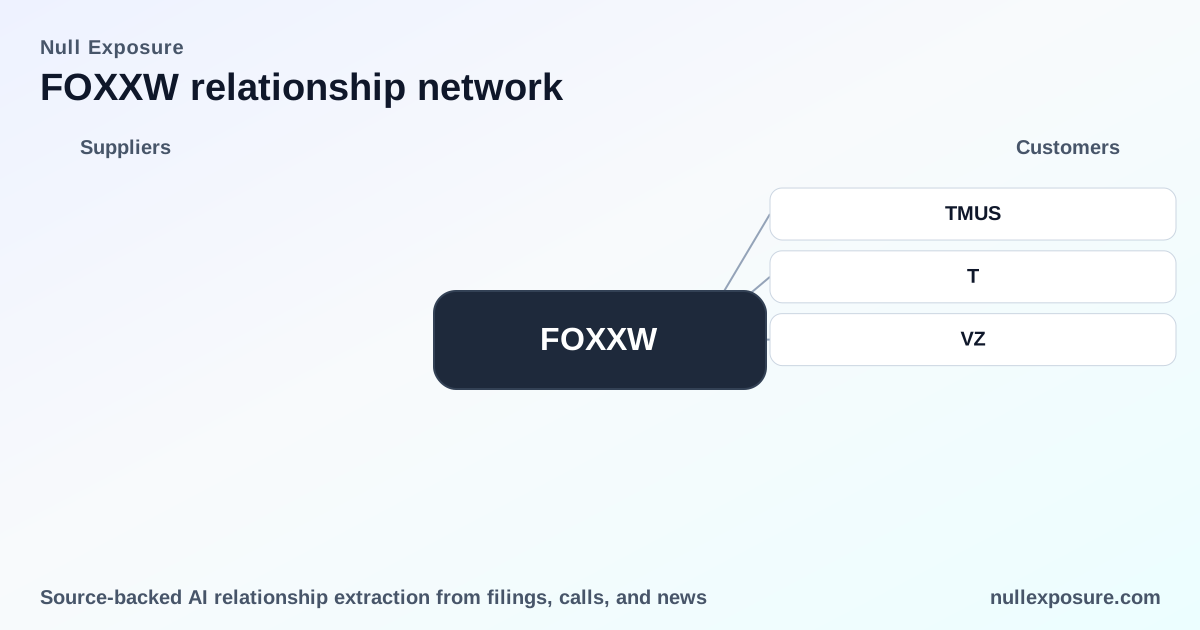
Foxx states that T‑Mobile is one of the major carriers served via distributors that sell Foxx-branded products into U.S. public channels and carrier channels. This relationship is reported in the company’s FY2025 Form 10‑K. (Source: Foxx Development Holdings, FY2025 Form 10‑K, year ended June 30, 2025.)
TMUS
The filing also surfaces the carrier under the ticker-style shorthand “TMUS”, reflecting the same inclusion of T‑Mobile among major carrier customers in the FY2025 10‑K. The record is effectively a second index entry in the filing’s customer list. (Source: Foxx Development Holdings, FY2025 Form 10‑K, year ended June 30, 2025.)
AT&T
AT&T is listed among the major U.S. carriers that receive Foxx-branded products through the company’s distributor network, positioning AT&T as a channel partner for Foxx hardware distribution. (Source: Foxx Development Holdings, FY2025 Form 10‑K, year ended June 30, 2025.)
Verizon
Verizon is likewise cited as a major carrier customer reached via wholesale distributors, completing Foxx’s declared set of the three principal national carrier relationships. (Source: Foxx Development Holdings, FY2025 Form 10‑K, year ended June 30, 2025.)
What the relationship map implies for revenue quality and risk
The carrier and distributor relationships underpin a rapid top-line expansion: Foxx reported revenue jumping from approximately $3.2 million in FY2024 to roughly $65.9 million in FY2025, driven by sales to three new major wholesale customers and launch of wearable products. That same filing signals very high customer concentration (three customers = 76% of sales), which converts commercial traction into material counterparty risk.
Operational and financial implications:
- Revenue is lumpy and concentrated — a small number of wholesale customers drive an outsized share of sales, which increases volatility and negotiating pressure on margins.
- Short-term, point-of-sale contracts limit visibility into recurring revenue, while master agreements with MVNOs provide strategic reach but not necessarily long-term revenue certainty.
- US-only exposure simplifies market assumptions but creates single-market sensitivity to carrier policies, supply-chain disruptions, or regulatory changes.
- Mix of hardware and app-service revenue offers margin diversification, but current profitability metrics (negative operating margin and negative EBITDA) indicate the hardware scale-up has not yet converted to net profits.
A compact view for investors: the firm is commercially validated by national carriers and distributors, but earnings quality is immature and concentrated, which elevates both upside if incumbents broaden distribution and downside if any major wholesale partner reduces orders.
Investment considerations — what to watch next
- Track quarterly revenue composition and whether the top-three customer concentration declines as channel distribution widens.
- Monitor gross margins on devices versus app/service revenue, since services can improve recurring cash flow and margin stability.
- Watch contract terms and any move from point-in-time sales to longer-term supply agreements; longer contracts would materially reduce revenue volatility.
- Evaluate cash runway and capital strategy given the FY2025 EBITDA loss and negative profitability metrics.
Key investor takeaways:
- Growth is real and carrier-backed, but reliance on a handful of wholesale customers is a major risk.
- Contract types are predominantly short-term wholesale, with MVNO master agreements providing strategic breadth but limited revenue duration certainty.
- Geographic concentration in the U.S. simplifies market exposure but concentrates regulatory and carrier risk.
For a structured relationship map and searchable filing excerpts, visit https://nullexposure.com/ for direct access to the underlying evidence and a relationship view.
Bottom line
Foxx Development has executed a rapid commercial scale-up into national carrier channels via distributors, turning hardware sales into substantial revenue in a single year. The commercial model monetizes primarily at device sale with ancillary services income, but revenue concentration and short-term contract dynamics create asymmetric risk until distribution broadens and margins improve. Investors should prioritize evidence of diversified wholesale bookings and margin stabilization to validate long-term valuation upside.