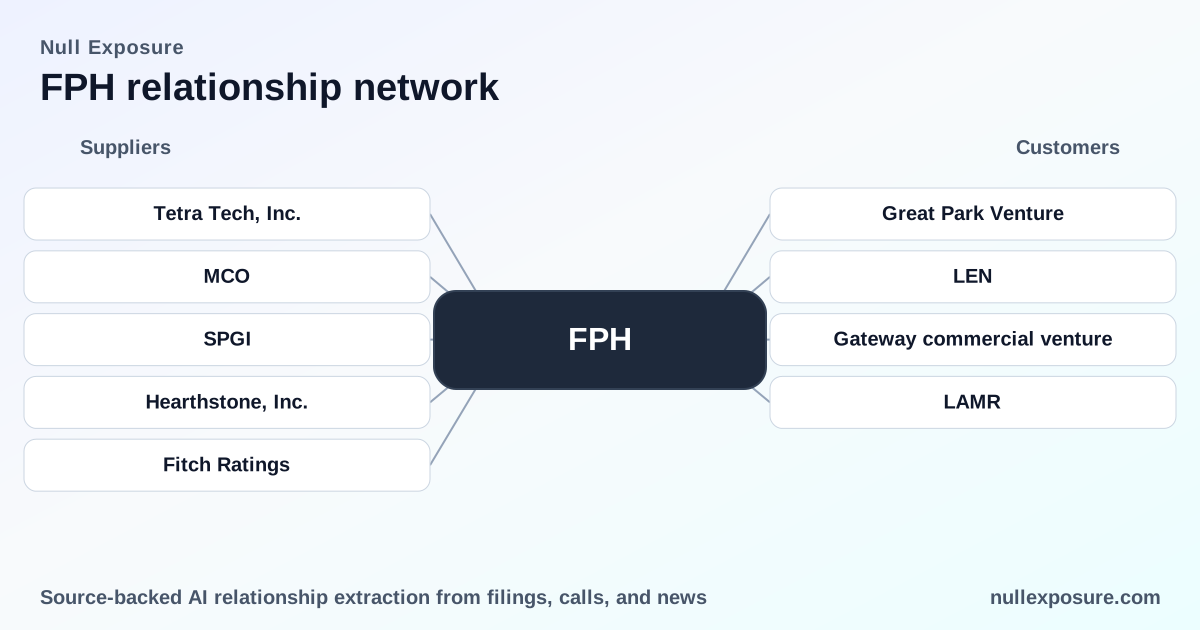
Five Point Holdings (FPH): The customer relationships that underwrite land sales and recurring fees
Five Point is a California master-planned-community developer that monetizes through two clearest levers: point-in-time land sales to homebuilders and commercial buyers, and ongoing development and property management fees tied to joint-venture ventures. Land transfers generate the bulk of transaction revenue when title passes at close of escrow, while management contracts deliver recurring, time‑recognized fees that include fixed and variable incentive components — a dual revenue model that concentrates cashflow risk around a handful of large counterparties. Learn more about the underlying customer relationships and sources at https://nullexposure.com/.
What to watch: contracts, concentration and the revenue mix
Five Point’s operating model blends two contracting postures. Land sales are spot, high-ticket transactions recognized at a point in time, whereas management services are long‑duration engagements recognized over the service period and often contain incentive-based variable consideration. This structure creates a rhythm of lumpy revenue from land closings complemented by steadier but contractually driven service income.
Key operating signals for investors:
- Contract posture: Dual — spot land sales and long‑term services with fixed and variable components (source: company disclosures on revenue recognition).
- Geography: Concentrated in California — the business is essentially a West Coast, U.S. play (company 10‑K disclosure).
- Concentration & criticality: Customer concentration is material; the Great Park Venture accounted for a very large share of consolidated revenue in recent periods (company filings).
- Roles: Five Point is both a seller of real estate and a service provider to venture partners, increasing counterparty interdependence.
- Spend scale: Management services to related ventures sit in the tens of millions per year (reported management services amounts).
These characteristics create levered exposure to a small set of counterparties: when land markets slow, the service revenue buffer matters; when a major JV pauses activity, both revenue lines suffer.
Customer map: the relationships you need on the radar
Great Park Venture — the single most consequential customer
Five Point receives substantial management fees and incentive compensation from the Great Park Venture; recent filings show the Great Park accounted for a material portion of consolidated revenues (roughly 40% in FY2024) and generated tens of millions of management revenue, including incentive payments reported in FY2026 results. According to Five Point’s FY2024 disclosures and subsequent earnings comments, the development management agreement with Great Park drives recurring service revenue and incentive compensation that materially affects consolidated performance (sources: Five Point 2024 Form 10‑K; FY2026 earnings commentary reported in InsiderMonkey and TradingView).
Gateway commercial venture — commercial campus and property services
Five Point’s Commercial segment historically included the Gateway Commercial Venture, which encompassed ownership interests in the Five Point Gateway Campus and property-management services provided by the management company. That commercial relationship contributed both operating results and management-fee income prior to dispositions disclosed in late 2024 (source: Q2 FY2021 earnings transcript and FY2026 market reporting on segment composition).
LEN — significant builder counterparty (reported as LEN)
Five Point reports regular sales of homesites to Lennar and its affiliates, and Lennar is identified as a sizable equity owner and buyer. Company disclosures state that Five Point has sold homesites to Lennar and expects to continue doing so, reflecting an ongoing commercial pipeline with that builder (source: Five Point 2024 Form 10‑K).
Lennar — large homebuilder buyer and equity partner
Independent reporting reiterates that builders, including Lennar, have purchased thousands of homesites across Five Point communities; a January 2026 profile notes that 9,400 homesites have been sold to builders, including Lennar, as of September 2025, underscoring Lennar’s role as a recurring buyer of finished lots (source: The Real Deal, January 2026).
Gateway Commercial Venture — management services and commercial operations
Separately reported in FY2026 market coverage, the Gateway Commercial Venture’s operating results have been consolidated under Five Point’s Commercial segment and included property‑management services performed by the management company; these services historically supplemented land-sale revenue with recurring fees (source: MarketScreener FY2026 earnings flash).
LAMR — shareholder and large purchaser (ticker reference)
Five Point’s relationship with Lamar (ticker LAMR) is notable because Lamar is described in 2021 earnings commentary as a major shareholder and a significant buyer of homesites in Valencia and Great Park communities, reflecting both strategic ownership and purchaser behavior that aligns interests across capital and operations (source: Q2 FY2021 earnings transcript published by The Motley Fool).
Lamar — strategic owner and home‑site buyer
Earnings commentary explicitly identifies Lamar as the largest shareholder and a top buyer of Five Point home sites, with an established history of investment in the Valencia and Great Park communities; that alignment reduces market friction and supports off‑take stability for certain neighborhoods (source: Q2 FY2021 earnings transcript).
WBI — reimbursing counterparty for services
A U.S. SEC filing for WBI indicates that Five Point provides geographic information services and legal support to WBI, with WBI reimbursing Five Point for usage — an example of the company’s ancillary service revenues outside pure land sales (source: SEC filing by WBI, FY2025).
What these relationships imply for investors
- Revenue concentration is real and quantifiable. The Great Park Venture’s contribution to consolidated revenue (reported at material percentages in recent years) makes Five Point’s topline sensitive to JV decisions and development pacing. The company’s own disclosures list the Great Park Venture as a major customer across multiple years (source: Five Point 2024 Form 10‑K).
- Dual revenue streams diversify timing but not counterparty risk. Land sales deliver cash in lumps; management fees smooth recognition, but both streams rely on a small pool of builders and venture partners. The accounting underscores this mix — land sales recognized at point of title transfer, management services over time with variable components.
- Operational dependence on California demand. The company’s projects and most customer contracts are California‑centric, concentrating economic exposure to the state’s housing cycle.
- Counterparty alignment through equity stakes reduces transactional uncertainty. Where counterparties are also shareholders or long‑term partners (e.g., Lamar, Lennar), commercial relationships carry strategic alignment that lowers execution risk but increases interdependent downside if local housing demand weakens.
For a detailed, single‑source view of these customer relationships and their revenue impact, visit https://nullexposure.com/. If you’re building a model, treat management services as a recurring but contractually contingent line and land sales as lumpy volume-driven cash events; stress tests should include a slowdown in homesite offtake and a pause in incentive compensation tied to the Great Park Venture.
Bold, transparent customer exposures define Five Point’s risk‑return profile: highly concentrated counterparty revenue with a hybrid mix of spot land receipts and long‑dated management fees that together determine near‑term cash flow volatility and medium‑term growth prospects.