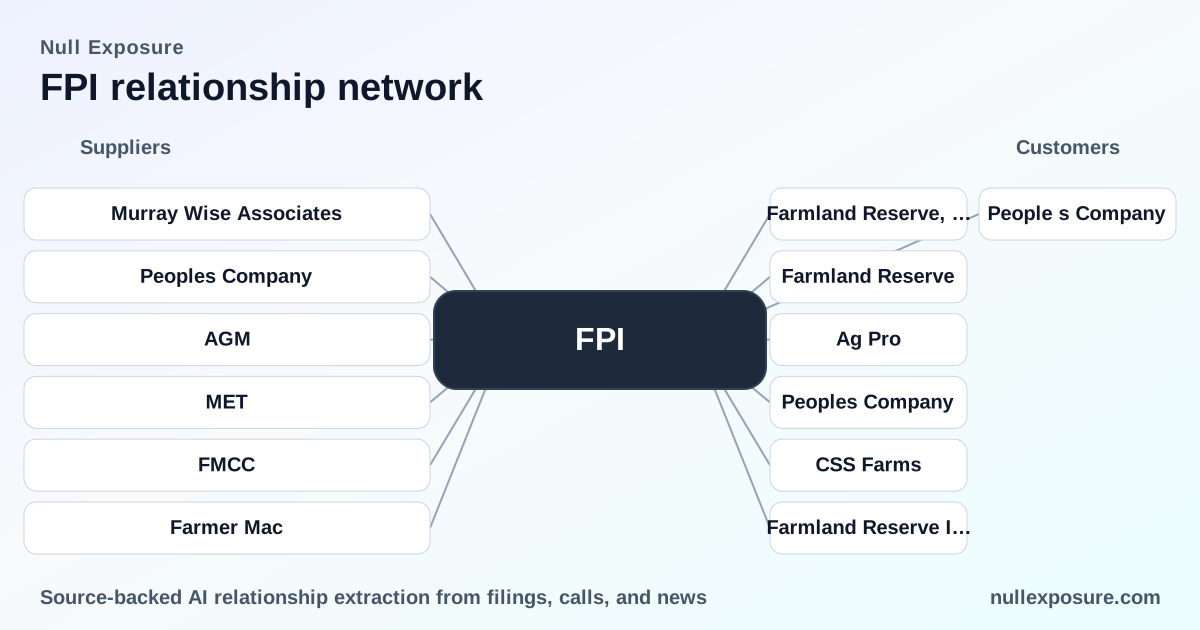
Farmland Partners (FPI): Customer relationships that shape asset liquidity and cash flow
Farmland Partners operates as an institutional farmland owner and manager, monetizing through rental income, selective property dispositions, and fee-based services including property management, brokerage and auction services. The company’s cash flow profile mixes short-duration farm leases with occasional long-term or large-sale transactions, creating a hybrid REIT that earns steady rent while unlocking value through asset sales and third‑party services. For an evidence-backed view of counterparties and operating constraints, read on — or visit https://nullexposure.com/ to explore the source collection supporting this analysis.
Why the counterparty roster matters to investors
Farmland Partners’ counterparties determine re-leasing risk, revenue concentration and the optionality from selling high-quality assets. High-frequency, short-duration farm leases produce recurring rent but increase churn and re-leasing exposure; large institutional buyers can compress transaction risk and accelerate balance-sheet deleveraging. The following section catalogs every relationship reflected in our coverage and gives a concise investment-relevant read on each.
Counterparty map: who FPI is transacting and working with
-
Farmland Reserve / Farmland Reserve, Inc.
- Farmland Reserve acted as the buyer in a major disposition of farmland from Farmland Partners, acquiring dozens of farms across multiple states in a transaction reported at roughly $289 million; this is a meaningful liquidity event that reduces portfolio scale while crystallizing asset value (Deseret News, Oct 2024; GlobalAgInvesting, 2024; OK Energy Today, 2024; Bisnow, 2024: https://www.deseret.com/business/2024/10/14/latter-day-saint-investment-auxiliary-farmland-reserve-agrees-to-buy-46-farms-in-eight-states/).
- Sources: Deseret News (Oct 2024), GlobalAgInvesting (2024), OK Energy Today (Oct 2024), Bisnow (2024).
-
Ag Pro (John Deere dealerships)
- Farmland Partners owns land and buildings for four agricultural equipment dealerships in Ohio that are leased to Ag Pro under the John Deere brand, providing a diversified rent stream outside core row-crop tenancy and anchoring cash flow with a national equipment retailer (company announcement/Yahoo Finance and Investing.com summaries, FY2025–FY2026; see https://sg.finance.yahoo.com/news/farmland-partners-inc-announces-date-220000106.html).
- Sources: Yahoo Finance (company release), Investing.com (FY2025 disclosure).
-
Peoples Company (also referenced as People s Company in some transcripts)
- FPI sold its brokerage/auction/asset management subsidiary MWA to Peoples Company but continues a close commercial relationship with the buyer and with the former MWA team, signaling ongoing service-level ties and transition-managed revenue flows (earnings call/transcript, FY2026; see The Globe and Mail and InsiderMonkey coverage, 2026: https://www.theglobeandmail.com/investing/markets/stocks/MET/pressreleases/370841/farmland-partners-fpi-earnings-transcript/).
- Sources: The Globe and Mail (FY2026 earnings transcript), InsiderMonkey (FY2026 transcript coverage).
-
CSS Farms
- Specific parcels acquired by Farmland Partners are rented to CSS Farms, identified as a major potato grower and chip supplier, which represents a large-enterprise tenant for those assets and underpins crop-specific cash flows on those leases (GlobalAgInvesting acquisition coverage, FY2022: https://globalaginvesting.com/farmland-partners-acquires-3843-acre-texas-farm-12-1m/).
- Source: GlobalAgInvesting (FY2022).
What the relationship mix implies about FPI’s operating model
Farmland Partners runs a blended operating posture that combines landlord licensing with active asset sales and third-party services:
- Contracting posture and duration mix: Filings and disclosures state that the bulk of farm leases are 1–3 years, while a minority of leases (for example, renewable-energy or some specialized arrangements) extend much longer, up to 40 years. This produces a dominant short-term lease profile with pockets of long-duration tenancy that stabilize specific assets.
- Concentration and materiality: Management warns that a failure of a significant tenant or inability to re-lease land could have a material adverse effect on performance, signaling meaningful tenant concentration risk at the portfolio or regional level rather than purely idiosyncratic tenant turnover.
- Counterparty composition: The company has large-enterprise permanent-crop relationships in certain markets (e.g., California), while most tenant counterparties are working farms on short leases — a mix that balances predictable revenue against re-leasing sensitivity.
- Service model and maturity: FPI is not a passive landlord only; it provides property management, brokerage and auction services, and agricultural lending, and as of year-end 2024 it managed roughly 48,300 acres on behalf of third parties, indicating a mid-stage services business layered onto its ownership model.
- Transaction scale: Public reporting and press coverage document nine-figure asset sales (the ~ $289M sale to Farmland Reserve), while the company’s rent-roll disclosures list multi-year fixed rent streams in the tens of thousands to hundreds of thousands in reported figures — together these suggest both large-cap disposal capability and recurring operating income.
(These are company-level signals drawn from filings and press excerpts; they are not assigned to specific counterparties unless the excerpt explicitly names them.)
Investor takeaways: risk, optionality and valuation implications
- Income predictability is mixed. The prevalence of 1–3 year farm leases delivers recurring rent but increases re-leasing volatility; investors should model higher turnover and variable renewal pricing into near-term cash-flow scenarios.
- Balance-sheet levers are real. Large institutional buyers like Farmland Reserve provide a clear exit channel to crystallize gains and reduce exposure; successful asset sales materially influence leverage and dividend capacity.
- Service operations underpin fee income and relationship depth. The retained relationship with Peoples Company after the MWA sale demonstrates FPI’s ability to harvest services revenue even when divesting operating subsidiaries.
- Concentration warrants monitoring. Management’s own disclosure flags tenant concentration as material — underwriting should stress-test scenarios where one or more large tenants reduce footprint or renegotiate rents.
How to use this intelligence
- For valuation work: treat short-lease rollover risk as a near-term volatility factor, offset by demonstrated ability to execute large dispositions.
- For operational diligence: focus on regional tenant concentration metrics and the health of large enterprise growers in California and other high-value markets.
- For credit analysis: incorporate service revenues and third-party management fees as moderate diversification but place primary emphasis on rent-roll stability and demonstrated sale proceeds.
For a deeper, source-level dossier and to monitor evolving counterparties and constraints, visit https://nullexposure.com/.
Bottom line
Farmland Partners is a hybrid landlord and services operator whose earnings profile combines short-term lease cash flow with the occasional large, balance-sheet‑shifting property sale. Its counterparty set spans national equipment lessees, large agricultural operators and institutional land buyers, creating both predictable rent streams and meaningful transaction optionality — but also concentration and re‑lease risk that investors must quantify in any valuation or credit analysis.