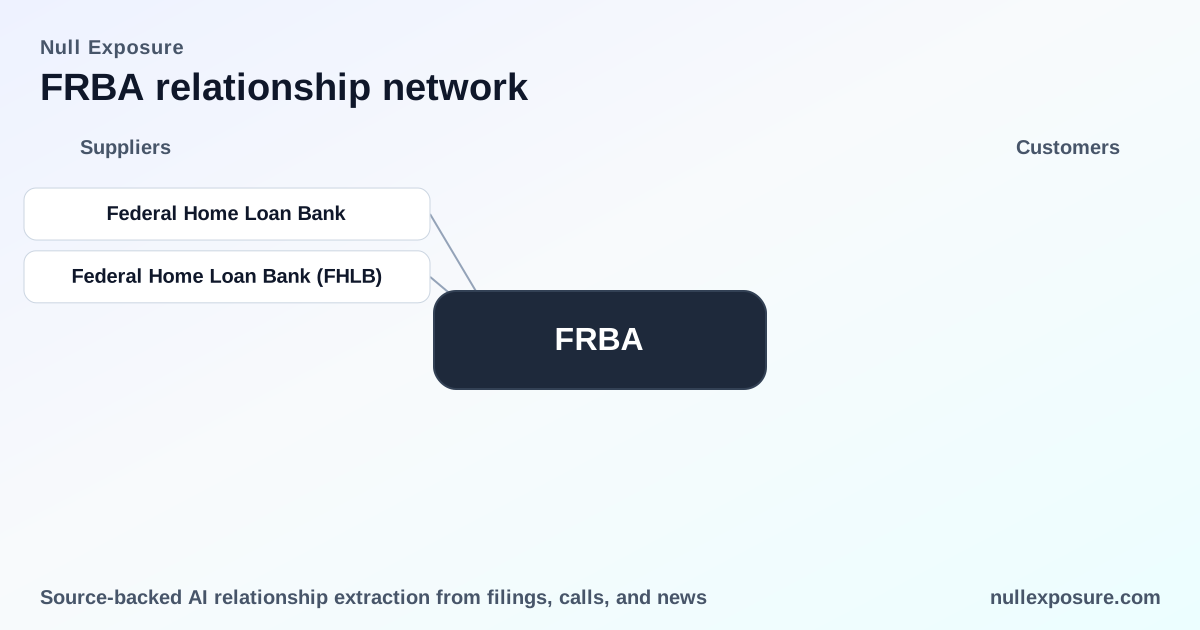
FRBA: The hidden plumbing of bank liquidity and what counterparty filings reveal
FRBA functions as a wholesale liquidity conduit for chartered banks, accepting collateralized pledges and extending advances that are priced as interest-bearing borrowings; the institution monetizes through interest differentials on secured advances and by supporting banks’ balance sheet management. For investors and operators assessing FRBA customer relationships, the filings show a consistent role as a secured lender of last resort for member banks, used to manage funding, liquidity and seasonal loan demand. Learn more about how we track these relationships at https://nullexposure.com/.
Operational thesis and why it matters to capital allocators FRBA’s business model is defined by three characteristics that drive earnings and risk:
- Collateralized contracting posture: counterparties pledge loans, leases and other assets to secure advances, which constrains credit exposure and supports recoverability.
- High counterparty criticality but low revenue concentration: many regional and specialty banks list FRBA advances alongside FHLB facilities as staple sources of secured wholesale funding, making FRBA critical for bank liquidity without over-dependence on any single customer.
- Stable, mature funding role: references in FY2024–FY2026 filings show FRBA functioning as a routine liquidity backstop rather than an episodic emergency lender, indicating predictable utilization and manageable credit-turnover dynamics.
Together these characteristics define FRBA as a low-margin, volume-driven liquidity provider whose earnings profile and capital usage depend on the scale and tenor of advances outstanding and the quality of pledged collateral.
How counterparties reference FRBA — an overview of the sample set The following company-level relationships were identified in filings and public releases dated FY2024–FY2026. Each entry below gives a concise, investor-focused take on how that institution uses FRBA funding and the context reported.
HTB HTB’s FY2024 10‑K discloses that commercial construction loans, indirect auto loans and municipal leases are pledged as collateral to secure outstanding FRB advances, indicating secured borrowing against diversified asset types. According to HTB’s FY2024 filing, the bank uses FRB advances as part of its collateralized wholesale funding mix.
PEBO (Peoples) Peoples’ FY2024 10‑K notes that its primary sources of secured wholesale funding are the FHLB of Cincinnati and the FRB, signaling that FRB advances are a core, not ancillary, component of the bank’s liquidity strategy. The filing frames FRB access as a routine element of the bank’s funding stack.
CFBK (CF Bankshares / CFBank) A corporate press release for CF Bankshares (FY2026 results) lists FHLB and FRB stock/borrowings in its funding summary, showing active use of both facilities in the bank’s funding profile. The company’s commentary in FY2026 highlights FRB exposures in the context of overall wholesale funding levels.
BRBS (Blue Ridge Bankshares) Blue Ridge’s FY2025 results disclose interest expense on FHLB and FRB borrowings, confirming FRB advances are an economic funding source that directly impacts net interest margin through borrowing costs. The FY2025 release reports FRB interest as a line-item within funding expenses.
ALLY (Ally Financial) Ally’s FY2026 material event filing reports unused pledged borrowing capacity at the FRB of $27.0 billion, establishing that Ally maintains substantial standby access to FRB advances alongside FHLB capacity. The disclosure positions the FRB facility as strategic contingent liquidity for a large, non‑bank-originator balance sheet.
CPBI (Central Plains Bancshares) Central Plains’ FY2026 10‑Q states the company is prepared to access FHLB and FRB advances if necessary to support additional loan funding, portraying FRB advances as a planned source of incremental loan supply rather than emergency funding.
FHB (First Hawaiian) First Hawaiian’s FY2026 report shows a strong liquidity position with borrowing capacity of $3.3 billion each from the FHLB and FRB, demonstrating FRB capacity is a material component of the bank’s assessed liquidity runway and contingency plans.
What these relationships reveal about FRBA’s operating model The cross‑section of bank disclosures yields several company-level signals about FRBA as a counterparty:
- Secured lending is the default contracting posture. Multiple filings explicitly describe pledged loans and leases securing FRB advances, indicating FRBA operates on asset-collateralized terms that reduce unsecured credit exposure.
- Broad, diversified customer base across regional and national banks. The sample spans community banks (HTB, BRBS, CPBI), regional players (FHB) and large specialty lenders (ALLY), evidencing a distribution of client types that lowers client concentration risk.
- Critical to routine liquidity management. Firms list FRB advances alongside FHLB funding as primary or standby sources, underscoring FRBA’s embedded role in normal funding strategies rather than just crisis backstops.
- Mature contractual relationships with predictable usage patterns. Fiscal-year disclosures from 2024–2026 treat FRBA access as standard operating practice, supporting the view of steady, repeatable advance flow rather than episodic spikes.
Key investment implications — drivers and risks
- Driver: predictable, fee‑less interest income from secured advances. FRBA captures yield spread on advances relative to its cost of funds; broad usage by banks supports a stable volume base.
- Risk: collateral quality and systemic liquidity shocks. While collateralization mitigates credit loss, a sectorwide deterioration in pledged asset values or simultaneous margin calls would pressure recoverability and utilization patterns.
- Counterparty diversification is a strength. The range of banks citing FRB access reduces dependence on any single client sector and limits concentration risk to geographic or asset-type clusters rather than to one large counterparty.
Practical takeaways for investors and bank operators
- Monitor pledged collateral composition disclosed by counterparties (construction, auto loans, municipal leases) as a forward indicator of collateral risk exposure across the FRB loan book.
- Track unused borrowing capacity in large counterparties (for example, Ally’s FY2026 disclosure of $27.0 billion unused capacity) to gauge systemic reliance and optionality across the banking sector.
- Incorporate FRB/FHLB usage trends into liquidity stress tests because these facilities are treated as core funding sources by a broad set of institutions.
If you evaluate funding counterparties or manage bank liquidity relationships, FRBA’s pattern of secured, broadly distributed advances defines it as a predictable and central piece of the U.S. wholesale funding ecosystem. For a consolidated view of how these counterparty disclosures evolve across filings and press releases, visit https://nullexposure.com/ for our tracking and analytics.
Data sources referenced in this note include HTB’s FY2024 10‑K; PEBO’s FY2024 10‑K; CF Bankshares’ FY2026 press release; Blue Ridge Bankshares’ FY2025 results release; Ally Financial’s FY2026 material event filing; Central Plains Bancshares’ FY2026 10‑Q; and First Hawaiian’s FY2026 report.