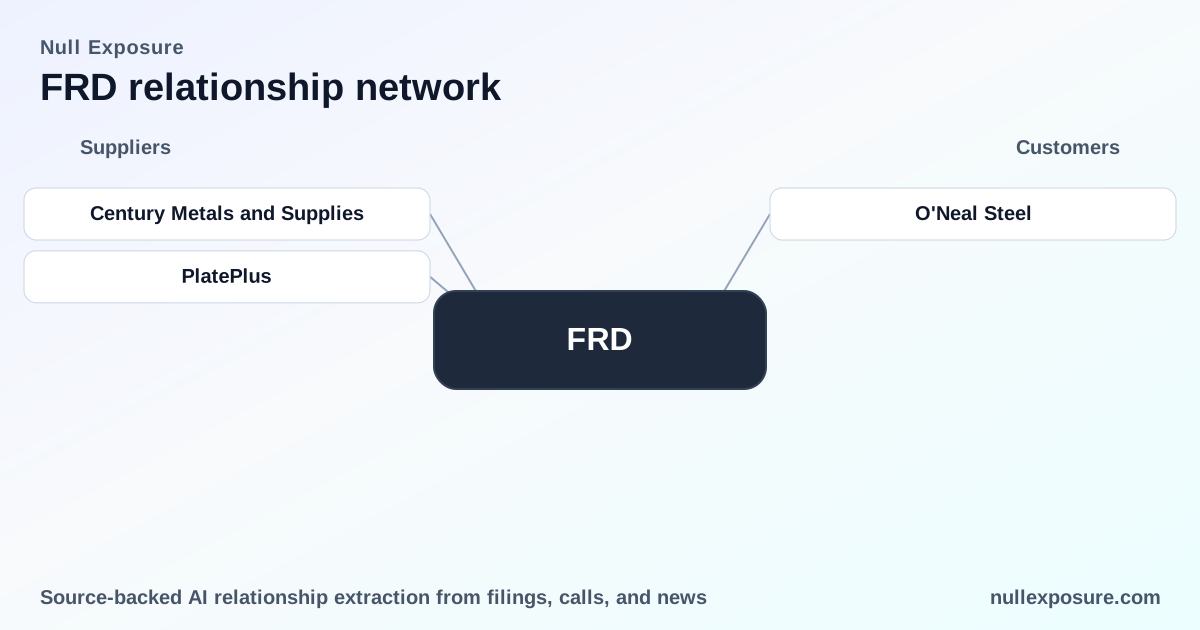
Friedman Industries (FRD): Customer Relationships That Drive Revenue — and Risk
Friedman Industries operates as a regional steel processor and distributor, monetizing through sales of flat-roll steel, pipe fabrication, processing and storage services to a broad base of industrial buyers across the U.S. Its revenue model is transactional and volume-driven: Friedman converts coil purchases into tailored product and just-in-time shipments for industrial customers and distributors, capturing margin on processing and distribution. For investors and operators, the central thesis is simple: steady commodity-volume throughput plus selective customer concentration creates modest margin upside but meaningful counterparty and delivery risks. For a concise view of Friedman’s customer signals and commercial risks, see NullExposure’s analytics: https://nullexposure.com/.
Overview and financial context
Friedman reported Revenue TTM of $584.35 million and a market capitalization near $145.5 million, operating with thin but positive margins (profit margin ~2.7%, operating margin ~2.3%). The business trades at a trailing P/E of 9.3 and an EV/EBITDA of ~8.7, reflecting a capital-light processing model with sensitivity to steel pricing and volumes. The customer base is large in count—roughly 442 customers—but the dynamics are not purely diversified: contractual posture, geographic concentration, and a handful of material buyers define operational risk.
What the filings say about how Friedman sells (company-level signals)
The company’s public disclosure frames the operating model and contracting posture in plain terms:
- Friedman sells flat-roll products “on a wholesale, rapid-delivery basis in competition with other processors of hot-rolled steel coils,” which signals predominantly short-term, transaction-oriented contracts rather than long-term purchase commitments. This is a company-level operating characteristic drawn directly from the 10‑K narrative.
- The customer footprint is national but regionally concentrated: Friedman serves approximately 442 customers located primarily in the midwestern, southwestern and southeastern United States, indicating regional market exposure and reliance on domestic demand corridors.
- The filing describes Friedman as a seller to industrial buyers and distributors, establishing its role as a supplier (seller) rather than an end-user buyer.
Together these company-level constraints indicate a playbook built on volume throughput, rapid-turn inventory, and price-competitive delivery: low contractual duration, regional concentration, and buyer-facing commercial posture.
Key customer relationship: O’Neal Steel
O’Neal Steel is Friedman's single disclosed material customer in the FY2025 filing. The company’s Form 10‑K states that sales of flat-roll products to O’Neal Steel accounted for approximately 16% of Friedman’s total sales for both fiscal years 2025 and 2024, signaling a meaningful revenue dependency on this one distributor across consecutive years. This is reported in Friedman’s FY2025 Form 10‑K filing (fiscal year ended March 31, 2025).
Why that 16% figure matters
A single counterparty accounting for roughly one-sixth of sales is material for an industrial processor operating with short-term commercial arrangements. That level of concentration creates two practical pressures:
- Operational: fulfillment and logistics must be agile to meet rapid-delivery expectations for a large distributor like O’Neal, increasing the importance of scheduling, inventory positioning, and working capital management.
- Commercial: pricing and leverage tilt to the buyer in short-term markets; losing or materially changing terms with a 16% customer would compress volumes and earnings quickly.
Constraints and operating-model implications for investors and operators
Interpret these filing-extracted signals as characteristics of Friedman’s business model rather than isolated facts about any single customer:
- Contracting posture — short-term and transactional. The 10‑K explicitly notes Friedman’s wholesale, rapid-delivery competition against other processors, so the company’s revenue is tied to spot or near-term price and volume dynamics rather than locked multi-year contracts.
- Concentration profile — moderate concentration despite a broad customer count. While Friedman sells to hundreds of customers, the disclosure of a 16% relationship with O’Neal shows that a handful of large distributors can dominate volume, increasing earnings volatility if trade terms or demand change.
- Geographic exposure — regional U.S. dependence. Customers cluster in the midwestern, southwestern and southeastern regions, so regional macro or industrial slowdowns will meaningfully affect Friedman’s volumes relative to a fully national or international footprint.
- Relationship role and criticality — seller-to-distributor model, criticality weighted by buyer scale. Friedman acts as a supplier; its value to large distributors is logistics and processing speed, making operational execution (fulfillment accuracy, on-time delivery) a differentiator and potential single-point weakness.
- Maturity and bargaining power — established commercial pathways but limited strategic pricing power. The combination of commodity-based product, short-term contracts, and distributor buyers implies margins will track commodity cycles and competitive delivery economics.
Operational and financial read-throughs
For operators: prioritize inventory turns, distribution routing, and customer service systems that support rapid-delivery commitments. Given the concentration in a few large buyers, contract terms that protect margin and payment timing are critical—even small slippage in payment or delivery performance can cascade.
For investors: Friedman’s fundamentals show positive operating income and a modest return profile (ROE ~11.6%), but earnings are sensitive to customer volume shifts and steel price volatility. The material exposure to O’Neal (16%) is a primary lens for downside scenarios: a loss or severe terms change with that partner would reduce top-line and magnify margin compression given fixed processing overhead.
Actionable takeaways
- Concentration is real and material — O’Neal’s ~16% share is an important risk factor for scenario analysis and downside stress tests. (Friedman Form 10‑K, FY2025.)
- Contracts are short-term — revenue depends on rapid-turn sales and competitive delivery rather than long-term locked pricing, increasing cyclicality. (10‑K disclosure on wholesale, rapid-delivery sales.)
- Regional exposure matters — industrial health in the midwest, southwest and southeast will disproportionately affect Friedman’s volumes.
- Operational execution is the moat — consistent delivery and processing speed are the primary differentiators against competing processors.
If you would like a deeper customer-concentration dashboard or a comparator analysis against peer steel processors, visit NullExposure for targeted analytics and sector coverage: https://nullexposure.com/.
Conclusion
Friedman Industries is a volume-centric steel processor with a transactional revenue model, meaningful regional concentration, and at least one material distributor relationship that accounts for ~16% of sales. For investors, the stock’s valuation metrics reflect this profile: modest margins, cyclical sensitivity, and concentrated counterparty exposure. For operators, the playbook is straightforward—optimize fulfillment, protect margin through trading discipline, and cultivate broader distribution channels to mitigate single-customer risk. The company’s filings provide direct, actionable signals; use them to prioritize operational KPIs and scenario planning.