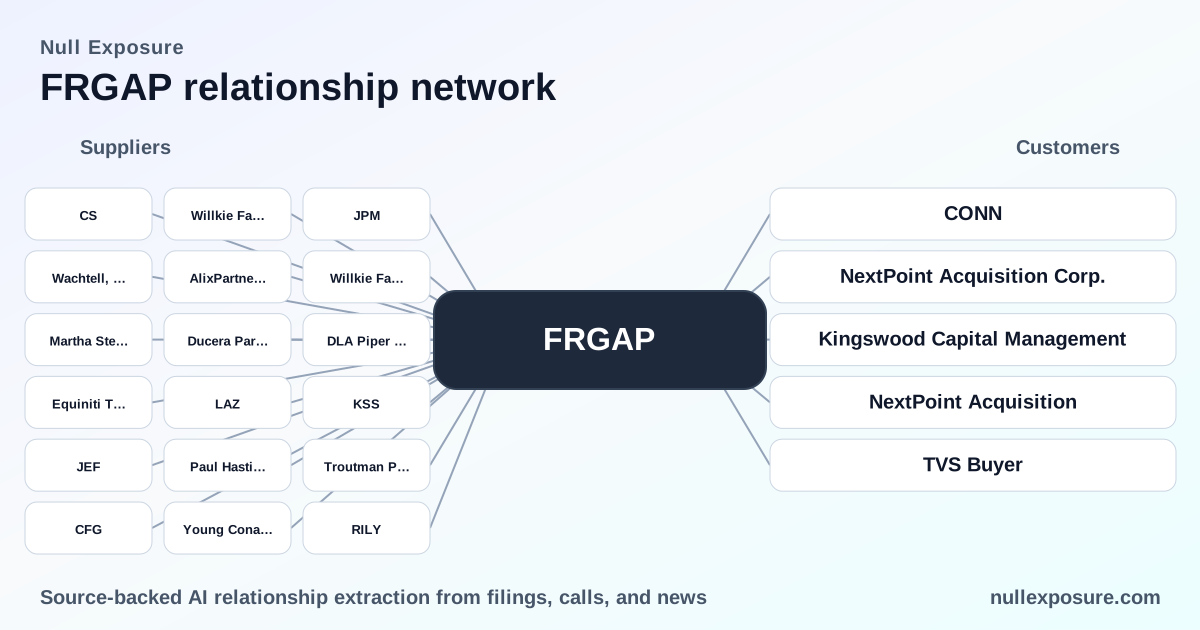
FRGAP customer relationships: what buyers, acquirers and bankruptcy filings reveal about exposure
Franchise Group (trading as FRGAP) operates as a holding company that acquires, operates and monetizes branded retail and services businesses through a blend of operating cash flow, strategic divestitures and opportunistic asset sales. Its monetization rhythm is as much driven by one-off transaction proceeds and restructurings as by ongoing retail operations, so investors should evaluate exposure through transaction counterparties, court filings and private-equity buyers as much as through recurring retail customers. This note summarizes every customer/transaction relationship surfaced in recent coverage and draws implications for concentration, contracting posture, criticality and the maturity of those ties. For a broader exposure analysis visit https://nullexposure.com/.
Snapshot thesis: transactional counterparties dominate FRGAP's customer footprint
FRGAP’s visible counterparty universe in public reporting is dominated by buyers and financial sponsors (private equity and SPACs) and by distressed retail counterparties; recurring, long-term commercial customers are not prominent in the public record. That structure produces a revenue and cash-flow profile that leans on asset sales and restructurings and therefore elevates counterparty credit and execution risk relative to purely retail-operating peers.
What the public relationships say — record-by-record review
- Performance Investment Partners — Retail Dive reported that Kingswood Capital Management and Performance Investment Partners agreed to acquire The Vitamin Shoppe from Franchise Group in May 2026, positioning Performance Investment Partners as a buyer of a FRGAP asset. This is a classic divestiture counterparty rather than an ongoing retail customer (Retail Dive, May 2, 2026).
- Conn’s Inc. (CONN) — AdvisorHub noted that Conn’s Inc. went bankrupt within months after buying rival W.S. Badcock from Franchise Group, linking a franchise divestiture to subsequent operator distress in FY2024; that sequence underlines execution and credit risk contagion among buyers of FRGAP assets (AdvisorHub, March 2026).
- NextPoint Acquisition Corp. — A GlobeNewswire press release from July 2021 records Franchise Group’s completion of the sale of Liberty Tax to NextPoint Acquisition Corp., with total consideration of approximately $249 million (about $182M cash + $67M in NextPoint shares), demonstrating FRGAP’s use of SPAC/financial-structure buyers to monetize non-core businesses (GlobeNewswire, July 2021).
- Kingswood Capital Management — Retail Dive and Bloomberg Law coverage identify Kingswood Capital Management as an equity investor in the buyer of The Vitamin Shoppe; Bloomberg Law named affiliates of Kingswood among equity investors in the transaction reported in March–May 2026, confirming private equity interest and signaling that buyers were financial sponsors rather than strategic retail partners (Retail Dive & Bloomberg Law, March–May 2026).
- TVS Buyer — Court filings cited by Bloomberg Law list the buyer of an asset simply as “TVS Buyer” in Franchise Group’s bankruptcy proceeding, indicating structured or special-purpose vehicle purchasers are working through FRGAP’s bankruptcy process and complicating transparency around ultimate owners (Bloomberg Law, March 2026).
- NextPoint Acquisition (alternate source) — A February 2021 SPAC-focused news release also recorded the Liberty Tax transaction into NextPoint’s platform, reinforcing that the Liberty Tax divestiture was executed via a SPAC combination as early as FY2021 (SPACConference News, Feb 2021).
- Kingswood Capital Management (Bloomberg Law) — Bloomberg Law specifically named Kingswood affiliates as equity investors in the buyer group for The Vitamin Shoppe, corroborating Retail Dive’s reporting and underscoring that the buyer base for these assets included institutional private equity backers (Bloomberg Law, March 2026).
(Note: the records above represent discrete public hits and news mentions tied to FRGAP asset sales, buyer identities and bankruptcy filings; each citation corresponds to the published report listed.)
What this relationship set implies about FRGAP’s operating and business model
- Contracting posture — transactional and asset-focused. The public relationships are primarily one-off sales and bankruptcy-related counterparties rather than long-term supply or license customers. That posture emphasizes deal execution and counterparty selection over recurring contract management.
- Concentration and counterparty profile. Buyers are concentrated in the financial sponsor and SPAC universe (Kingswood, Performance Investment Partners, NextPoint, special-purpose buyers). Concentration among PE and SPAC buyers increases exposure to sponsor credit cycles and financing windows.
- Criticality to operations — low recurring criticality, high transactional importance. These counterparties are critical at the moment of sale or restructuring but are not evidence of ongoing revenue-backbone customers; the firm’s near-term liquidity and valuation depend heavily on successful divestitures and bankruptcy process outcomes.
- Maturity and transparency signals. Several transactions date back to 2021 (Liberty Tax) while others are concentrated in 2025–2026 (Vitamin Shoppe sale, bankruptcy filings). The mix of multi-year activity plus opaque buyer vehicles (e.g., “TVS Buyer”) signals uneven transparency and limited public visibility into long-term counterparty commitments.
Bold takeaways: FRGAP’s customer universe as reported is dominated by acquirers and restructuring counterparties; valuation and cash-flow stability therefore hinge on execution of asset sales and the solvency of those acquirers.
Risk checklist for investors and operators
- Counterparty credit risk: buyers that are private equity or SPAC-backed can default on earn-outs or financing commitments.
- Execution and legal risk: bankruptcy process buyers (e.g., TVS Buyer) add complexity and potential drag on proceeds.
- Concentration risk: recurring revenue exposure is not visible in public records; asset-sale concentration elevates profile volatility.
- Transparency and governance: multiple buyers and special-purpose vehicles reduce clarity about long-term ownership and operational plans.
If you evaluate FRGAP for portfolio positioning, prioritize diligence around buyer financing proofs, court filings tied to bankruptcies, and the terms of recent divestitures.
Bottom line and next step
FRGAP’s public customer footprint is transaction-heavy, populated by private-equity sponsors, SPACs and court-identified buyers; that structure creates asymmetric exposure to deal execution and counterparty solvency rather than to retail demand stability. For a systematic exposure map and ongoing monitoring of counterparties and filings, visit https://nullexposure.com/ to view expanded tracking and alerts.