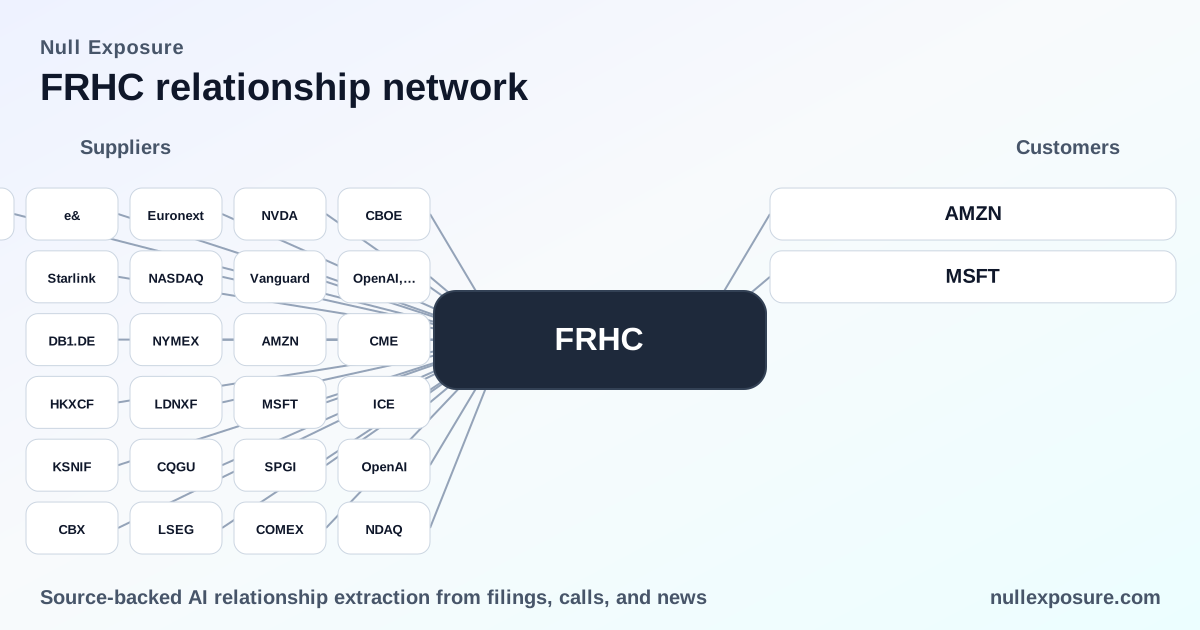
Freedom Holding Corp (FRHC): Customer Relationships and Strategic Implications
Freedom Holding Corp is a Kazakhstan‑headquartered financial conglomerate that monetizes through brokerage and banking franchises, margin lending, market‑making and expanding fee businesses — now extending into telecom and data‑center infrastructure to sell compute capacity to global cloud players. The company reports $1.49 billion in trailing revenue and large margin‑lending receivables (~$3.3 billion as of March 31, 2025), while a single market‑maker relationship accounted for 56% of fee and commission income in fiscal 2025. Investors evaluating FRHC should focus on concentration, cross‑border operational complexity, and the strategic pivot into infrastructure as a new customer channel. For a consolidated view of relationship signals, visit https://nullexposure.com/.
Business model in one paragraph: how customer relationships drive cash flow
Freedom’s core cash flow is generated by retail and institutional brokerage fees, interest income from margin loans, and commissions and market‑making revenues; these streams are supplemented by banking services from its regional bank and underwriting/transaction fees. The firm internalizes order flow, extends large margin lines, and operates omnibus relationships for institutional customers, creating a high‑velocity revenue mix that is sensitive to trading volumes and the health of its major market‑maker counterparties. The company’s recent public commentary and filings show it is deliberately redeploying capital into telecom and data‑center projects to capture new, non‑trading revenue streams from international cloud customers.
How FRHC contracts and who pays the bills
Freedom’s relationship signals show a mixed contracting posture. The company operates both long‑duration contracts (e.g., life/annuity products cited in corporate disclosures) and short‑duration brokerage and transactional relationships, indicating a hybrid revenue profile. Customer types span individual retail clients, SMEs, institutional market‑makers and government/municipal accounts, and operations are explicitly global — subsidiaries and representative offices cover EMEA, APAC and North America. Two company‑level constraints stand out as decisive: high revenue concentration (a single market‑maker driving a material share of fee income) and very large margin lending exposure (multi‑billion dollar receivables), both of which elevate counterparty importance and operational leverage.
Company‑level constraints that matter for investors
- Concentration and criticality: The market‑maker customer produced $284.7 million of fee and commission income in fiscal 2025, representing 56% of total fee and commission income — a critical dependency that directly affects results if that counterparty changes behavior.
- Material revenue buckets: Aggregate revenue from concentrated customers reached $317.5 million in fiscal 2025 (about 15% of total revenue), confirming that a handful of counterparties materially move reported results.
- Large credit exposure: Margin lending receivables of approximately $3.3 billion as of March 31, 2025 create sizable interest income opportunity and associated credit risk.
- Global footprint and regulatory complexity: Operating subsidiaries across Kazakhstan, Cyprus, the U.S., the U.K., and multiple former Soviet states implies cross‑jurisdictional regulatory and compliance overhead.
- Ownership concentration: Insider ownership is high (70.6% insiders), while institutional ownership is low (~3.9%), signaling founder/insider control over strategic direction and capital allocation.
- Relationship roles: Freedom acts both as a seller of financial products and a service provider for execution, custody and market‑making services — a dual role that increases both revenue potential and operational interdependence with large counterparties.
These constraints are company‑level signals derived from public disclosures and earnings detail rather than attributes of any single named third‑party relationship.
Named third‑party relationships and what they imply
Amazon (AMZN)
Freedom publicly positions its data‑center ambitions to sell cloud capacity to global cloud players such as Amazon, signaling a strategic move from pure financial services into infrastructure sales and wholesale compute contracts. This signals that future revenue streams could include long‑term capacity agreements with hyperscalers. Source: BlockchainReporter (March 9, 2026) and RiverJournalOnline (March 2026).
Microsoft (MSFT)
Management has articulated the same infrastructure objective with Microsoft explicitly named as a target customer for cloud and public‑sector compute needs, indicating Freedom’s go‑to‑market for the Akashi data center includes major cloud service providers and public agencies. This gives investors a clear line of sight into potential large, multi‑year contracts outside the firm’s historical revenue base. Source: KZ.Kursiv (February 4, 2026) and BlockchainReporter (March 9, 2026).
China Mobile International
Freedom’s Akashi Data Center project has attracted interest from China Mobile International, demonstrating early international partner engagement and validating the project’s appeal to large telecom operators. That engagement is evidence the initiative is already generating commercial conversations with strategic infrastructure partners, which could accelerate adoption and tenancy. Source: Business Focus Magazine (April 29, 2026).
What these relationships mean for revenue and risk
The named cloud and telecom interests represent a strategic diversification away from trading‑sensitive revenue toward infrastructure contracts that are typically longer‑dated and capital‑intensive. That reduces reliance on trading volumes but increases exposure to capex cycles, project execution risk, and new counterparty credit dynamics. Meanwhile, the firm's brokerage franchise continues to carry concentration risk: a single institutional market‑maker produced the majority of fee income in fiscal 2025 and is responsible for material interest income from margin lending.
Investment implications and where to focus due diligence
- Concentration is the largest operational risk: Given the 56% fee‑income concentration, investors must monitor the status and terms of the market‑maker relationship and the quality of margin collateral supporting ~$3.3 billion in receivables.
- Infrastructure pivot introduces new counterparties and leverage: Projects like Akashi expand counterparty relationships beyond finance (cloud vendors, telecom operators); these can widen the revenue base but demand capital and execution capabilities that differ from brokerage operations.
- Governance and control matter: High insider ownership concentrates strategic choices; assess governance arrangements and minority investor protections.
- Valuation vs. earnings mix: Market cap (~$8.6 billion) and Price/Book (~5.93) reflect investor expectations of growth and successful diversification; forward P/E (12.29) versus trailing anomalies require reconciliation with near‑term earnings sensitivity to trading volumes.
For a more granular, signal‑level analysis of FRHC’s customer landscape, see https://nullexposure.com/ for expanded relationship coverage and monitoring.
Bottom line for investors
Freedom Holding’s customer relationships combine high‑return, high‑concentration trading revenues with a deliberate pivot into capital‑intensive infrastructure that targets large cloud and telecom customers. That strategy can re‑shape the company’s revenue durability, but it also introduces execution, credit and capital allocation risks that are now as material as the legacy brokerage exposures. Investors should underwrite both the stability of the market‑maker and margin‑loan book and the firm’s ability to execute and monetize data‑center projects with the likes of Amazon, Microsoft and China Mobile International.