First Merchants (FRME): Customer relationships that reveal strategic lending and regional footprint choices
Thesis: First Merchants Corporation is a Midwest-focused community bank that monetizes through interest income on loans, fee income from payment and servicing activities, and strategic commercial lending. The bank generates recurring revenue by servicing mortgage portfolios and providing short- to medium-term commercial credit, while selectively optimizing physical footprint through branch divestitures and participating in sponsor-backed acquisition financings. Investors should view First Merchants as a regional lender with diversified retail and commercial counterparties, steady profitability metrics, and demonstrable willingness to deploy balance-sheet lending into institutional deals. For a deeper view of these relationship signals, visit https://nullexposure.com/.
Why relationships matter for a regional bank investor
Customer and counterparty ties explain where a bank sources interest income, how it manages credit concentration, and how it sizes and times liquidity commitments. First Merchants shows a mixture of everyday retail banking activities plus targeted commercial lending to buyers of branches and sponsor-led acquisitions — a combination that supports stable deposit funding and opportunistic loan growth.
Old Second National Bank — branch sale to reshape the footprint
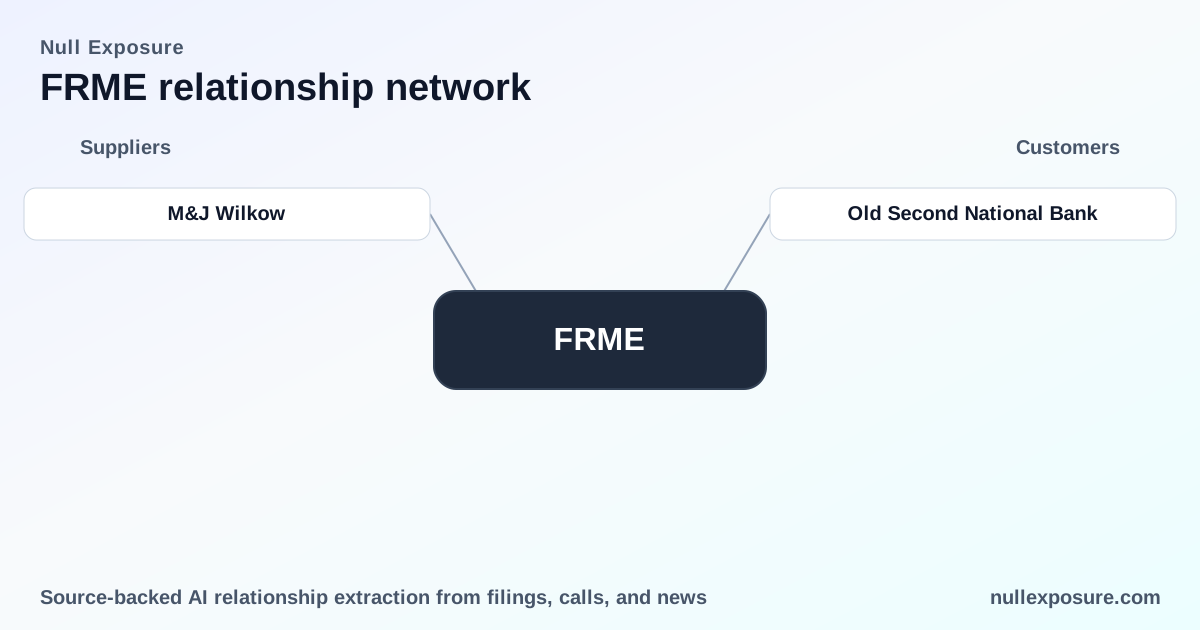
On December 6, 2024, First Merchants completed the sale of five suburban Chicago branches to Old Second National Bank. This transaction is documented in First Merchants’ FY2024 annual filing and reflects a tactical divestiture of non-core retail locations in the Chicago suburbs. According to the FY2024 10‑K filing, the branch sale was completed on that date and is part of the company’s ongoing footprint management (FY2024 10‑K).
CREX / Creative Realities — senior term loan for an acquisition (announcement)
A MartechCube press release announcing Creative Realities’ transformational acquisition disclosed the financing package that includes a three‑year, $36 million senior term loan provided by First Merchants Bank alongside $30 million of convertible preferred equity from North Run Capital. The press release frames the loan as part of the buyer’s short‑to‑medium‑term acquisition finance structure and highlights First Merchants’ role as a lender in sponsor-style M&A activity (MartechCube, March 2026).
CREX / Creative Realities — senior term loan for an acquisition (close)
A subsequent MartechCube announcement confirming close of the Creative Realities acquisition reiterates that the deal was financed with a three‑year, $36 million senior term loan from First Merchants Bank and $30 million of convertible preferred equity. The closing notice confirms First Merchants executed on the commitment outlined in the acquisition financing (MartechCube, March 2026).
How these relationships fit the bank’s operating model
The documented relationships reflect consistent company-level characteristics derived from First Merchants’ disclosures and context:
- Contracting posture — short‑term orientation. The company explicitly references standby letters of credit and acquisition financing with terms like three‑year senior loans; First Merchants operates with a meaningful set of short- to medium-term credit instruments, which supports nimble balance-sheet deployment but requires continuous refinancing and funding discipline.
- Counterparty mix — broad retail and commercial base. Disclosures identify customers across individuals, small business, mid‑market commercial, and public finance clients; this diversified counterparty mix reduces single-sector exposure while keeping risk concentrated regionally.
- Geographic concentration — domestic Midwest focus. The bank’s offices and banking locations are primarily in Indiana, Ohio, Michigan and northeast Illinois, and all operations are domestic; this regional concentration supports local deposit stability but exposes the franchise to economic cycles in the Upper Midwest.
- Relationship role — service provider and seller. First Merchants both provides services (mortgage servicing, interest rate hedging for commercial borrowers, deposit and payment processing) and sells banking products (loans and branch assets). Mortgage servicing and derivative offerings indicate ongoing fee streams and commercial client engagement.
- Maturity and stage — active, recurring engagements. Mortgage servicing balances and the bank’s participation in multi‑year acquisition financing show active, recurring relationships rather than one-time disposition activity alone.
- Single-segment clarity. The company operates in one significant business segment: community banking, which provides revenue transparency but limits diversification into non‑banking lines.
Investment implications and risk map
- Positive: recurring fee and interest engines. Mortgage servicing and a broad consumer and commercial deposit base support stable net interest income and fee income, which underpin First Merchants’ profitability metrics (profit margin and operating margin reported in trailing figures).
- Positive: disciplined, tactical footprint management. The Chicago‑area branch sale demonstrates active management of branch economics and capital allocation — an investor-friendly signal when combined with a dividend that the company maintains.
- Risk: regional concentration and refinancing cadence. The bank’s Midwest footprint concentrates underwriting and deposit risk geographically; short- to medium-term lending requires consistent access to liquidity and credit underwriting discipline.
- Risk: credit exposure from sponsor‑style financings. Participation in sponsor-backed acquisition loans — for example, the Creative Realities transaction — exposes First Merchants to sponsor credit and covenants that differ from traditional middle‑market lending, requiring active credit surveillance.
Marketplace context and valuation posture
First Merchants presents as a mid-cap regional bank with a market capitalization around $2.5 billion and a P/E in the low double digits. The bank’s price-to-book near parity and dividend yield reflect a stable earnings profile and a return-of-capital posture attractive to income-focused portfolios. Analysts’ consensus target price and ratings indicate balanced sentiment across buy/hold categories.
For investors evaluating counterparties and customer relationships, the documented transactions show First Merchants executing both retail optimization (branch sale) and commercial lending plays (acquisition financing), consistent with its community banking strategy. For additional analysis and more granular relationship signals, visit https://nullexposure.com/.
Bottom line: actionable signals
- First Merchants is a community bank that balances core retail deposit and servicing income with selective commercial lending. The bank demonstrates active portfolio management by divesting branches and providing short‑term acquisition financing.
- Concentration in the Midwest and a short‑term contracting posture are the primary structural risks; these are offset by diversified counterparty types and recurring fee income streams.
For portfolio managers and corporate researchers, First Merchants’ customer interactions provide a clear line of sight into how the bank deploys capital and manages regional concentration — an operational profile that supports income generation but requires disciplined credit and liquidity oversight.