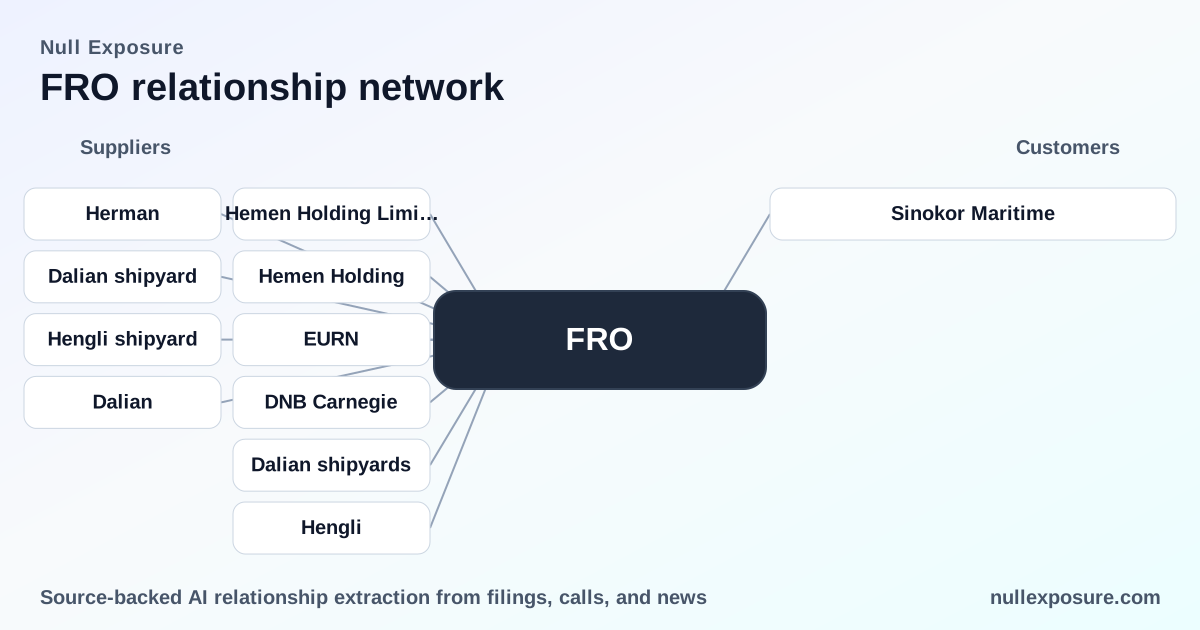
Frontline Ltd (FRO): Counterparty Signal — Sinokor Maritime and what it means for investors
Frontline Ltd operates a global crude oil and petroleum-products shipping franchise and monetizes its fleet through chartering and voyage contracts that convert vessel days into cash flow and shareholder distributions. The company’s operating leverage and free-cash conversion are driven by charter rates, fleet utilization and counterparty credit; customer relationships such as the March 2026 reported engagement with Sinokor Maritime are discrete inputs to that cash-flow equation. For a consolidated view of counterparty exposures and sources, see https://nullexposure.com/.
The headline relationship: a March 2026 deal tied to Sinokor Maritime
-
Finviz reported in March 2026 that the counterparty in a recent Frontline transaction is South Korea’s Sinokor Maritime. According to the Finviz note, the market reaction to the deal contributed to a short-term move in FRO’s share price.
Source: Finviz news write-up, March 9, 2026. -
InsiderMonkey published a matching write-up the same day that repeats the identification of the counterparty as Sinokor Maritime and the link between the disclosure and the stock’s weekly performance.
Source: InsiderMonkey coverage, March 9, 2026.
Together, these items establish a publicly reported commercial engagement between Frontline and Sinokor Maritime in March 2026; both outlets cited market commentary identifying Sinokor as the counterparty.
Why a single reported counterparty matters for analysis
Frontline’s financials show an EBITDA of $898 million and a TTM revenue of about $1.97 billion, with operating margins among the stronger profiles in the midstream shipping segment (operating margin TTM ~44.5%). Those metrics underline that transient news about a single counterparty can influence near-term investor sentiment but must be read in the context of enterprise-scale cash generation. A named customer like Sinokor is relevant for short-run revenue recognition and credit exposure, but not necessarily determinative of company-wide risk unless repeated or material in size.
Operating-model characteristics investors should weigh
-
Contracting posture: Frontline converts vessel availability into contracted cash flows via a mix of charter types; the company’s margin profile and dividend cadence indicate meaningful exposure to long- and short-term charter-rate cycles. Reported single-deal counterparties reflect a transactional element consistent with a hybrid chartering model.
-
Counterparty concentration: The public record here contains a discrete signal — Sinokor Maritime is identified against one transaction — but there is no evidence in the reviewed sources of persistent concentration or material dependency on any single customer. Frontline’s scale, reflected in a market capitalization above $8 billion and diversified chartering activity, reduces the operational risk of any single counterparty shock unless the counterparties represent unusually large or long-dated commitments.
-
Criticality and credit: Shipping counterparties are commercially critical when they underwrite long-term time charters or pay large voyage receivables; a March 2026 press-level identification of Sinokor as the other party flags a commercial relationship but does not, on its own, reveal credit tenor, security, or size. Investors should watch for contractual disclosure in company filings for confirmation of whether the engagement is a spot voyage, time charter, sale/leaseback or other arrangement.
-
Maturity and governance: Frontline’s metrics — return on equity ~15.6% and a dividend yield near 4.8% — indicate an established, cash-return focused enterprise. That corporate posture implies disciplined counterparty selection and an appetite for predictable cash distribution that shapes its commercial choices.
Risk implications from the reported relationship
-
Short-term sentiment risk: Market headlines tying a specific counterparty to a transaction can drive price volatility, particularly when headlines are repeated by outlets. The March 2026 articles are a classic example of news-driven trading signals.
-
Counterparty credit risk: If a named counterparty is the counterparty to a large time charter, credit weakness at that counterparty would be consequential; the current public signals do not disclose contract size or tenor. Investors should prioritize any subsequent company filing that specifies contract terms.
-
Concentration risk monitoring: Given Frontline’s scale, a single reported counterparty is not currently a company-level red flag, but repeated naming of the same counterparties across multiple large contracts would elevate concentration risk. Track periodic filings for counterparty schedules when available.
What investors should monitor next
-
Look for confirmation in Frontline’s formal disclosures (quarterly reports or investor presentations) that specify the nature and size of the Sinokor engagement. Media reports are directional; only company filings or transaction notices quantify exposure.
-
Follow subsequent market coverage to see whether Sinokor shows up in additional transactions with Frontline; one isolated mention does not equal systemic concentration.
-
Monitor Frontline’s working-capital and receivable disclosures for any change in credit provisioning that could accompany larger voyage receivables or time-charter receivables tied to new counterparties.
For a structured view of counterparty mentions and historical transaction reporting across public sources, review the consolidated intelligence at https://nullexposure.com/.
Bottom line for investors
Frontline remains a high-margin, cash-return oriented shipping operator whose stock is sensitive to discrete transaction headlines. The March 2026 coverage naming Sinokor Maritime is a credible customer signal reported by multiple outlets, but it is a single public datapoint rather than proof of concentration or credit stress. Investors should treat this as a monitorable commercial disclosure and prioritize formal contract-level information from Frontline’s filings to assess materiality.
If you require a deeper, source-linked aggregation of Frontline’s counterparty mentions or want ongoing alerts when a counterpart is repeatedly referenced, visit https://nullexposure.com/ for investigative coverage and relationship tracking.