JFrog (FROG): Customer relationships that transform a binaries business into an AI artifact platform
JFrog operates a hybrid, subscription-led software supply chain platform that monetizes primarily through tiered annual and multi‑year subscriptions with embedded usage pricing for SaaS customers. The company sells to large enterprises globally and positions its registry as the system of record for binaries and AI artifacts, unlocking higher data consumption and expansion into model management revenue streams. For a concise view of how these customer relationships change the growth and risk profile, visit https://nullexposure.com/.
Why these partner and customer ties matter to investors
JFrog’s business model is subscription-first with usage economics: its public filings describe multi‑tier subscription products (Pro, Pro X, Enterprise X, Enterprise Plus) and both fixed and usage‑based SaaS fees. That contracting posture creates predictable recurring revenue and expansion levers via usage growth. The company reports a global enterprise footprint—more than 7,300 customers across 90+ countries and roughly 82% of Fortune 100 on the platform—establishing both scale and low single‑customer concentration (no customer >10% revenue; top 10 ~8% of revenue).
Taken together, these are company‑level signals: contracted, enterprise-grade revenue with meaningful renewal economics and a geography mix tilted to the United States (~60% of revenue) that supports stability while leaving room for international growth. The strategic pivot to be a model registry increases product criticality inside AI development workflows, which translates into higher stickiness and potential for usage‑based monetization as customers ship models and artifacts at scale.
Catalog of named relationships called out in filings and coverage
Below are every relationship referenced in the available results, with a short, plain‑English description and a concise source reference.
-
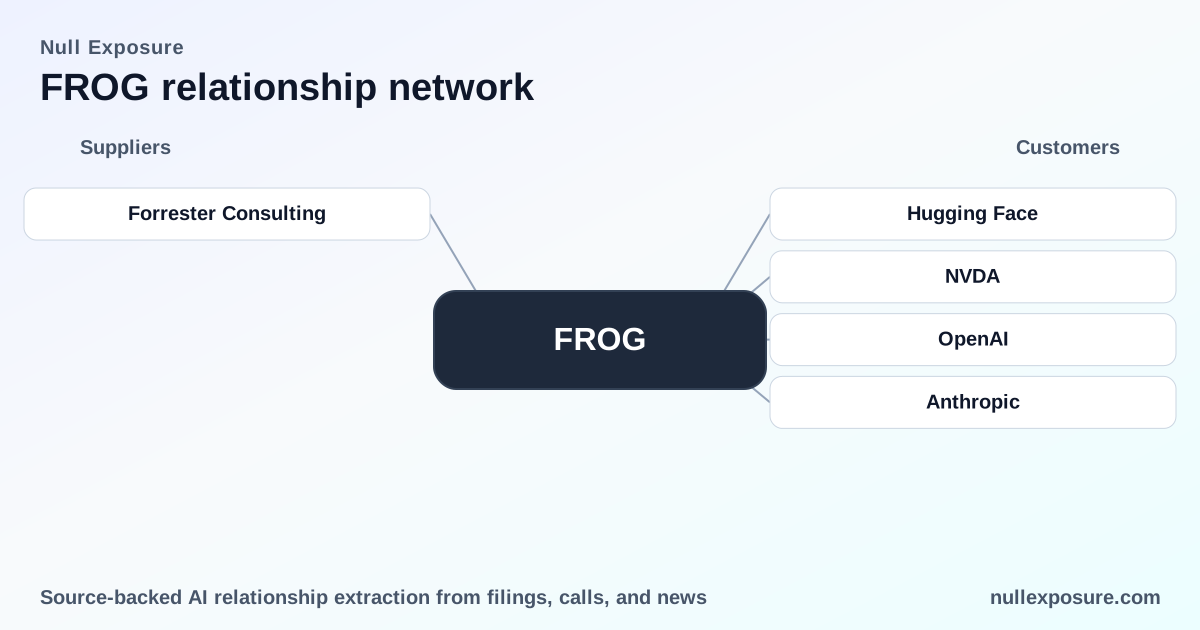
Hugging Face — JFrog announced a partnership to secure Hugging Face’s open‑source model hub so enterprises can consume models in a trusted way; management described this linkage as part of its push to be the system of record for AI artifacts. (Q4 2025 earnings call, referenced in news coverage March 2026)
-
NVIDIA / NVDA — JFrog said it partnered with NVIDIA (referenced both as NVDA and NVIDIA) to integrate as the secure model and artifact registry for NVIDIA’s Enterprise AI Factory, positioning JFrog inside NVIDIA’s enterprise AI stack. (Q4 2025 earnings call, March 7, 2026; corroborated in news coverage March–May 2026)
-
NVIDIA Enterprise AI Factory — Management specifically named NVIDIA’s Enterprise AI Factory as a customer to which JFrog serves as the secure model and artifact registry, signaling strategic alignment with one of the industry’s largest AI platforms. (Q4 2025 earnings call; InsiderMonkey and Globe & Mail coverage, March 2026)
-
Cursor — JFrog’s Software Supply Chain Platform became an officially verified plugin in the Cursor marketplace on March 31, 2026, integrating governance and vulnerability scanning into Cursor’s AI coding workflows and exposing JFrog to Cursor’s developer user base. (Sahm Capital coverage, April 3–7, 2026; SimplyWallSt coverage, May 2026)
-
Anthropic — Management referenced serving Anthropic’s Opus model family as part of the new tools using JFrog as a system of record, indicating adoption by next‑generation AI model providers. (Q4 2025 earnings call transcript published in March 2026)
-
OpenAI — JFrog cited OpenAI agents as examples of new tooling that rely on JFrog as their artifact system of record, demonstrating engagement with leading AI infrastructure consumers. (Q4 2025 earnings call; Globe & Mail transcript, March 2026)
What these relationships imply for growth and margins
-
Higher revenue per customer through data consumption. Strategic wins with NVIDIA, Hugging Face, and AI leaders convert JFrog from a binaries registry into a data‑consumption platform: model hosting, artifact telemetry, and usage billing scale with AI workloads. News coverage highlighted this dynamic as a driver for expansion in data consumption and customer commitments (SimplyWallSt and Sahm Capital, April–May 2026).
-
Stronger product stickiness and renewal economics. Being the system of record for models and binaries embeds JFrog deeper in CI/CD and AI pipelines, strengthening renewal rates and upsell pathways—consistent with company statements that a significant portion of revenue derives from subscription renewals.
-
Hybrid pricing that balances predictability and upside. Public filings and disclosures describe annual/multi‑year subscriptions plus optional usage charges on SaaS plans; this mix preserves recurring revenue while enabling upside capture as customers scale model usage.
Operational constraints and company‑level signals investors should track
-
Contracting posture: Subscription‑led, offered as self‑managed and SaaS with annual and multi‑year terms; some SaaS plans include usage‑based fees. This structure supports predictable bookings while allowing variable revenue tied to consumption.
-
Customer concentration: No single customer accounted for ≥10% of revenue; the top 10 customers represented ~8% of revenue in FY2024, a signal of diversified enterprise exposure.
-
Geography: Revenue skews to the United States (~60%) with a broad global base (>90 countries), balancing domestic strength and international growth runway.
-
Counterparty profile: Large enterprise focus—JFrog’s install base includes an outsized share of Fortune 100 companies—translating into large contract values but also longer sales cycles.
-
Maturity and criticality: Transitioning from package/binary management to AI artifact registry increases product criticality inside customer stacks and supports higher retention and monetization potential.
Key risks and watch‑items for investors
-
Competitive displacement in model registries. Major cloud vendors and specialist model registries compete for the same enterprise workflows; partnership wins (NVIDIA, Hugging Face) materially reduce that risk but do not eliminate it.
-
Execution on usage monetization. The thesis depends on customers increasing model and artifact throughput; JFrog must convert product adoption into sustained usage fees without disrupting renewal economics.
-
Concentration of AI partner narrative. High-profile relationships improve go‑to‑market credibility but create perceptual risk if any partner shifts strategy; monitor announcements and contract depth.
-
Macro and enterprise IT spend cycles. Large enterprise customers deliver scale but lengthen sales cycles; continued renewal strength is critical to transform customer wins into predictable revenue growth.
Bottom line
JFrog has converted its core binaries business into a strategic system of record for AI artifacts, with explicit partnerships (NVIDIA Enterprise AI Factory, Hugging Face) and integrations (Cursor) that materially upgrade its monetization runway through increased data consumption and usage billing. The combination of subscription rigidity, enterprise depth, and emerging usage economics positions FROG for durable recurring revenue and upside from AI adoption, while execution on partner integrations and usage monetization is the primary growth lever to monitor. For a structured view of these customer signals and how they map to revenue exposure, see https://nullexposure.com/.