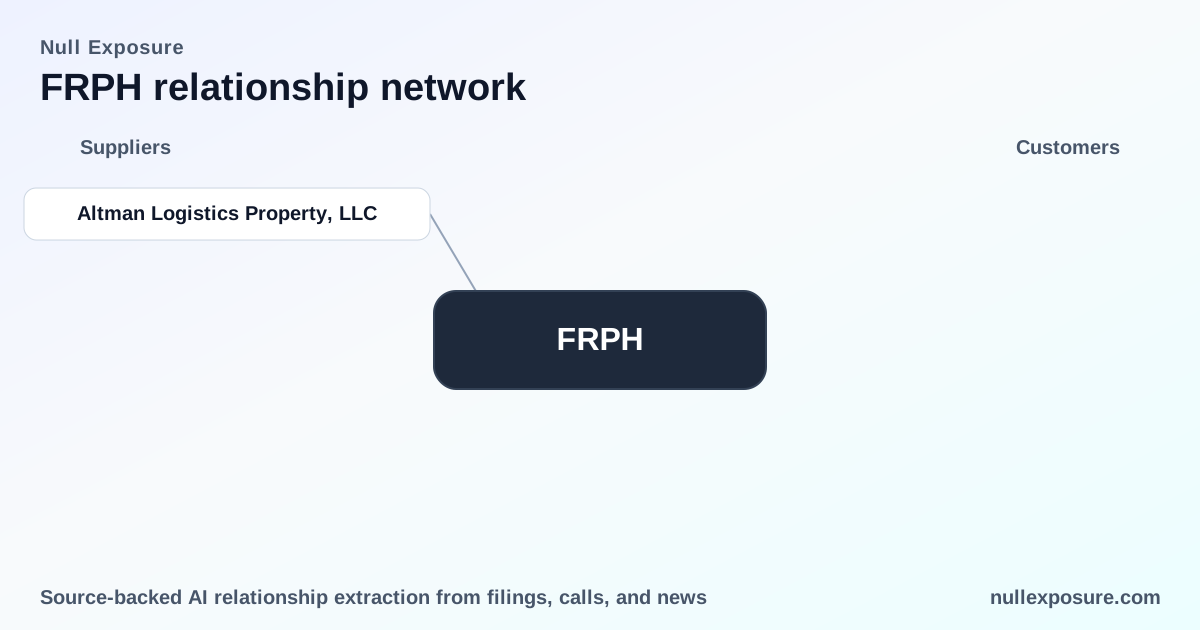
FRPH — Customer Relationships and What They Mean for Investors
FRP Holdings operates as a diversified real estate owner, developer and licensor that monetizes land and built property through long-term commercial leases, mining royalty arrangements and shorter-term residential leases; the company converts land ownership and development options into steady rental and royalty cash flows while retaining optionality through joint ventures on development projects. For investors evaluating customer-counterparty risk, the core takeaway is simple: FRPH’s revenue mix is anchored by a small number of large, long-duration commercial and mining contracts, creating predictable income but concentrated counterparty exposure. Read more at https://nullexposure.com/ for structured coverage and comparative analytics.
How FRP actually makes money — a readable operating map
FRP runs four coherent business lines: industrial and commercial leasing, mining royalty lands, development (entitlement and construction), and multifamily via joint ventures. The company collects rents and royalty payments, sells developed parcels when opportunistic, and participates in JV upside on multifamily and commercial projects. The mining royalty model is critical — FRP leases land to extractive operators under long-term agreements that convert natural-resource access into recurring royalties, while retail and industrial tenants provide fixed-base rent streams. FRP's public metrics show a compact capital base: market capitalization around $400 million and trailing revenue near $33.7 million, underscoring why large tenants exert outsized influence on consolidated results.
Contracting posture, concentration and maturity — constraints that define the business
FRP’s contracts split into durable, high-tenor commitments and a shorter residential book:
- Long-term commercial and mining leases: Retail and mining leases typically run 10–15 years with renewal options, creating cash flow visibility and leasehold permanence. Company disclosures describe mined-land leases that grant lessees the right to extract and sell sand and stone in exchange for royalties.
- Short-term residential leases: The multifamily/residential component renews on 12–15 month cycles, introducing portfolio turnover and re-pricing opportunities that balance the long-term fixed cash from mining and retail.
- Geographic concentration: Asset footprint is heavily regional — nearly all mining royalty properties are located in Florida and Georgia, with one site in Virginia; FRP also holds a Brooksville joint venture that includes 4,280 acres tied to a partner in the mining sector.
- Role and exposure: FRP functions as a licensor/lessor and seller of developed property; the mining royalty business is structured as a licensor relationship where tenants pay royalties rather than FRP operating extraction directly.
These characteristics create a hybrid risk profile: stable, long-duration revenues from royalties and retail leases coupled with cyclical development and shorter-term residential cash flows. That structure supports predictable operating cash but concentrates counterparty risk where single tenants take a material share of revenues.
The customer relationships investors need on their radar
Vulcan Materials (VMC) — a material tenant and mining partner
Vulcan is an active tenant and collaborator in FRP’s mining royalty portfolio. According to FRP’s public disclosures, Vulcan accounted for 23% of FRP’s consolidated revenues in 2024 and represented an active lessee in the mining lands segment, with a related accounts-receivable balance reported at $426,000 as of December 31, 2024. An earnings transcript referenced in May 2026 also noted Vulcan as an operational tenant supplying concrete to development projects and occupying sites pending future development. (Sources: FRP Holdings 2024 annual disclosures; earnings transcript published May 2, 2026 on The Globe and Mail.)
That relationship is both material and operationally critical: Vulcan’s payments and ongoing tenancy drive near-term royalty and rental cash flow and tie directly to FRP’s asset utilization strategy in its Brooksville joint venture and broader mining portfolio.
(There are no other customer relationships surfaced in the available results to report.)
What these relationship facts imply for valuation and downside risk
- Concentration risk is real and quantifiable. A single tenant representing 23% of revenue elevates counterparty risk: a contract disruption or renegotiation has an outsized effect on consolidated top line and near-term cash conversion.
- Cash flow durability is high on the mining side. Long-term leases with royalty mechanisms provide durable, contract-backed receipts that are less cyclical than development profits. That durability supports premium valuation multiples for the mining component even as development segments compress margins.
- Mix creates valuation dispersion. FRP’s public multiples (for context: trailing P/E above 100 and forward P/E near mid-teens, EV/EBITDA in the high 20s, P/B roughly 0.94) reflect a company with modest earnings today, disproportionate balance-sheet asset value, and material upside contingent on development execution and tenant retention. Investors should expect continued volatility in short-term earnings while asset-backed long-term cash flows normalize valuations over multiple cycles.
- Operational counterparty exposure is manageable but concentrated. The Brooksville JV and other site-level partnerships create strategic optionality, but the company’s dependence on a handful of lessees for mining rent revenue is a structural constraint that must be monitored each reporting cycle.
Investment checklist — what to watch next quarter-to-quarter
- Confirm continued royalty receipts and accounts-receivable trends with top lessees (Vulcan being the primary watch item).
- Track lease renewals and option exercises for retail and mining sites; long-term renewals underpin the dividend and buyback optionality FRP could deploy.
- Monitor development JV progress and entitlement milestones that convert latent land value into realized gains.
- Compare operating margins and cash conversion against the company’s reported EBITDA and revenue run rate to assess how short-term residential leasing and development spending are affecting free cash flow.
Bottom line: a defensive real-estate income base with concentrated counterparty risk
FRP Holdings delivers reliable royalty and rental cash flows via long-duration lease structures, while retaining upside through selective development activity and joint ventures. The business model is asset-backed and cash-flow oriented, but investors must price in concentration risk—notably the outsized contribution from Vulcan—and the execution risk inherent in turning development optionality into realized value. For portfolio analysts and operators focused on counterparty exposures, the single largest practical risk is tenant retention and contract renewal cycle timing; for value investors, the combination of low P/B and asset-backed cash flows justifies a closer look at downside protection and scenario stress tests.
For a comparative view across similar landlord-licensor models and to track customer-level exposures, visit https://nullexposure.com/ for deeper periodic coverage and relationship analytics.