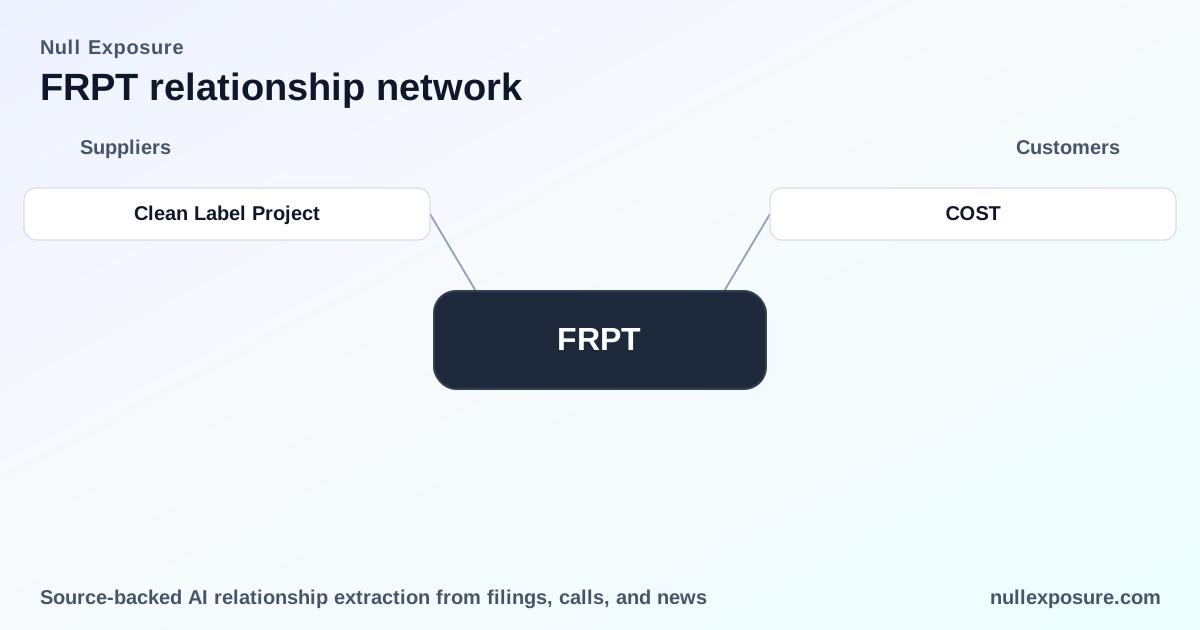
Freshpet’s Retail Partnerships: What investors need to know about customer dynamics and risk
Freshpet manufactures and sells refrigerated fresh pet food and treats, monetizing primarily through wholesale sales to large retail customers and through third‑party distributors while also expanding e‑commerce and in‑store fridge placements that drive category lift and repeat purchases. The business converts product placement—branded refrigerated fixtures and expanded retail footprint—into higher sell‑through and margin capture with national retail partners. For a focused view of Freshpet’s customer relationships and the operational constraints that control growth and risk, read on. If you want a quick reference on relationship mapping and signals, visit the Null Exposure homepage: https://nullexposure.com/.
How Freshpet gets paid and why retailers matter
Freshpet’s revenues come from direct sales to retailers and from sales through distributors; the company operates a single consolidated segment covering manufacturing, marketing and distribution of fresh pet food. That model makes retail partners both the primary revenue channel and the amplifier of brand value—store fridge placements and e‑commerce listings produce measurable category lift and customer repeat purchase behavior that drives top‑line growth.
Company disclosures and analyst coverage also signal several important operating characteristics for investors:
- Concentration: Freshpet reports that in 2022–2024 one customer accounted for more than 10% of net sales, a structural concentration that increases counterparty risk for investors.
- Large enterprise counterparties: Management explicitly targets blue‑chip retailers, positioning Freshpet as a margin‑enhancing supplier for large chains.
- Geography: The company generates the vast majority of sales in North America while selling in Canada and Europe, so performance is tied to North American retail execution.
- Distribution model: Revenues flow through direct retail sales and distributor arrangements; the company’s largest distributor (Animal Supply Co.) accounted for a notable share of net sales, illustrating a mix of direct and indirect contracting.
- Maturity: Recent press coverage highlights the company crossing significant scale thresholds—management and some analysts now talk about $1 billion in sales and positive free cash flow in the latest cycle—shifting Freshpet from high‑growth investment mode to a profit and cash generation story in the view of several market participants.
These operating realities shape contract posture (large retailers with bargaining power), criticality (fridge placements and national listings are materially important), and capital allocation (scaling manufacturing and distribution footprints to meet retail demand).
Customer relationships in the news: each mention summarized
Costco — StocksToTrade coverage (April 7, 2026)
Freshpet is actively pursuing expanded branded fridge placements at Costco despite competition from Costco’s Kirkland private label, positioning Costco as a strategic outlet for incremental scale and visibility. A StocksToTrade article (April 7, 2026) highlighted management’s view that additional fridges at Costco create a channel expansion opportunity.
Tractor Supply Company (TSCO) — Investing.com analyst note (May 4, 2026)
Analyst coverage referenced an accelerated Freshpet rollout within Tractor Supply, increasing the planned footprint to approximately 700 locations from 500, underscoring growing retail adoption in specialty channels. An Investing.com summary of the analyst note (May 4, 2026) recorded this faster rollout as a point of distribution expansion.
Costco — SAHM Capital commentary (April 11, 2026)
SAHM Capital tied Freshpet’s recent milestone of reaching roughly $1 billion in sales and turning free cash flow positive to expanded e‑commerce and fridge placements in retailers such as Costco, an operational lever analysts cited when upgrading expectations. SAHM Capital‘s write‑up (April 11, 2026) framed Costco placements as a contributor to improved cash generation and analyst sentiment.
Costco — TradingView (Zacks) coverage (March 9, 2026)
Zacks/TradingView noted that total U.S. pet retail channels, explicitly including Costco, recorded strong year‑over‑year growth of 9.4%, linking broader channel strength to Freshpet’s retail performance. That March 9, 2026 coverage signals that channel growth has been a contemporaneous tailwind for Freshpet.
Costco — duplicate TradingView entry (March 9, 2026)
A second flagged mention from the same Zacks/TradingView piece reiterates the same data point: Costco‑inclusive channels contributed to the 9.4% U.S. pet retail growth figure, reinforcing the same channel dynamic reported earlier. TradingView’s March 9, 2026 coverage was captured twice in monitoring, reflecting multiple references to Costco in the same earnings context.
What these relationships mean for investors: practical takeaways
- Retail placements are operationally critical. Branded refrigerated fixtures and national listings at large partners translate directly into sales velocity and higher margins; contracts and merchandising agreements with large chains therefore carry outsized influence on growth.
- Concentration is non‑trivial. A single customer exceeded 10% of net sales across multiple years, so losing or materially changing terms with a major partner would have measurable P&L impact.
- Distribution complexity is real. Freshpet uses a hybrid model—direct selling and third‑party distributors (the company’s disclosures identify Animal Supply Co. as the largest distributor by sales at 7.9%)—so revenue realization and margin profile depend on both direct retail relationships and distributor economics.
- Channel diversification is underway but still North‑America centric. Expansion into Tractor Supply and deeper placements at Costco show active diversification across big‑box and specialty retail, yet management emphasizes that the majority of sales remain in North America even as Europe contributes a smaller portion.
- Competition and private labels are a strategic constraint. Management and market commentary explicitly call out private‑label competition (e.g., Kirkland) as a headwind that Freshpet counters with branded fridges, sampling and premium positioning.
Key investor risks and monitoring points
- Monitor retailer concentration metrics in quarterly filings and any disclosure that a single customer’s share of net sales has shifted materially from the reported >10% level.
- Track the pace and economics of fridge rollouts at Costco and Tractor Supply—success in rollouts should show up in sell‑through, reorder rates and improved margins at those channels.
- Watch distributor dynamics, particularly contract terms with large distributors; Animal Supply Co.’s ~7.9% contribution to net sales is a meaningful counterparty to watch given its explicit mention in company disclosures.
- Keep an eye on European execution versus North American performance; slow penetration in EMEA relative to North America will constrain upside from international expansion.
Freshpet’s retail relationships are the engine of growth: store‑level placement and national rollouts convert into recurring revenue and improved unit economics, but the strategy also concentrates execution risk with a handful of large enterprise partners and distributors. For a rolling view of relationship signals and constraint‑level insights tailored to investors and operators, see more at Null Exposure: https://nullexposure.com/.