Federal Realty (FRT) customer relationships: who pays the rent and why it matters
Federal Realty is a geographically concentrated, U.S.-only owner-operator of urban and suburban retail and mixed-use shopping centers that monetizes primarily through long-term commercial leases with a mix of national anchors and local operators. Revenue derives from recurring base rent and occupancy across 104 predominantly retail properties, with active leasing progress in 2026 noted on recent calls — a model that delivers predictable cash flow but exposes investors to leasing cycles and tenant mix risk. For a concise view of Federal Realty’s customer footprint and primary tenant relationships, visit https://nullexposure.com/.
How Federal Realty’s business model maps to customer risk and resilience
Federal Realty runs a classic retail REIT playbook: it acquires and selectively redevelops high-quality centers in dense, coastal and select growth markets, then collects long-term operating lease income. Company filings through December 31, 2025, show 104 properties across 14 states and DC and roughly 3,700 commercial leases, underscoring scale with geographic concentration in U.S. coastal markets. Those filings also state that no single tenant accounted for more than 2.4% of annualized base rent, which translates to low single-tenant revenue concentration despite large anchor relationships. Commercial leases generally run multiple years and anchors often sign longer terms, supporting stable cash flow and high occupancy metrics reported for FY2025.
Key operating signals:
- Contracting posture: long-term leases dominate; commercial leases often run three to ten years with anchors longer. (Company filings, Dec 31, 2025)
- Counterparty mix: national chains plus small proprietors; Federal Realty mixes major retailers and local small businesses across centers. (Company filings, Dec 31, 2025)
- Geography: U.S.-only, coastal-tilt; no operations outside the United States. (Company filings, Dec 31, 2025)
- Materiality: immaterial single-tenant exposure; no single tenant >2.4% of ABR. (Company filings, Dec 31, 2025)
- Relationship role and stage: landlord (seller of real estate exposure) with an active leasing portfolio; overall portfolio occupancy and leasing progress labeled active in FY2025–FY2026 disclosures.
Customer roster and what each relationship signals to investors
Below I list every named customer relationship found in recent coverage and provide a concise investor-oriented takeaway and source for each.
PNC Bank
PNC signed an 11,000-square-foot lease at Santana West, taking the last remaining space and bringing the project to 100% leased, highlighting Federal Realty’s ability to attract creditworthy financial-services anchors. (Q1 2026 earnings call transcript on Investing.com, May 2, 2026).
Petco
Petco is an anchor at the Congressional North center, reflecting Federal Realty’s strategy to secure everyday-need anchors that drive foot traffic across mixed-use properties. (SimplyWall.St narrative on FRT, May 2, 2026).
Crate & Barrel
Crate & Barrel is cited among full-price, aspirational retailers that are outperforming in Federal Realty centers, indicating demand at higher-price-point concepts and positive sales mix dynamics. (Q1 2026 earnings call transcript on Investing.com, May 2, 2026).
Madewell
Madewell is listed with other aspirational apparel brands that continue to outpace the mall average, signaling strong category performance for lifestyle apparel in FRT centers. (Q1 2026 earnings call transcript on Investing.com, May 2, 2026).
Aldi
Aldi anchors Congressional North and underscores Federal Realty’s use of value-oriented grocery anchors to drive frequency and resilience in retail trade areas. (SimplyWall.St narrative on FRT, May 2, 2026).
RH Outlet
RH Outlet serves as an anchor at Congressional North, demonstrating FRT’s ability to blend premium home-furnishings concepts with grocery and service tenants in affluent markets. (SimplyWall.St narrative on FRT, May 2, 2026).
FRT-P-C
Coverage referencing FRT-P-C relates to a Huntington shopping center renovation and structural design notes, reflecting the trust’s capital improvement and redevelopment activity—an operational lever to increase rent and occupancy. (GreaterLongIsland coverage of Huntington renovation plans, March 9, 2026).
Anthropologie
Anthropologie is identified among high-performing lifestyle retailers in the portfolio, reinforcing a tenant mix skewed toward aspirational, experiential retail. (Q1 2026 earnings call transcript on Investing.com and InsiderMonkey, May 2, 2026).
Aritzia
Aritzia is repeatedly cited as an outperforming apparel concept in FRT centers, supporting the thesis that curated specialty retail drives higher sales per square foot in select assets. (Q1 2026 earnings call transcript on Investing.com and InsiderMonkey, May 2, 2026).
Staples
Staples anchors Congressional North alongside Aldi and other tenants, reflecting a blend of necessity-based and office-supply retail that stabilizes weekday traffic. (SimplyWall.St narrative on FRT, May 2, 2026).
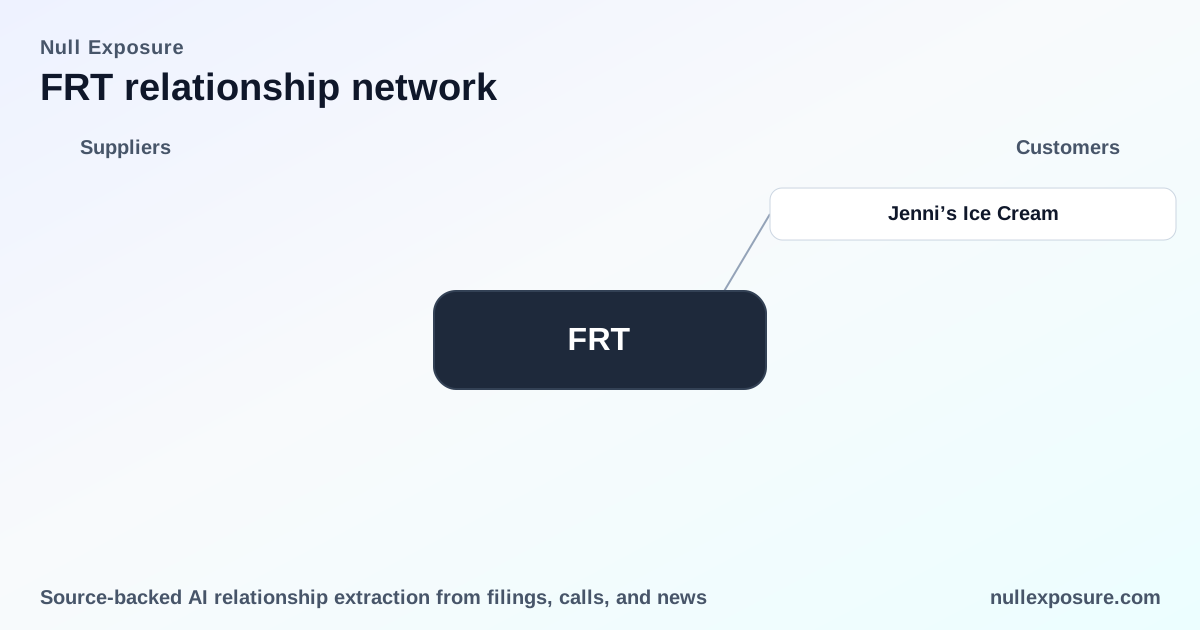
Jenni’s Ice Cream
Jenni’s Ice Cream is mentioned in a Village at Shirlington enhancement program, illustrating Federal Realty’s focus on activating public spaces and local F&B operators to boost center vibrancy. (CityBiz announcement of Shirlington enhancements, March 9, 2026).
Bed Bath & Beyond
Bed Bath & Beyond is referenced as a historic vacancy at a standalone power-center parcel, a reminder that legacy big-box vacatur still surfaces as a redevelopment opportunity rather than a permanent drag. (Q1 2026 earnings call transcript on Investing.com and InsiderMonkey, May 2, 2026).
What these relationships collectively tell investors
- Tenant mix balances national anchors and local operators, which reduces single-tenant revenue concentration but introduces operational complexity in leasing and tenant-fit decisions. (Company filings, Dec 31, 2025)
- Leasing maturity is long-dated and active; Federal Realty reported high portfolio leased/occupied metrics in FY2025 and continues to convert redevelopment work into leased space in FY2026 calls.
- Criticality is moderate: anchors matter for foot traffic and valuation uplift at the property level, but company-level revenue concentration remains low, insulating the balance sheet from single-tenant shocks.
Investment implications and actionable next steps
Federal Realty’s leasing wins with creditworthy anchors like PNC and resilient tenants such as Petco, Aldi and lifestyle brands support the cash-flow narrative for an owner/operator focused on dense coastal markets. However, the presence of legacy vacancies (Bed Bath & Beyond) and ongoing redevelopment tasks (Huntington, Shirlington) make execution on redevelopments and tenant replacement the principal near-term value drivers.
For analysts and portfolio managers:
- Assess the pace and economics of identified redevelopments and how they convert vacant or underperforming boxes into stabilized rent rolls.
- Monitor earnings-call commentary for forward guidance on lease spreads and occupancy on assets like Santana West and Congressional North.
For deeper coverage and continual signal monitoring, visit https://nullexposure.com/ for additional context and relationship tracking.
Bold takeaway: Federal Realty’s diversified anchor mix and long-term leasing profile create stable, recurring rent streams, while redevelopment execution is the lever for material value creation.