First Seacoast Bancorp (FSEA): Customer Relationships That Anchor a Regional Banking Model
First Seacoast Bancorp operates as the holding company for First Seacoast Bank, monetizing primarily through net interest income on a geographically concentrated loan portfolio and fee income from loan servicing and wealth management services. The company gathers retail and commercial deposits in the New Hampshire / southern Maine seacoast, converts those deposits into mortgage and commercial credit, and supplements margins with wealth-management and servicing fees. For faster access to our relationship intelligence on regional banks, visit https://nullexposure.com/.
A compact footprint with long-term lending at its core
First Seacoast runs a classic community/regional bank model centered on deposit-funded lending. The firm’s primary market is Strafford and Rockingham Counties in New Hampshire and York County in southern Maine, and most business activity is with customers located in that seacoast region, as stated in the company’s FY2024 filings. This geographic concentration produces a high degree of local credit correlation and operational concentration: deposits are the bank’s primary funding source, making customer relationships with depositors structurally critical to liquidity and lending capacity (company Form 10‑K, year ended December 31, 2024).
Contracting posture and revenue mix reflect that orientation. Residential mortgage lending carries long-term contractual horizons (up to 30-year terms under Freddie Mac guidelines), while portions of the fee base are usage-based—for example, loan servicing fees calculated as a percentage of outstanding principal and recognized over time (company Form 10‑K, FY2024). That combination creates predictable interest margin over multi-decade horizons, with fee income that scales with outstanding loan balances.
Who the bank serves — a cross-section of households, small business and middle-market borrowers
First Seacoast serves a diversified set of customer types within its region: individuals (retail depositors and retail borrowers), small businesses (SBA-backed credit), mid-market companies (loans to businesses with roughly $10–75 million in EBITDA by the bank’s internal definition), and not-for-profit organizations. The bank also operates a wealth-management channel offering non‑FDIC products including retirement planning and portfolio management. These categorizations are drawn from the company’s disclosures rather than external inference (company Form 10‑K, FY2024).
Average balances point to a commercial book that is moderate in size—the reported average commercial real estate loan balance was roughly $461,000, placing many commercial relationships in the $100k–$1m spend band. Residential real estate is material: the company reported $275.2 million of one- to four-family residential real estate loans, representing 62.7% of total loans as of December 31, 2024—implying total loans on the order of approximately $438.9 million (company Form 10‑K, FY2024).
The bank’s relationship roles — both seller and service provider
First Seacoast conducts customer-facing activity across multiple relationship roles. The bank acts as a seller of financial products and, on occasion, real estate assets—most recently completing a $7.5 million sale of four branch properties in mid-2024. Simultaneously, the bank is a service provider: it services mortgage loans for others (earning servicing fees on a contractual percentage of principal) and offers investment management and insurance distribution through its wealth arm (company Form 10‑K, FY2024). These dual roles diversify revenue sources, but concentrate operational exposure in loan servicing systems and branch footprint decisions.
One documented customer relationship: Greater Dover Chamber of Commerce
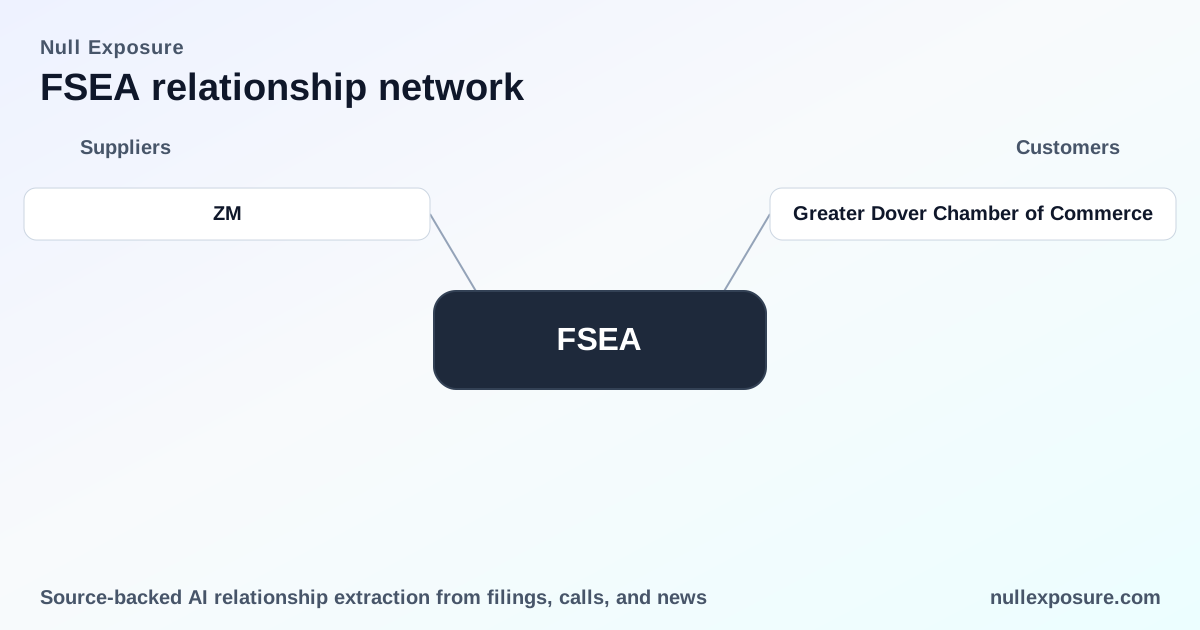
First Seacoast Bank served as the underwriter for the Greater Dover Chamber of Commerce’s 19th annual Sweepstakes and Auction, a community sponsorship role documented in local press coverage from early 2021. The bank’s participation reflects community-facing marketing and underwriting activity rather than a material commercial-credit relationship. (Foster’s Daily Democrat, Feb 5, 2021.)
What these relationships and constraints mean for investors
- Concentration risk is real and quantifiable. The bank’s lending and deposit book is geographically concentrated within a compact New England market, making local economic cycles and real‑estate conditions primary drivers of loan performance (company Form 10‑K, FY2024).
- Funding criticality elevates depositor relationships. Because deposits are the primary funding source for lending and investment, customer retention and pricing on deposit products directly affect liquidity and margin. The filing explicitly flags deposits as the primary source of funds.
- Revenue durability is split between long-term interest income and usage-based fees. Long-term mortgage contracts provide predictability to interest income, while loan servicing and wealth fees are usage-linked to outstanding balances, aligning fee revenue with portfolio scale (company Form 10‑K, FY2024).
- Relationship maturity skews toward established, active engagements. The company reports an active loan portfolio with substantial residential exposure, indicating that many customer relationships are ongoing rather than one-off transactions.
- Scale limits and profitability pressures are visible in the market data. As of the latest public metrics, First Seacoast shows negative trailing EPS (-$0.24) and a modest Price-to-Book ratio (~0.84), signaling current profitability pressures and valuation below book value; investors should align expectations with a small regional bank profile (company financials, latest quarter).
Operational and credit considerations investors should watch
- Monitor local real-estate trends and commercial activity in the New Hampshire / southern Maine seacoast: that geography drives the bulk of credit risk.
- Watch deposit retention and pricing dynamics: elevated competition for deposits or outflows would materially constrain lending capacity because deposits are the primary funding source.
- Track servicing balances and wealth-management flows: these are the primary sources of non‑interest income and are usage-based, so declines in outstanding principal or assets under management reduce these revenue streams.
- Asset mix and capital metrics deserve focus: residential mortgages are over 60% of loans, so residential credit performance is the immediate sensitivity for the balance sheet.
Conclusion — a community bank with concentrated but clear economics
First Seacoast Bancorp presents a clear, regionally anchored operating model: deposit-funded lending with long-term mortgage exposure, supplemented by fee-based servicing and wealth services. That model delivers predictability but concentrates risk geographically and across funding channels. For investors evaluating customer‑relationship exposure, the shaping signals are straightforward: deposit relationships are critical, residential mortgages dominate the book, and fee income is tied to outstanding balances—all documented in the company’s FY2024 disclosures. For deeper coverage and comparable relationship insights across regional banks, explore https://nullexposure.com/.
Disclaimer: this commentary synthesizes company-reported relationship and constraint disclosures (Form 10‑K, year-ended December 31, 2024) and a press account of a community sponsorship (Foster’s Daily Democrat, Feb 5, 2021).