Flag Ship Acquisition (FSHP): Customer relationships and investor implications
Flag Ship Acquisition Corp. (FSHP) is a publicly traded SPAC focused on consumer and hospitality targets and monetizes by completing a business combination and realizing sponsor/promote value on the post-merger equity thesis. FSHP has no operating revenue today; investor returns depend entirely on completing a value-accretive merger and the capital structure that follows. For ongoing tracking and consolidated relationship intelligence, see https://nullexposure.com/.
The concise investment thesis investors need first
FSHP operates as a shell entity that sources and structures a business combination; it does not run an operating business with recurring customers. That structure means counterparty relationships are transactional and primarily service or platform contracts rather than revenue-driving customer agreements, so balance-sheet events (trust cash, sponsor capital, deal terms) are determinative of valuation. As of the most recent quarter (2025-09-30), FSHP’s market capitalization sits around $55.13 million, with ~5.03 million shares outstanding, and a high insider ownership (≈39%) alongside institutional holders (≈59%), signaling concentrated governance around the sponsor and a base of institutional liquidity.
What the documented customer links actually show
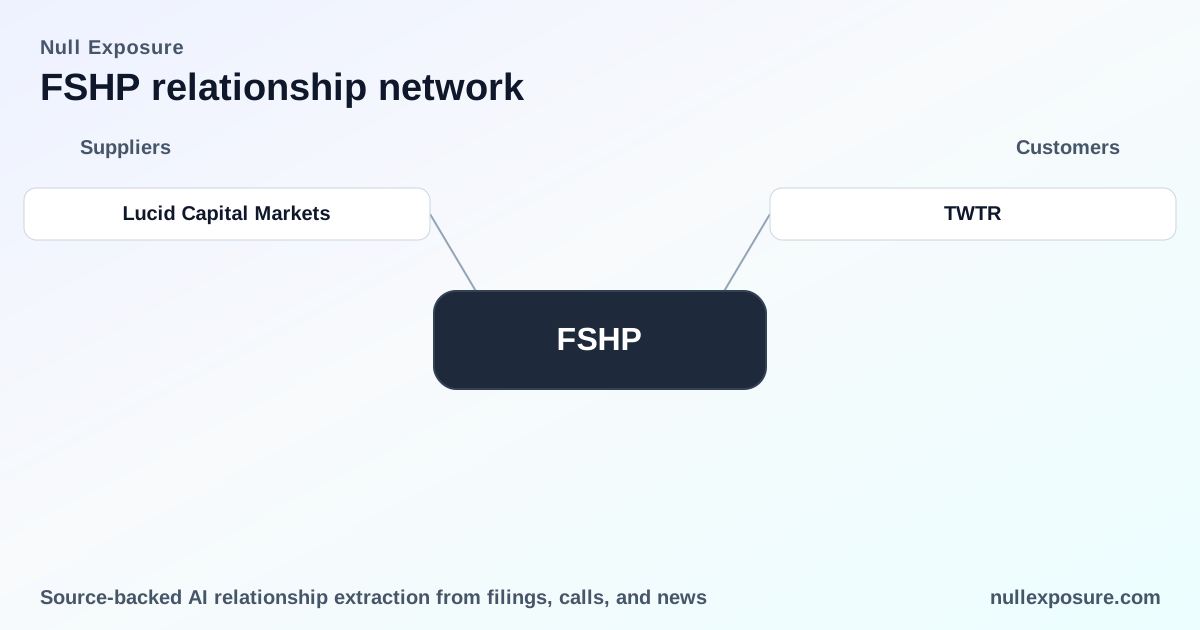
The relationship records for FSHP are thin and specific. The available public mention relates to a single contractual tie to Twitter (TWTR), documented in the media record below.
-
Twitter (TWTR) — A 2022 media report records that a contract between FlagShip and Twitter ended on December 9; the item quotes Miranda describing the contractual termination (WSWS, December 7, 2022). (https://www.wsws.org/en/articles/2022/12/07/bwyd-d07.html)
-
TWTR (duplicate entry) — The same WSWS article is recorded a second time in the relationship results, reiterating that the FlagShip–Twitter contract officially ended on December 9, 2022 (WSWS, December 7, 2022). (https://www.wsws.org/en/articles/2022/12/07/bwyd-d07.html)
Why this single relationship matters to operators and investors
The flagged Twitter contract is not a revenue contract that underpins an operating business; rather, it is a vendor/platform relationship consistent with how SPACs and sponsor teams communicate, market deals, or maintain corporate accounts. The termination of that contract is a headline-level detail with limited direct financial impact on FSHP’s valuation, because FSHP reports zero revenue and has no operating margins to protect. However, the contract termination is useful as a signal about the company’s public communications posture and vendor dependence during the SPAC lifecycle.
For context, FSHP’s financial signals through its latest reported quarter (2025-09-30) include:
- No operating revenue reported (RevenueTTM = 0) and no EBITDA, consistent with a SPAC shell profile.
- Trailing PE of 42.19 and EPS of 0.26, reflecting market pricing dynamics on a thin earnings base and the peculiarities of SPAC accounting treatment.
- Book value slightly negative (-0.572) and standard SPAC balance-sheet characteristics where value will crystallize only upon a successful deal.
Operating model signals and practical constraints investors should use
With no explicit constraint entries in the relationship data, treat these as company-level signals rather than relationship-specific constraints:
- Contracting posture: Transactional and vendor-focused — FSHP’s external contracts appear limited to service providers and platform vendors rather than multi-year customer contracts that create predictable revenue streams.
- Concentration: High governance concentration — insider ownership (~39%) and significant institutional holdings (~59%) indicate concentrated decision-making and potential sponsor-driven deal timelines.
- Criticality: Low operational dependency on customers — because FSHP does not operate a revenue business, customer relationships do not drive intrinsic value; the critical dependencies are capital and sponsor execution capability.
- Maturity: SPAC stage / pre-merger — the company’s profile is that of a pre-transaction vehicle where valuation is contingent on completing and pricing a target acquisition.
Risk checklist: what to monitor next
- Deal execution and timeline — FSHP’s value realization hinges on a successful business combination and the terms negotiated with the target.
- Sponsor liquidity and parties aligned — concentrated insider ownership means sponsor incentives and capacity to support transaction economics are critical.
- Public communications and vendor exposure — the recorded Twitter contract and its termination are signal events that reflect how FSHP manages public outreach; future vendor terminations or disputes could affect market perception.
- Regulatory and market environment for SPACs — macro-level shifts in SPAC regulation or investor appetite will directly alter FSHP’s exit options and pricing.
For a concise dashboard of FSHP’s counterparties and relationship signals, investors can consult https://nullexposure.com/ for aggregated coverage and updates.
Final takeaways for investors and operators
- FSHP is a classic SPAC vehicle: no recurring revenue, concentrated governance, and value tied to completing a merger.
- Documented customer/vendor relationships are minimal and transactional; the single publicly recorded contract termination with Twitter is a reputational/operational signal rather than a material financial event.
- Primary investment risk is execution risk on the business combination and sponsor alignment, not customer churn or contract renewals.
Stay focused on deal economics, timeline transparency, and sponsor-related disclosures — those are the drivers that will convert FSHP’s shell value into operating equity value for investors.