Flexible Solutions International (FSI): Customer Relationships That Drive Cash and Concentration Risk
Flexible Solutions International develops, manufactures and sells specialty chemicals that slow evaporation of water, monetizing through direct sales to large industrial customers, private-label supply, and distributor channels across the Americas and internationally. The firm's revenue model depends on a small set of large customers, recurring supply contracts, and distributor penetration in North and South America, with working-capital exposure where large customers carry significant receivables. Learn more about how we map these customer relationships at https://nullexposure.com/.
Why customer relationships are the central investment question
Flexible Solutions is a small-cap specialty chemicals manufacturer (Market Cap ~$79m; Revenue TTM ~$38.5m). Three customers generated 54% of 2024 sales, making customer retention and contract structure the dominant operational and valuation lever. That concentration converts directly into earnings volatility: loss or renegotiation of a single major account would cause a material revenue swing and pressure margins and cash flow.
Geography and channels: North America core with meaningful international reach
The company reports the bulk of revenue from the United States and maintains distributor networks across North and South America, while shipments outside the U.S. comprised roughly 24% of revenue in 2024. This profile results in two practical characteristics of the operating model:
- Geographic concentration in North America for direct sales and private-label programs, with Latin America served primarily through distributors.
- Moderate global exposure that introduces FX, logistics and trade considerations but does not make the business globally diversified.
These are company-level signals: the firm sells branded products (SUN 27™, N Savr 30™) through distributors in North and South America and exports material volume internationally, but the revenue base remains heavily weighted toward the U.S. market.
Contracts and lifecycle: active, sometimes exclusive, and materially concentrated
Management discloses multiple long-standing customer relationships and flags three customers as sufficiently large that losing any one would be significant. The company records meaningful accounts receivable tied to large customers, indicating working-capital sensitivity to customer payment performance.
Contract posture is mixed: the firm sells both as a direct manufacturer and through distributors, and management has publicly referenced multi-year exclusive arrangements for certain customers. This combination creates a hybrid contracting environment in which some revenues are sticky via multi-year supply agreements, while others flow through distributor channels with different renewal dynamics.
Financial scale and operational implications
FSI’s latest operating profile shows modest profitability (Profit Margin ~2%), subdued operating margins, and an EBITDA around $5.54m on ~$38.5m revenue. Insider ownership is high (≈46%), institutions are light (≈12%), and valuation multiples are elevated on trailing earnings (Trailing PE ~103.5; Forward PE ~32.3). These facts produce a distinct investor calculus:
- High concentration amplifies downside risk for a small-cap balance sheet.
- Elevated valuation multiples price in growth or de-risking that must come from customer retention or diversification.
- Receivables tied to large customers create short-term liquidity and credit risk that operators must manage.
If you evaluate customer credit exposure and supplier concentration, FSI’s balance of recurring supply contracts and distributor sales is a primary focus for both credit risk and upside scenarios. For a deeper comparative read, visit https://nullexposure.com/.
Relationship-by-relationship briefing
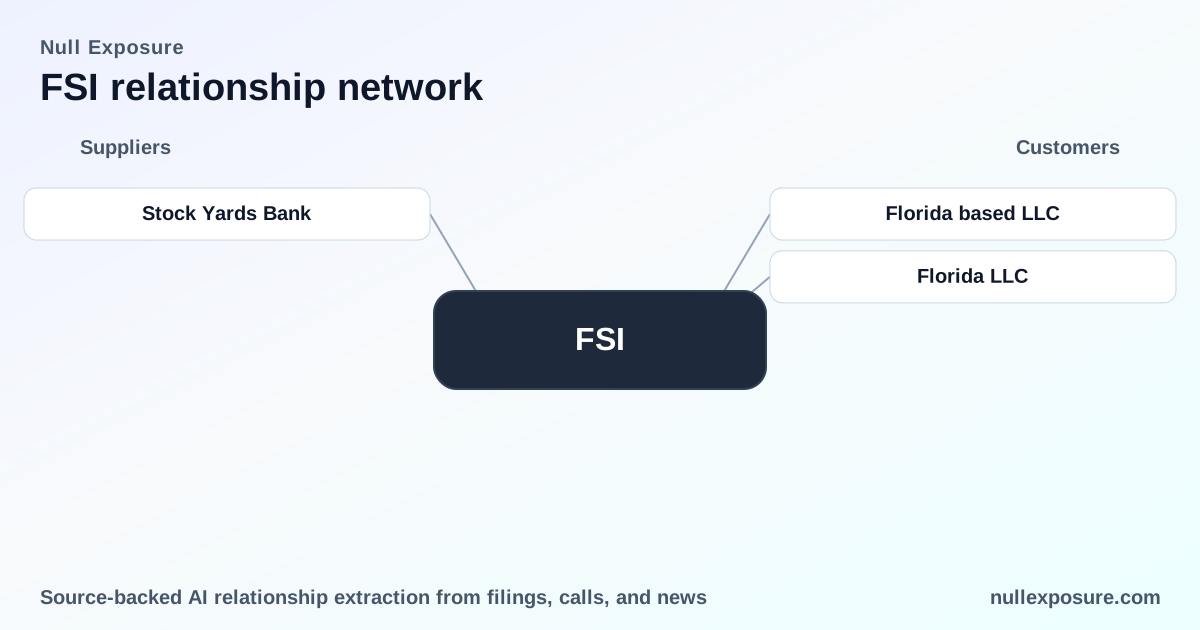
The public records return two distinct references to Florida-based customer relationships; both are active and consequential.
- Florida based LLC — During the year ended December 31, 2024, FSI recorded $8,235,394 of sales to a Florida-based LLC and showed $1,866,645 of accounts receivable from that customer on the 2024 balance sheet, highlighting significant working-capital exposure to this single buyer. This information is drawn from the company’s 2024 Form 10‑K filing covering the year ended December 31, 2024.
- Florida LLC — Management stated in a Q4 2024 earnings call transcript (reported on InsiderMonkey) that the LLC has retained FSI as an exclusive supplier for five years, signaling a multi-year contractual relationship that underpins recurring revenue for that customer segment. This remark was captured in the Q4 2024 call coverage (reported in March 2026 by InsiderMonkey).
What the constraints tell operators and investors
Several company-level signals from public disclosures shape the operating risk profile:
- Customer concentration is material. Three customers accounted for $20.78m (54%) of 2024 sales, which makes business continuity and contract renewals high-impact events for revenue stability.
- Channel duality. The firm acts both as a direct seller and as a supplier to distributors, which diversifies go-to-market but introduces varying margin and renewal dynamics.
- Manufacturing footprint and product specialization. The company manufactures TPAs (including food-grade products) in U.S. facilities (e.g., Peru, Illinois) and sells under both brand and private-label arrangements, indicating operational specialization that supports margin but creates supplier risk if capacity or compliance issues arise.
- Geographic profile. North America is the core market, with Latin American distributor channels and ~24% international shipment exposure — sufficient to introduce trade and FX considerations but not to dilute North American dependence.
These constraints together imply a contracting posture that mixes multi-year exclusives for large buyers with distributor-driven volume, a criticality to a handful of customers that increases covenants and counterparty monitoring needs, and a maturity level consistent with a small-cap manufacturer still dependent on a concentrated buyer base.
Bottom line: key takeaways for investors and operators
- Concentration is the primary risk and opportunity. Retention of the three largest customers and renewal of exclusive supply arrangements materially determines cash flow and valuation.
- Receivable exposure matters. Large AR balances tied to single customers require active credit management and create short-term liquidity sensitivity.
- Channels provide both stability and complexity. Distributor networks broaden reach but limit direct pricing control; private-label and exclusive supply contracts add predictability where secured.
For investors and corporate credit teams, the immediate diligence focus is customer contract tenor, renewal pipeline, and receivables ageing for the named Florida customer and the other two large accounts that collectively represent more than half of 2024 revenue. If you want a structured assessment of FSI’s counterparty exposures and contract profiles, see our company relationship mapping and analytics at https://nullexposure.com/.
Concluding: Flexible Solutions operates as a niche, manufacturing-led specialty chemicals supplier whose near-term performance is heavily dependent on a few large, active customer relationships and the firm’s ability to convert exclusive supplier positions into predictable, repeatable cash flow.