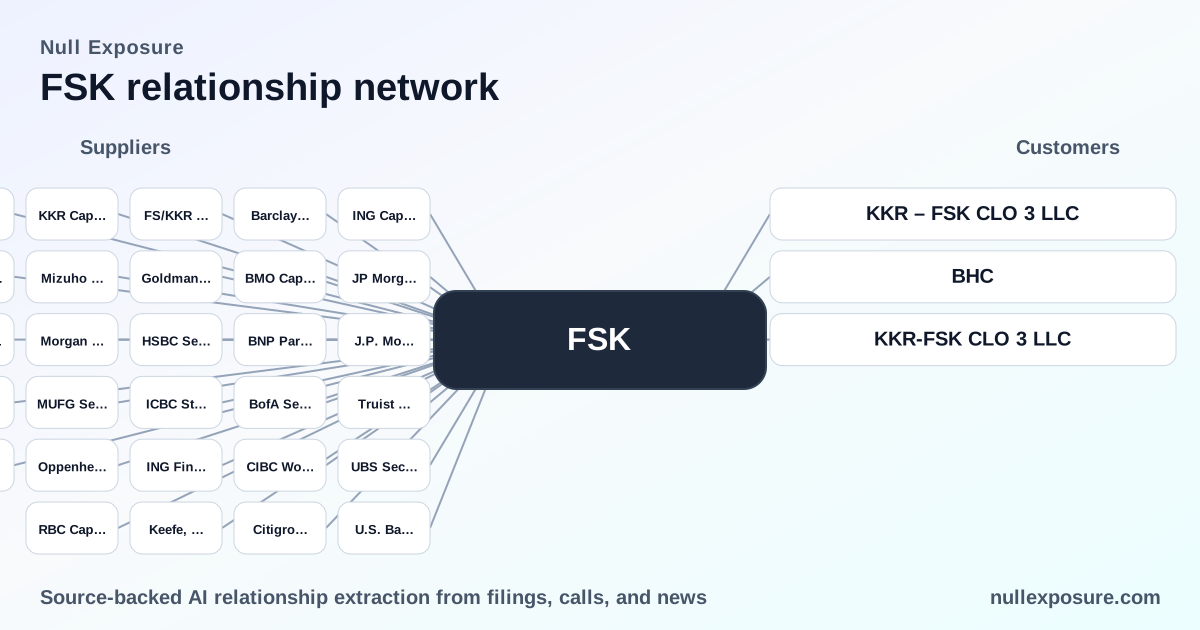
FS KKR Capital (FSK) — customer relationships and what they tell investors
FS KKR Capital Corp. operates as a lender and credit investor focused on U.S. middle‑market companies and monetizes through interest income on direct and syndicated loans, fee income from arranging and participating in structured financings, and capital markets transactions that move credit exposure off the balance sheet (for example, CLOs and private note placements). The firm’s commercial model blends originations and syndication with balance‑sheet management via securitizations and special‑purpose vehicles, creating multiple channels for liquidity and fee capture. For a deeper look at counterparties and transaction footprints, visit https://nullexposure.com/.
How to read FSK’s customer relationships: the strategic pattern
FSK’s customer footprint is defined by two related dynamics. First, a concentration on middle‑market U.S. issuers positions the company as a provider of bespoke senior secured and unitranche credit solutions. Second, the use of securitizations and CLO vehicles shows a deliberate contracting posture: FSK originates and accumulates assets, then monetizes and distributes risk through structured financings to institutional investors. These behaviors produce predictable income streams from coupon and fees while also introducing funding‑market sensitivity tied to CLO issuance and placement.
Key operating signals for investors
- Contracting posture: active asset transfer to SPVs and private placements, not pure buy‑and‑hold balance‑sheet lending. Evidence: completion of a term debt securitization and presale activity for a managed CLO (FY2025).
- Concentration: borrower mix skewed to middle‑market U.S. companies (EBITDA $50M–$150M), which can drive idiosyncratic credit risk but supports higher spreads than broadly syndicated lending.
- Criticality: participation as an initial lender in large non‑recourse facilities indicates FSK is a meaningful capital provider in syndicated or structured financings (example: a $600M facility to a named corporate counterparty).
- Maturity posture: use of multi‑tranche notes with extended maturities (transactions maturing into 2038) signals strategic use of long‑dated funding to match asset lives.
For research teams needing systematic monitoring of these behaviors, our coverage at https://nullexposure.com/ offers consolidated transaction tracing.
The record: every customer and counterparty mention in the file
Below are the relationships identified in the collected results, each described in plain English with a source reference.
KKR – FSK CLO 3 LLC (term debt securitization completed)
FSK’s wholly owned special purpose subsidiary, KKR – FSK CLO 3 LLC, completed a $389.5 million term debt securitization on December 18, 2025, transferring a diversified portfolio of primarily middle‑market loans and participation interests to the issuer and issuing multiple tranches of senior secured and deferrable floating‑rate notes and loans maturing in 2038. According to a press release covered by The Globe and Mail, the transaction provided cash proceeds to FSK in exchange for the initial collateral, with any excess fair value treated as a capital contribution (reporting on the Dec. 18, 2025 transaction; first seen Mar 2026). Source: The Globe and Mail press release coverage (reported Dec. 18, 2025 / seen Mar 9, 2026).
Bausch Health Companies Inc. (BHC) — $600 million non‑recourse financing facility (FSK as initial lender)
Bausch Receivables Funding LP, a subsidiary of Bausch Health, entered into a US $600 million non‑recourse financing facility arranged with KKR and its credit funds and accounts, where FS KKR Capital Corp. is listed among the initial lenders alongside other KKR vehicles and credit funds. PE‑Insights reported the facility and named FS KKR Capital Corp. as an initial lender in this corporate receivables financing (FY2024 reporting; reported Mar 2026). Source: PE‑Insights feature on Bausch Health financing (reported Mar 2026).
BHC (duplicate entry reported by the same source)
The same PE‑Insights item is recorded again in the source set: Bausch Receivables Funding LP’s US $600 million non‑recourse facility includes FS KKR Capital Corp. among initial lenders to the Bausch receivables vehicle, reinforcing FSK’s role as a syndication/participation lender in larger corporate finance structures (FY2024 reporting; seen Mar 2026). Source: PE‑Insights (reported Mar 2026).
KKR‑FSK CLO 3 LLC (presale rating for a separate CLO tranche)
A separate notice references a presale rating for “KKR‑FSK CLO 3 LLC” covering a $476.6 million CLO managed by the firm, indicating CLO market marketing activity and rating agency engagement ahead of tranche issuance. ad‑hoc‑news reported the presale rating for this managed CLO vehicle in FY2025 (reported Mar 2026). Source: ad‑hoc‑news reporting on presale rating activity (FY2025 / seen Mar 2026).
What these relationships imply for investors
- FSK is executing a dual strategy: originate middle‑market credit and then deploy securitization channels to diversify funding and crystallize capital. The pair of CLO references (presale for $476.6M and a completed $389.5M term issuance) shows active sequencing of managed vehicles and note placements.
- Counterparty profile is institutional and corporate: participation as a named initial lender in a $600M facility to a large corporate borrower like Bausch Health demonstrates FSK’s role standing alongside private credit funds and large asset managers. That elevates FSK’s placement in the syndicated/private financing market beyond purely retail BDC behavior.
- Funding and market sensitivity are real considerations: reliance on CLO issuance and private placements exposes FSK to investor demand and rating outcomes; the existence of long‑dated notes maturing in 2038 is a material feature of its maturity profile. Investors should monitor placement execution and rating trajectories as drivers of capital costs and balance‑sheet flexibility.
Risks and upside to watch
- Upside: fee capture and spread enhancement from structuring and placing CLOs and large receivables facilities can materially lift returns relative to simple buy‑and‑hold lending.
- Risk: concentration in U.S. middle‑market borrowers compresses diversification; credit stress in this segment could disproportionately affect asset quality.
- Execution risk: market appetite for CLO tranches and private placements is a gating factor — rating presales and completed transactions should be tracked for evidence of investor demand and pricing.
Bottom line and next steps
FSK’s customer relationships reflect a clear playbook: middle‑market credit origination plus active use of securitization and syndication to monetize assets and manage funding. The documented transactions — a completed $389.5M term securitization, a $476.6M presale rating for a managed CLO, and participation as an initial lender in a $600M facility to Bausch Health — collectively illustrate how FSK converts lending activity into diversified capital outcomes.
For investors and operating managers who want continuous tracking of these counterparty linkages and structured financing activity, explore our coverage at https://nullexposure.com/ for transaction‑level signals and relationship mapping.