First Solar (FSLR): Customer Footprint and Commercial Implications
First Solar operates as a vertically focused manufacturer and seller of CdTe thin‑film solar modules, monetizing primarily through the design, manufacture and long‑term sale of solar modules to system developers, independent power producers, utilities and other large project owners. The company converts manufacturing scale and U.S. production credentials into pricing power on projects where buyers prioritize tariff‑ and seizure‑risk mitigation, and it supplements cash flow through the structured sale of tax credits and selective IP licensing. For investors, the revenue story is driven by large, long‑dated module contracts, a heavily U.S.‑centric sales footprint, and recurring monetization of tax incentives. For a consolidated view of customer relationships and implications, visit https://nullexposure.com/.
How First Solar’s customer relationships shape cash flow and risk
First Solar’s commercial posture is contracted and project‑driven rather than spot retail. The company reported long‑term forward commitments—68.5 GW of modules at roughly $20.5 billion in aggregate consideration—to be recognized through 2030, which establishes a multi‑year revenue runway and reduces near‑term volume volatility. At the same time, the customer base is typical of large‑scale energy transactions: enterprise counterparties, project developers and utilities, primarily in the United States where 2024 invoicing accounted for the bulk of net sales.
- Contracting posture: Predominantly long‑term contracts that stretch revenue recognition to 2030, improving visibility but locking in product commitments and delivery schedules.
- Counterparty profile: Large enterprises (developers, IPPs, utilities) are the main buyers—transactions are structured and commercially significant rather than transactional retail.
- Geographic concentration: The U.S. dominates sales (93% of 2024 net sales cited in filings), which supports margin stability via domestic manufacturing incentives but concentrates policy and tariff risk.
- Customer concentration: No single customer accounted for 10%+ of module sales in 2024, indicating low single‑counterparty materiality despite large individual contracts.
- Business model drivers: First Solar is first and foremost a hardware manufacturer and seller of modules; service and licensing are complementary but not the primary revenue engine.
Together these dynamics create predictable top‑line recognition and margin profiles but expose investors to sector cycle effects (project pipelines, permitting) and U.S. policy shifts.
Relationship roll call: who buys from First Solar and why it matters
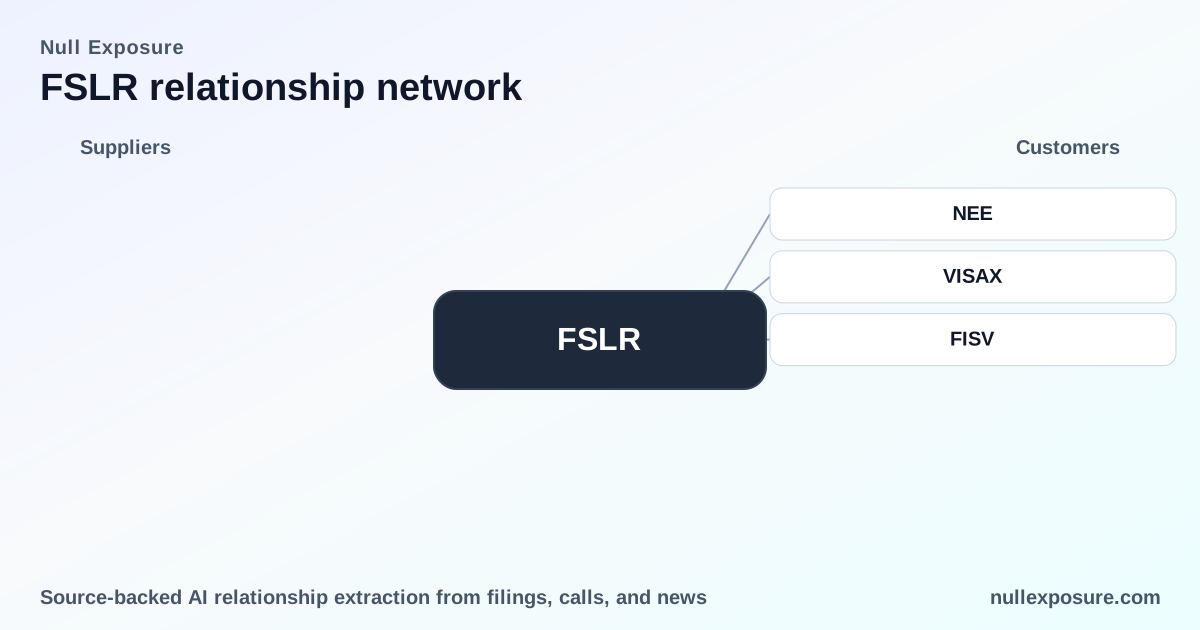
Below are every customer relationship cited in the available results, each summarized in plain English with the source noted.
NextEra Energy
NextEra and its developers are willing to pay a premium for First Solar modules to avoid border seizure and retroactive tariff risk, reflecting First Solar’s commercially valuable U.S. manufacturing footprint. (FinancialContent, Mar 6, 2026.)
NextEra Energy Resources, LLC
First Solar has executed construction and supply agreements with NextEra subsidiaries, including a historic 250 MW AC project in Riverside County, California, demonstrating an ongoing developer‑to‑manufacturer commercial relationship. (Yahoo News report referencing project announcement; archived reporting.)
Fiserv (FISV)
First Solar sold $687.2 million of Section 45X tax credits generated in 2023 to Fiserv for aggregate cash proceeds of $659.7 million, illustrating a structured tax‑credit monetization channel to financial technology and payments firms. (First Solar Form 10‑K, FY2024.)
Visa / VISAX
In December 2024, First Solar entered two agreements with Visa for the sale of $857.2 million of Section 45X tax credits for aggregate cash proceeds of $818.6 million, signaling the company’s use of large corporate counterparties to convert tax incentives into near‑term liquidity. (First Solar Form 10‑K, FY2024.)
Renewable Properties
Renewable Properties purchased 118 MW of Series 7 monofacial CdTe modules from First Solar’s U.S. plants, reflecting demand from smaller utility and community‑scale developers for domestically manufactured modules. (PV‑Magazine USA press release, May 2026.)
Tesla (TSLA)
First Solar’s public remarks in a Q1 2026 earnings call noted they would enter commercial licensing discussions if Tesla pursued a TOPCon product using First Solar IP, indicating First Solar leverages its IP as a complementary revenue stream when counterparties seek access. (Q1 2026 earnings call transcript reported by InsiderMonkey.)
GE Energy Financial Services
GE EFS is cited as an equity partner in large utility projects near First Solar construction sites, demonstrating the company’s role as an engineering and construction partner selling modules into financed, developer‑sponsored projects. (Yahoo News project coverage; historical project reporting.)
Sumitomo Corporation of America
Sumitomo is listed as a co‑owner in project joint ventures where First Solar provided construction and module supply, representing First Solar’s integration into consortia that combine developer, engineer and financial sponsor roles. (Yahoo News project coverage; historical reporting.)
Trina
First Solar disclosed it has licensed IP to Trina and that Trina is paying fair value for the technology enabling certain products, indicating selective licensing deals with other module manufacturers as a commercialization path for non‑CdTe technologies. (Q1 2026 earnings call transcript reported by InsiderMonkey.)
What investors should take away
First Solar’s customer relationships reveal a manufacturing‑led commercial model with predictable revenue from long‑dated supply contracts and supplemental liquidity through tax‑credit monetization. Key investment implications:
- Revenue visibility is strong: The 68.5 GW / $20.5 billion forward backlog provides multi‑year recognition, reducing execution uncertainty on volumes.
- Policy sensitivity is high but manageable: Heavy U.S. revenue exposure and the premium paid by buyers to avoid tariff/seizure risk create both a moat and a single‑jurisdiction policy dependence.
- Counterparty risk is dispersed: No single modules customer exceeded 10% of sales in 2024, limiting client concentration risk even as First Solar sells large capacity to enterprise buyers.
- Non‑core monetization reduces cash volatility: Sales of Section 45X credits to Visa and Fiserv converted tax incentives into immediate cash, materially supporting liquidity without relying on module shipments alone.
- Intellectual property is a lever: Licensing conversations (e.g., Trina, potential with Tesla) provide an ancillary revenue path and defensive commercialization of IP.
Investors evaluating FSLR should weight the stability of contracted module sales against U.S. policy concentration and the execution risk inherent in large project deliveries. For comparative relationship intelligence and structured summaries of other public companies, see https://nullexposure.com/.
Final view
First Solar’s customer book is characterized by large enterprise buyers and long‑term contractual commitments, anchored by a U.S. manufacturing advantage that supports premium pricing and tax‑credit monetization. That configuration delivers mid‑to‑long‑term revenue visibility and margin resilience, while concentrating risk in North American policy and project execution. For investors focused on the intersection of manufacturing scale, policy dynamics and structured commercial contracts, First Solar represents a clear, contract‑backed exposure to utility‑scale solar deployment.