Fortuna Silver Mines (FSM): Counterparty Transactions Reveal a Capital‑Recycling Playbook
Fortuna Silver Mines operates and monetizes by exploring, extracting and processing precious and base metals across Latin America and selectively divesting non‑core assets to fund core operations and growth. The company converts operating cash flow into balance‑sheet optionality—selling peripheral mines and offering small, targeted financing to counterparties—while maintaining an asset base large enough to support near‑term production and earnings stability. For an investor looking at counterparty exposure and customer relationships, these transactions read as deliberate portfolio management rather than revenue dependence on third parties.
Learn more about commercial relationship mapping at https://nullexposure.com/.
What recent deals tell investors about Fortuna’s operating posture
Fortuna’s recent deals reveal a focused strategy: explicit monetization of non‑core assets, selective deployment of small corporate financing, and engagement with regional private buyers rather than large strategic suitors. The company completed multiple asset sales and recorded small bridge financing to assist transaction close costs—actions consistent with an operator prioritizing capital recycling and balance‑sheet flexibility.
- Contracting posture: Fortuna executes definitive share purchase agreements and asset sale closings with local and regional buyers, indicating a transactional, contract‑based approach to non‑core divestitures rather than ongoing JV partnerships.
- Concentration and criticality: The transactions concern non‑core mines (for example, Yaramoko and San José‑related assets), so counterparty risk is non‑critical to Fortuna’s core revenue profile, given Fortuna’s 2025 revenue of about $947m and EBITDA of ~$548m.
- Maturity and scale: Financials (Market Cap ~$2.814bn, Profit Margin ~30.3%, Return on Equity ~18%) point to a mature mid‑cap miner that uses disposals to sharpen its portfolio and improve capital allocation.
- Liquidity posture: The offer of a secured bridging loan up to $3m to an acquirer demonstrates opportunistic, low‑scale credit deployment to smooth transactions, negligible relative to Fortuna’s market capitalization and cash‑generating capacity.
If you want a structured view of counterparties and how each relationship moved through the market, our mapping provides concise, source‑linked entries below. For broader coverage of counterparties and governance signals visit https://nullexposure.com/ for more analysis.
Recent counterparties — a concise ledger for investors
-
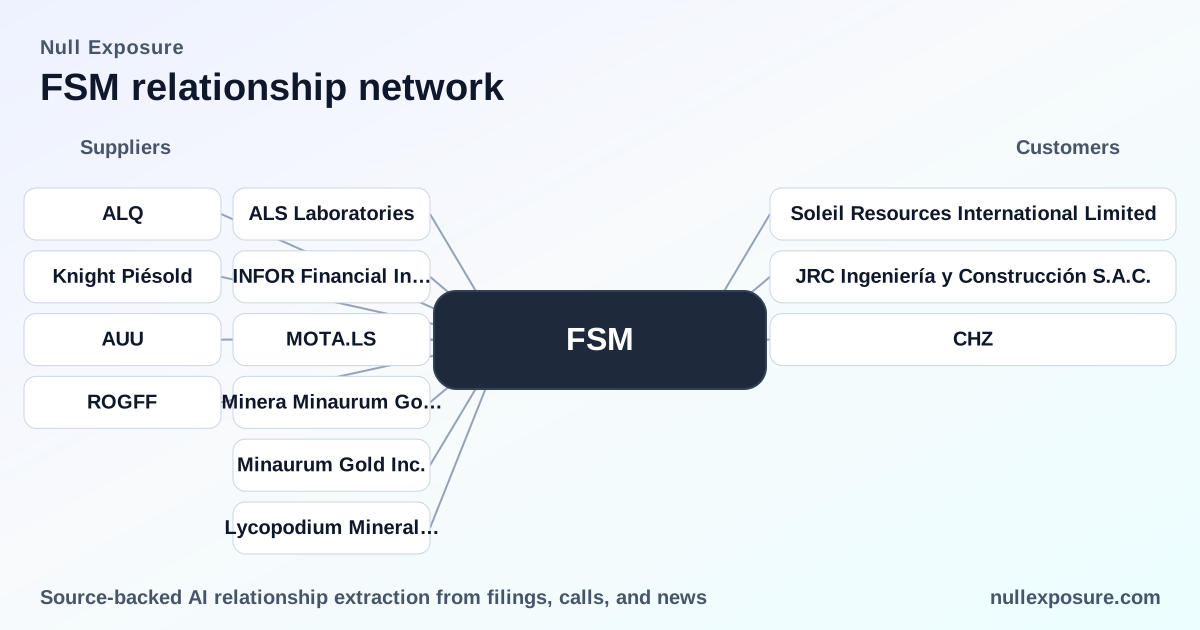
Soleil Resources International Limited — Fortuna entered into a definitive share purchase agreement to sell Roxgold Sanu SA (owner/operator of the Yaramoko Mine) and three other Burkina Faso subsidiaries that hold exploration permits; this is a straight divestiture of non‑core West African assets. According to a GlobeNewswire press release dated April 11, 2025, the transaction transfers operational and exploration liabilities to Soleil Resources International Limited.
-
JRC Ingeniería y Construcción S.A.C. — Fortuna completed the sale of its 100% interest in Compañia Minera Cuzcatlan S.A. de C.V. to JRC, marking a closing of a previously announced divestment of non‑core Mexican assets. The company announced the completion in a GlobeNewswire statement on April 14, 2025.
-
Jrc Ingenieria Y Construccion S.A.C. (reported acquisition detail) — Market reporting captured a purchase price detail for the same Cuzcatlan sale, noting JRC acquired the asset from Fortuna for $16 million on April 16, 2026, indicating reported price disclosure in secondary financial coverage. This figure is recorded in financial media coverage summarized on SimplyWall.st in April 2026.
-
Minas del Balsas S.A. de C.V. — Independent coverage recorded a binding letter agreement, dated January 15, 2026, in which Minas del Balsas agreed to acquire Compañia Minera Cuzcatlan from Fortuna for $17 million; this indicates that the Cuzcatlan asset attracted multiple offers and was subject to competing transaction reports. The transaction terms were reported on SimplyWall.st in early 2026.
-
Chesser Resources — Fortuna extended a secured bridging loan facility of up to $3 million to support Chesser’s transaction costs in the context of takeover activity, demonstrating Fortuna’s willingness to provide small, secured financing to counterparties executing transactions that intersect with Fortuna’s strategic objectives. This financing arrangement was reported by SmallCaps.com.au in coverage of the Chesser takeover discussions (reported in connection with fiscal year 2023 disclosures).
-
CHZ (ticker reference for Chesser Resources) — Market commentary replicated the same secured bridge loan detail with the CHZ ticker reference, confirming the financing was structured and disclosed publicly in takeover coverage; SmallCaps.com.au reported the arrangement in its takeover article. The loan represents a tactical, limited‑scale credit exposure relative to Fortuna’s balance sheet.
Interpreting the counterparty pattern: what investors should track next
- Capital‑allocation discipline is the dominant theme. Fortuna sells peripheral assets and uses proceeds to consolidate core operations and reduce optionality friction. Given reported revenue of ~$947m (TTM) and EBITDA of ~$548m, these disposals are material for portfolio simplification but not core revenue replacement.
- Counterparty diversity is increasing: buyers are private regional firms and project‑level acquirers rather than global miners, implying transactions will close faster but carry integration and political‑risk dimensions that investors should monitor via local operational disclosures.
- Credit exposure is immaterial: the $3m secured bridge to Chesser is a small fraction of Fortuna’s market cap (~$2.8bn) and operating cash flow, yet it signals opportunistic use of corporate capital to facilitate transactions that Fortuna judges strategically useful.
- Price discovery for non‑core assets is public and somewhat bifurcated — the Cuzcatlan references ($16m and $17m) show transaction prices are visible in market reporting and can vary as bids and binding agreements evolve.
Risk checklist and monitoring triggers for investors
- Monitor official closing statements and post‑closing working capital adjustments for each sale to confirm net proceeds and contingent liabilities. GlobeNewswire press releases serve as primary transaction confirmations; follow periodic company filings for the full financial treatment.
- Watch regional political and regulatory changes where divested assets operate (for example, Burkina Faso and Mexico), because operational and title risks transfer to new owners and can retroactively affect Fortuna’s contingent liabilities disclosures.
- Track follow‑on capital deployment: consistent reinvestment of proceeds into core mines or shareholder returns will validate the capital‑recycling thesis; divergence toward mid‑sized financing activities would require reassessment.
Bottom line
Fortuna’s recent counterparties and transactions reinforce a capital‑recycling, transaction‑driven operating model: selective asset sales to regional buyers, small targeted financing to facilitate deals, and use of proceeds to support core operations. For investors evaluating customer and counterparty exposure, these moves reduce operational concentration risk on non‑core assets while creating short‑term contractual counterparties whose credit and execution risk are manageable relative to Fortuna’s scale. Further diligence should focus on post‑closing accounting, any retained contingent liabilities, and the strategic use of sale proceeds.
Curious about mapping similar counterparty ecosystems for other names? Visit https://nullexposure.com/ for structured relationship intelligence and deal flow summaries.