Franklin Street Properties (FSP): The customer map investors need to know
Franklin Street Properties operates and monetizes as a specialized owner-operator of office real estate, generating cash flow through long-term commercial leases, property-level rental income and fee-based asset/property management services delivered by its subsidiaries FSP Investments LLC and FSP Property Management LLC. The company’s customer roster mixes corporate tenants, energy firms and professional services firms whose contracted rents and occupancy drive both recurring revenue and asset valuation. For a quick overview of how this tenant base shapes cash flow and risk, visit https://nullexposure.com/.
Why the customer list matters to your valuation
The tenant composition reveals three actionable characteristics of FSP’s operating model. First, lease tenor is long, with typical terms quoted at five to ten years, which structurally supports predictable rental revenue but also concentrates expirations (the company notes up to approximately 20% of rental revenue could expire annually). Second, geographic focus is domestic—the portfolio targets infill and CBD office properties in the U.S. Sunbelt, Mountain West and select opportunistic markets—so macro regional office dynamics will disproportionately affect performance. Third, FSP acts as a service provider to its portfolio and sponsored REIT via in‑house management and accounting capabilities, creating recurring fee streams and operational control but also dependency on internal management continuity.
Taken together, these signals imply stable, contract-based cash flow tempered by tenant concentration risk and regional office market exposure.
The full roster: what each relationship contributes (FY labels where available)
Below are the customer and counterparty relationships that appear in public filings and press coverage, with one-line commercial summaries and source context.
- CITGO Petroleum Corporation — Listed in FSP’s FY2026 disclosure with a line item of 248,399 representing 5.2% of the reported figure in that period, indicating CITGO is one of the largest single contributors to FSP’s FY2026 revenue mix. According to the company’s FY2026 results release (BizWire, Mar 9, 2026), CITGO is shown as a material tenant.
- EOG Resources, Inc. (EOG) — Appears in the FY2026 release with a 169,167 figure equal to 3.5% of the period total, identifying EOG as a meaningful office tenant within the portfolio (BizWire, Mar 9, 2026).
- Kaiser Foundation Health Plan, Inc. — Reported as 120,979 or 2.5% in FY2026, signaling healthcare-sector tenancy that diversifies industry exposure (BizWire, Mar 9, 2026).
- Deluxe Corporation (DLX) — Shown as 98,922 / 2.0% in FY2026, representing a mid-sized corporate tenant in the period’s revenue breakdown (BizWire, Mar 9, 2026).
- Ping Identity Corp. — Listed at 89,856 / 1.9% in the FY2026 release, reflecting a technology-sector lease within the portfolio (BizWire, Mar 9, 2026).
- Olin Corporation (OLN) — Reported with 81,480 / 1.7% in FY2026, adding manufacturing/industrial corporate tenancy to the mix (BizWire, Mar 9, 2026).
- Permian Resources Operating, LLC — Appears at 67,856 / 1.4% in FY2026, underlining continued exposure to energy-related tenants (BizWire, Mar 9, 2026).
- Hall and Evans LLC — Listed as 65,878 / 1.4% in FY2026, showing law firm tenancy across the portfolio (BizWire, Mar 9, 2026).
- Cyxtera Management, Inc. — Reported at 61,826 / 1.3% in FY2026, indicating data center / managed infrastructure tenancy within FSP properties (BizWire, Mar 9, 2026).
- Precision Drilling (US) Corporation — Shown at 59,569 / 1.2% in FY2026, reflecting another energy-sector tenant (BizWire, Mar 9, 2026).
- PwC US Group — Listed at 54,334 / 1.1% in FY2026, representing professional services tenancy (BizWire, Mar 9, 2026).
- Coresite, LLC — Appears at 49,518 / 1.0% in FY2026; another infrastructure-related tenant that diversifies cash flow (BizWire, Mar 9, 2026).
- Schwegman, Lundberg & Woessner, P.A. — Reported at 46,269 / 1.0% in FY2026, indicating specialized legal services tenancy (BizWire, Mar 9, 2026).
- Ark‑La‑Tex Financial Services, LLC. — Listed at 41,011 / 0.9% in FY2026, showing financial services exposure (BizWire, Mar 9, 2026).
- Moss, Luse & Womble, LLC — Appears at 34,071 / 0.7% in FY2026, another legal tenant in the roster (BizWire, Mar 9, 2026).
- QB Energy Operating, LLC. — Reported at 34,063 / 0.7% in FY2026, representing additional energy-industry tenancy (BizWire, Mar 9, 2026).
- Invenergy, LLC. — Listed at 35,088 / 0.7% in FY2026, signaling renewables/energy project-related occupancy (BizWire, Mar 9, 2026).
- International Business Machines Corporation (IBM) — Appears at 31,564 / 0.7% in FY2026, providing a large-cap technology tenant to the mix (BizWire, Mar 9, 2026).
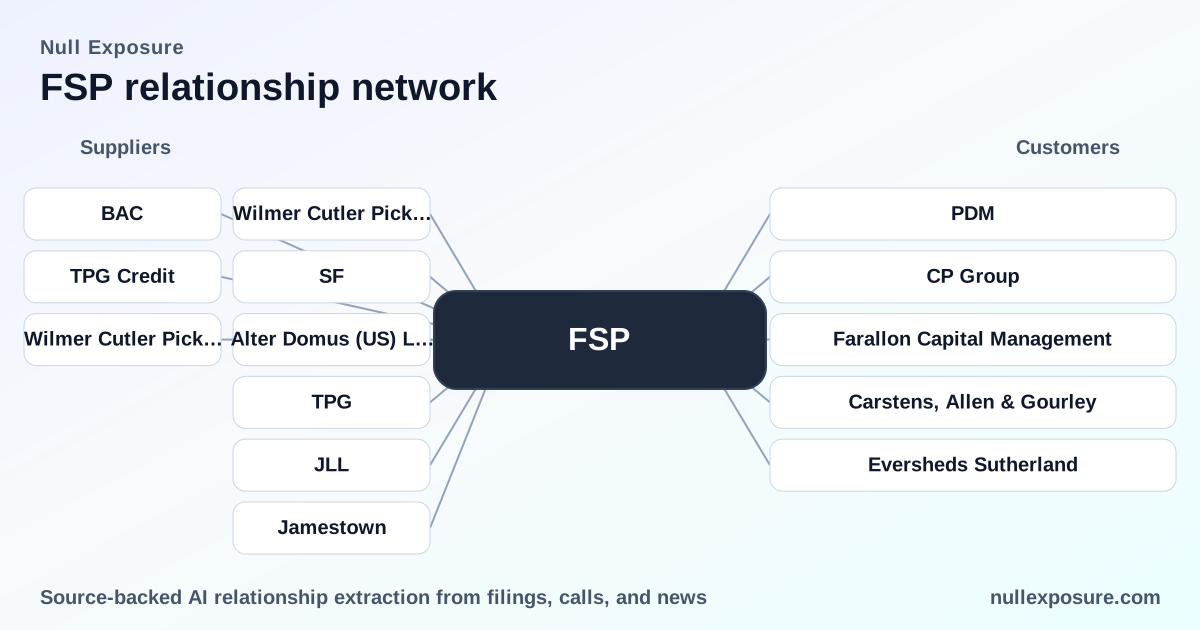
- PDM / Piedmont Operating Partnership, LP / Piedmont Office Realty Trust (PDM) — Multiple FY2021 filings and press items show Franklin Street sold or entered agreements related to 999 Peachtree Street and other assets to Piedmont entities, including a confirmed under-contract sale of a 622K SF tower for $223.9M (WhatNow and Bisnow coverage, FY2021).
- CP Group / Farallon Capital Management — Press reporting from FY2021 documents a CP Group / Farallon joint venture acquiring a three-property portfolio from Franklin Street, evidencing FSP’s disposition activity and third‑party capital partnerships (WhatNow and Bisnow, FY2021).
- Eversheds Sutherland — Identified as an anchor tenant at 999 Peachtree Street in reporting around that asset’s sale, indicating law‑firm anchoring on certain properties (WhatNow, FY2021).
- PDM (repeat references) — Piedmont’s acquisition activity and related confirmations are documented in Bisnow (FY2021) confirming material asset dispositions by FSP.
- Carstens, Allen & Gourley — Local brokerage coverage (REJournal, FY2022) notes Franklin Street acted as landlord in a relocation transaction, reflecting ongoing leasing and tenant services at the property level.
- KIM-P-L (Kimco) — A June 2025 JaxDailyRecord note shows Franklin Street acting as a leasing representative for Kimco at a River City Marketplace property, indicating third‑party leasing assignments or agency roles (JaxDailyRecord, Jun 27, 2025).
What these relationships mean for risk, valuation and operations
- Contracting posture and maturity: FSP’s reliance on five-to-ten year lease terms creates predictable near-term cash flow and supports cap-rate-based NAV calculations, but also schedules concentrated expirations (company note on lease expirations).
- Concentration: The FY2026 data show the largest single tenant contribution at ~5.2% (CITGO) with several other tenants in the 1–3.5% range; tenant concentration is moderate and investors should monitor the top 10 tenant roll‑forward.
- Criticality and diversification: The tenant base spans energy, professional services, health plans and technology, which diversifies industry exposure but concentrates geography in U.S. Sunbelt and Mountain West markets—so regional office fundamentals dominate performance.
- Service exposure: FSP’s role as an asset and property manager creates fee revenue and operational control, but also links valuations to in‑house management execution and contractual stability with sponsored entities.
Investment takeaways and next steps
- Primary thesis: Franklin Street delivers lease-backed, fee-enhanced cash flows driven by long-term tenants and active asset disposition activity. Investors should prioritize monitoring lease expirations, top-tenant roll rates and regional office vacancy trends.
- For deeper diligence on tenant roll‑forwards and governance of sponsored REIT arrangements, see the firm’s investor materials and filings and review recent asset sale disclosures at https://nullexposure.com/.
Bottom line: FSP’s customer list supports a stable income profile anchored by long-term leases and diversified industry exposure, but growth and downside protection depend on execution across leasing, asset sales and regional market cycles.