L.B. Foster (FSTR): Customer relationships that define a capital-light rail and infrastructure supplier
Thesis: L.B. Foster monetizes through the sale and installation of engineered rail and infrastructure products, recurring long‑term supply agreements, and project services across distribution and precast manufacturing lines; the company collects product revenue plus contractual service margins and preserves cash flow through backlog conversion and selected divestitures. For investors, the critical questions are contract tenor, customer concentration, and the revenue sensitivity to order cancellations and settlements—factors that have driven recent headline volatility. Learn more on the company profile at the Null Exposure homepage: https://nullexposure.com/.
What the customer footprint tells investors about the operating model
L.B. Foster operates as a hybrid manufacturer-distributor and service provider. Revenue derives from product sales (rail, precast, steel) and project/service contracts that are frequently performed over time under long‑term agreements, which creates predictable backlog conversion but also ties working capital to project timing. The company shows a North America‑heavy revenue base with global rail reach, combining U.S. manufacturing and distribution hubs with export activity in Europe and Asia.
Key operating characteristics for valuation and operational risk:
- Contracting posture: the business relies on long‑term customer arrangements and multiyear project contracts where performance obligations are satisfied over time, supporting recurring revenue visibility.
- Concentration: headline single-customer disclosures are small in absolute dollars relative to consolidated revenue (company signal of a sub‑$100k single customer reference), implying limited single‑counterparty financial dependency.
- Criticality and maturity: customers include major Class I railroads and regional operators, giving high operational criticality to certain product lines (e.g., concrete crossties, rail distribution), while the Infrastructure segment reflects a more projectized, mid‑cycle revenue profile.
- Role diversity: L.B. Foster functions as seller, manufacturer and service provider, operating manufacturing plants, distribution centers, and offering aftermarket/project services that each carry distinct margin and working‑capital dynamics.
- Geographic spread: North America is dominant, but the firm maintains global rail market access—this matters for currency, logistics, and pricing power.
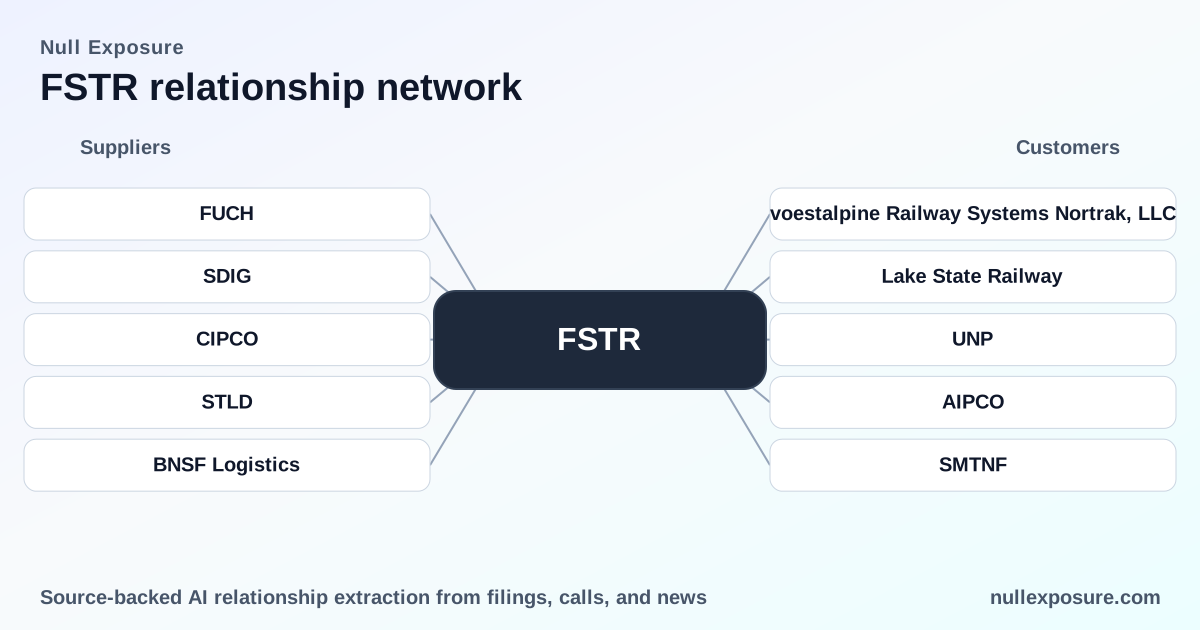
Below I catalogue the customer relationships surfaced in public reporting and trade press; each entry is a plain-English summary with source context.
Relationship snapshots — what public reporting and trade press document
voestalpine Railway Systems Nortrak, LLC (FY2023)
L.B. Foster completed the sale of substantially all operating assets of its CXT prestressed concrete railroad tie business in Spokane to voestalpine Railway Systems Nortrak, LLC, reflecting portfolio rationalization in the precast tie business. Railway Age reported the transaction as announced on July 5 (RailwayAge.com, FY2023): https://www.railwayage.com/mw/l-b-foster-sells-cxt-subsidiary-to-nortrak/
JD Fields & Co. (FY2021)
L.B. Foster sold its steel piling products division to JD Fields & Co., an earlier divestiture that reduced exposure in piling and steel products and sharpened focus on core rail and infrastructure offerings (Houston Business Journal, 2021): https://www.bizjournals.com/houston/news/2021/09/27/lb-foster-steel-piling-products-division-jd-fields.html
Union Pacific / UNP — multi‑year supply relationship (FY2012 reported; recurring mentions through FY2026)
L.B. Foster secured a multi‑year contract extension to supply prestressed concrete railroad ties from its Tucson facility to Union Pacific, a long-standing commercial relationship that underpins rail segment revenues and backlog. The contract extension was reported in RT&S (FY2012) and the Union Pacific relationship is referenced repeatedly in later earnings commentary regarding settlement payments and cash flow (RT&S; Investing.com transcripts; Globe and Mail, FY2012–FY2026): https://www.rtands.com/track-construction/track-structure/ballast-ties-rail/lb-foster-union-pacific-enter-agreement-for-concrete-crossties/ and https://www.investing.com/news/transcripts/earnings-call-transcript-lb-foster-misses-q1-2025-eps-forecast-stock-drops-109-93CH-4025593
Union Pacific — settlement payments and cash‑flow impact (FY2025)
Management disclosed that average free cash flow in 2023–2024 excluded approximately $8.0 million of Union Pacific payments that are now behind the company, a disclosure that materially affects cash‑flow run‑rate analysis for those years (Investing.com earnings call transcript, Q1‑2025): https://www.investing.com/news/transcripts/earnings-call-transcript-lb-foster-misses-q1-2025-eps-forecast-stock-drops-109-93CH-4025593
Union Pacific — settlement completion and adjusted FCF (FY2026)
In Q4 commentary management reiterated that over the last three years average free cash flow was about $28.0 million excluding Union Pacific settlement payments, which were completed at the end of 2024; this frames normalized cash generation for valuation modeling (Investing.com / Globe and Mail Q4‑2025/Q4‑2025 transcript coverage, FY2026): https://www.investing.com/news/transcripts/earnings-call-transcript-lb-foster-misses-eps-forecast-revenue-beats-in-q4-2025-93CH-4538185 and https://www.theglobeandmail.com/investing/markets/stocks/FSTR/pressreleases/537270/lb-foster-fstr-q4-2025-earnings-transcript/
Lake State Railway (FY2025)
L.B. Foster developed and delivered a 320‑foot rail for Lake State Railway to improve distribution efficiency, illustrating product innovation and execution for short‑line rail customers (RT&S supplier news, FY2025): https://www.rtands.com/supplier-news/l-b-foster-developed-and-delivered-the-first-320-rail-to-lake-state-railway/
AIPCO (FY2025)
Management noted that L.B. Foster acted as an in‑line coater for AIPCO and that a contract cancellation was initiated by the customer, highlighting order cancelation exposure in coating/steel services (InsiderMonkey transcript, Q3‑2025): https://www.insidermonkey.com/blog/l-b-foster-company-nasdaqfstr-q3-2025-earnings-call-transcript-1639875/
Summit / SMTNF / SUMMITSEC.BSE — order cancellation and backlog impact (FY2025‑FY2026)
A $19.0 million Summit protective‑coating order cancellation materially reduced Infrastructure net orders and lowered backlog, an event management cited across earnings transcripts that directly affected near‑term revenue recognition in bridgeforms and precast concrete lines (Investing.com; Globe and Mail; InsiderMonkey, FY2025–FY2026): https://www.investing.com/news/transcripts/earnings-call-transcript-lb-foster-misses-eps-forecast-revenue-beats-in-q4-2025-93CH-4538185 and https://www.theglobeandmail.com/investing/markets/stocks/FSTR/pressreleases/537270/lb-foster-fstr-q4-2025-earnings-transcript/ and https://www.insidermonkey.com/blog/l-b-foster-company-nasdaqfstr-q4-2025-earnings-call-transcript-1708869/
What investors should take away — sizing the risk and the optionality
- Backlog and long‑term contracts provide revenue visibility, but the business remains exposed to mid‑cycle cancellations and project timing (as shown by the Summit cancellation and customer‑initiated changes such as the AIPCO coating order).
- Single‑customer concentration is not financially significant on reported figures (company disclosure shows a referenced rail customer at ~$71.8k for the year), so commercial risk is more about portfolio composition and project volatility than single counterparty default.
- Settlements and one‑off items (Union Pacific) distort free‑cash‑flow comparables; normalize cash flow for valuation by excluding these discrete items per management commentary.
- Geographic diversification is real but North America dominates; investors should model U.S. infrastructure cycles and Class I maintenance capex when forecasting demand for key product lines.
If you want a concise scorecard of counterparty exposure, portfolio shifts, and order‑book movements for modeling, visit https://nullexposure.com/ for the full company profile and curated relationship summaries.
Final thought
L.B. Foster combines manufacturing and distribution economics with projectized infrastructure work; the mix yields steady recurring margins when contracts run to completion but creates episodic volatility when large orders cancel or settlements occur. For equity investors, the valuation hinges on normalized free cash flow post‑settlements, backlog conversion, and management’s execution on the restructured product portfolio.