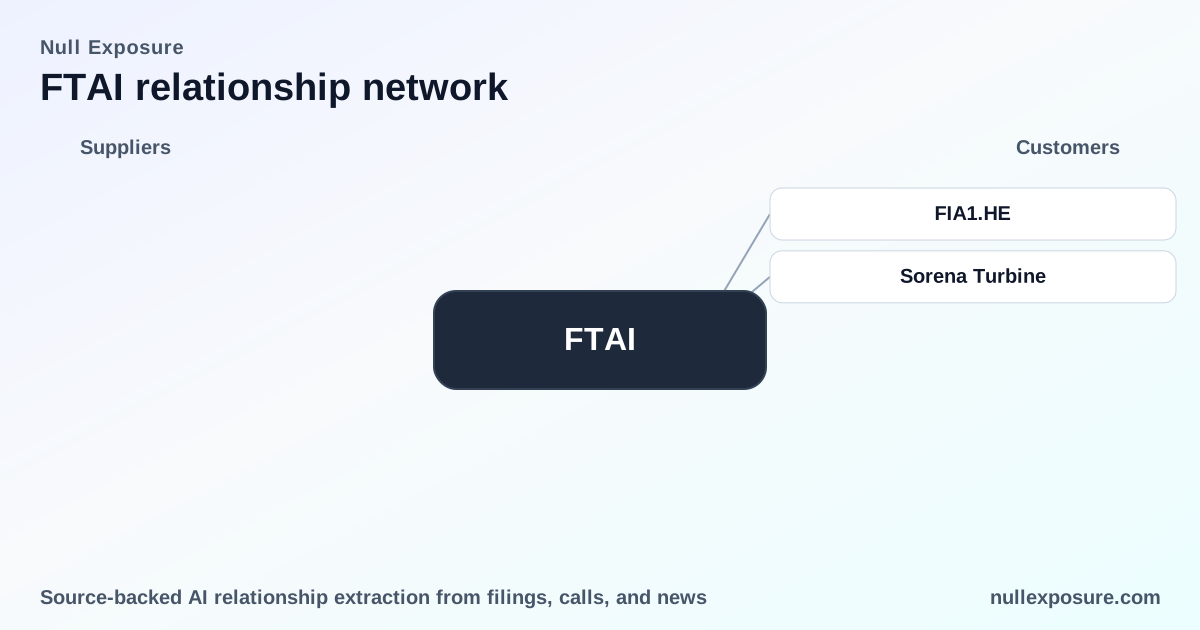
FTAI Aviation Ltd.: Customer relationships that shape cash flow and operational risk
FTAI Aviation Ltd. monetizes a dual model: it leases aircraft and engines to global carriers and operators while manufacturing and servicing aftermarket engine components, generating recurring lease cash flows and aftermarket sales and MRO revenue. The company’s financial profile—$24.6 billion market cap, $2.84B revenue TTM, $1.02B EBITDA—reflects the combination of long-lived leasing assets and higher-margin aerospace products and services that drive predictable, asset-backed cash flow.
Explore more company relationship intelligence at https://nullexposure.com/
Key financial context investors need up front
- Market capitalization: $24.62B.
- Revenue TTM: $2.836B; EBITDA: $1.020B; Profit margin: 18.9%.
- Operational split: Aviation Leasing (long-term operating leases) and Aerospace Products (manufacture, repair, sell CFM56 and V2500 components).
How FTAI contracts, customers and geographies shape risk and optionality FTAI’s customer signals reveal a contracting posture weighted to long-term, structural cash flow with a secondary cohort of short-duration engine exchanges. Company disclosures state a weighted average remaining lease term of roughly 47 months for aircraft and 22 months for engines, and the firm reports contracted minimum future annual cash flows under operating leases, which supports revenue visibility. At the same time, the engine exchange business and aftermarket services introduce more transactional, shorter-duration exposure alongside the leasing base.
Geographically, FTAI serves a global customer base—North America, Europe, Asia and Latin America are material—so geopolitical and regulatory risk is diffuse but persistent across jurisdictions. Customer concentration is low: no single customer or lessee accounted for more than 10% of revenue as of year-end 2024, which reduces single-counterparty credit risk but increases dependence on the macro aviation cycle. FTAI is both a lessor and a manufacturer/seller, operating active relationships across leasing and MRO/manufacturing segments, which creates diversified revenue streams but requires multi-disciplinary operational execution.
Customer relationships: concise, sourced takeaways Below are every relationship item captured in the source results, each with a plain-English takeaway and a tight source reference.
MARA / Marathon Digital Holdings — Long Ridge Energy & Power transaction
FTAI Infrastructure Inc. agreed to sell its Long Ridge Energy and Power assets to MARA Holdings, Inc., a transaction that represents a non-core asset disposition from FTAI’s infrastructure arm and reduces exposure to power-generation operating subsidiaries. According to MarketBeat’s coverage referencing a Yahoo Finance announcement in late March 2026, the sale to MARA was publicized as part of FTAI Infrastructure’s strategic disposals (MarketBeat / Yahoo Finance, March 2026).
MARA (second mention) — coverage reiteration
Market commentary repeated the same Long Ridge sale story in mid-March 2026, underscoring market attention and liquidity implications for the infrastructure division ahead of consolidation activity. MarketBeat’s March 24, 2026 alert reiterated the transaction details and market reaction (MarketBeat, March 24, 2026).
Finnair Plc — Perpetual Power engine exchange agreement (Investing.com)
FTAI signed a multi-year Perpetual Power Agreement with Finnair covering 36 CFM56-5B engines, where FTAI provides engine exchanges in lieu of shop visits to enhance fleet reliability and cost predictability for the airline. Investing.com reported this commercial arrangement in early March 2026 as a material commercial win for FTAI in its engine-exchange and aftermarket services line (Investing.com, March 2026).
Finnair Plc — Perpetual Power engine exchange agreement (MarketScreener)
MarketScreener covered the same Finnair deal and highlighted the strategic fit: engine exchange services reduce downtime for operators and create predictable service revenue for FTAI under a perpetual-power commercial structure (MarketScreener, March 9, 2026).
Finnair / FIA1.HE (duplicate listing) — same commercial agreement captured under alternate ticker
A duplicate Marketscreener notice listed the Finnair agreement under an alternate Finnair ticker reference, reinforcing that this is an active, multi-year services engagement for 36 engines and a continuation of FTAI’s aftermarket growth strategy (MarketScreener, March 2026).
Sorena Turbine — Muddy Waters images and brand placement
A third-party short-seller report (Muddy Waters) included images from Sorena Turbine, an MRO in Tehran, showing an FTAI module factory-branded box; the report raised questions about whether that image represented a single anomaly or a broader pattern of potentially problematic distribution channels. A GlobeNewswire press release documenting market reaction and Muddy Waters’ assertions was published in March 2025 (GlobeNewswire / Muddy Waters reference, March 10, 2025).
Sorena Turbine (second entry) — press release duplicate
A duplicate GlobeNewswire item repeated the Muddy Waters imagery claim and the subsequent market commentary, reinforcing reputational and compliance scrutiny around third-party handling of parts that carry U.S. export control and sanctions implications (GlobeNewswire, March 2025).
What investors should take from these relationships
- Commercial strength: The Finnair perpetual-power commitment is a clear example of FTAI converting manufacturing and inventory capacity into long-duration service revenue, improving revenue visibility and aftermarket margins. The Finnair relationship directly validates FTAI’s strategy to scale engine-exchange programs.
- Asset recycling and focus: The Long Ridge sale to MARA indicates FTAI’s willingness to divest non-core infrastructure holdings to sharpen capital allocation on core aviation leasing and aerospace products. Asset monetization supports balance-sheet optionality.
- Reputational and compliance risk: The Muddy Waters–Sorena Turbine thread introduces a regulatory and sanction-compliance angle that requires active management; images linking FTAI-branded boxes to an Iranian MRO drove adverse market headlines in early 2025. Operational controls over third-party distribution channels are a salient risk vector.
Operational constraints and how they affect customer risk management FTAI’s relationship fabric is shaped by a mix of long-term leasing contracts (structural cash flow) and shorter-term, higher-frequency engine exchanges and MRO engagements (transactional revenue). The company’s disclosure of lease term lengths and the fact that no single customer accounts for over 10% of revenue are company-level signals that point to diversified, durable cash flows with operational complexity across geographies. The global footprint—North America, Europe, Asia, Latin America—is a deliberate commercial design that spreads market and regulatory exposure but requires rigorous compliance controls.
Final investor take FTAI combines predictable, asset-backed leasing cash flows with higher-growth aftermarket services that capture margin upside; the Finnair win demonstrates commercial execution on the aftermarket strategy, while the Long Ridge sale shows active portfolio management. Key risks include geopolitically driven compliance exposures and the operational challenge of coordinating manufacturing, MRO, and leasing at scale. For ongoing relationship intelligence and to track how counterparties and transactions evolve, visit https://nullexposure.com/ for deeper coverage and updates.