FTAIN: A predictable engine-leasing operator with expanding third‑party partnerships
Fortress Transportation and Infrastructure Investors (FTAI) operates a dual aviation business: it owns and leases aircraft and engines while also manufacturing and servicing aftermarket components for the dominant CFM56 engine family. The firm monetizes through long‑term operating leases and recurring aftermarket services, producing a capital‑intensive, cash‑flow driven profile underpinned by a broad geographic footprint and a diversified lessee base. For investors, the key investment thesis is straightforward: stable contracted lease cash flows plus higher‑margin aftermarket services create a resilient revenue mix with expansion optionality from strategic partner agreements. Learn more on the platform that aggregates these customer signals: https://nullexposure.com/.
How FTAI makes money and why that matters to investors
FTAI’s revenue mix combines lease income from the Aviation Leasing segment and higher‑margin sales and repair work from the Aerospace Products segment. The company reported trailing revenues of roughly $2.84 billion with gross profit near $1.03 billion, demonstrating that aftermarket work meaningfully lifts margins compared with pure leasing. Lease cash flows provide durability; aftermarket services drive margin expansion and scalability when paired with third‑party agreements.
A secondary lever for returns is asset disposition — selling engines and teardown inventory when parts recover value — which supplements recurring income and supports free cash generation. This hybrid model produces operating leverage as service contracts and platform agreements scale.
Operating characteristics and company‑level constraints
FTAI’s operating model shows several clear, investor‑relevant characteristics drawn from company disclosures:
- Long‑term contracting posture. The company discloses contracted minimum future lease revenue extending several years — a structural feature that supports predictable free cash flow (e.g., disclosed minimum annual operating lease revenues for 2025–2029 and beyond as of Dec. 31, 2024).
- Large enterprise counterparties. Customers and lessees are primarily global transportation operators and industrial firms, including airlines, indicating enterprise‑grade credit and procurement cycles.
- Global revenue footprint. Revenues are geographically diversified across North America, Europe, Asia and South America, with Europe and North America representing meaningful shares on a company disclosure of geographic revenue composition for the year ended Dec. 31, 2024.
- Customer concentration is immaterial. No single customer or lessee accounted for more than 10% of revenue or receivables in the fiscal year ended Dec. 31, 2024, which reduces counterparty concentration risk.
- Dual segment maturity. The business combines manufacturing/repair capabilities (engine development, repair/refurbishment and aftermarket components) with service/asset leasing (owning and leasing engines and aircraft), creating complementary revenue streams and cross‑selling potential.
These constraints define FTAI as a capital‑intensive operator with predictable lease cash flows, diversified global demand, and higher‑margin service lines that amplify returns when volume and partner reach increase.
Customer and partner relationships — what investors should track
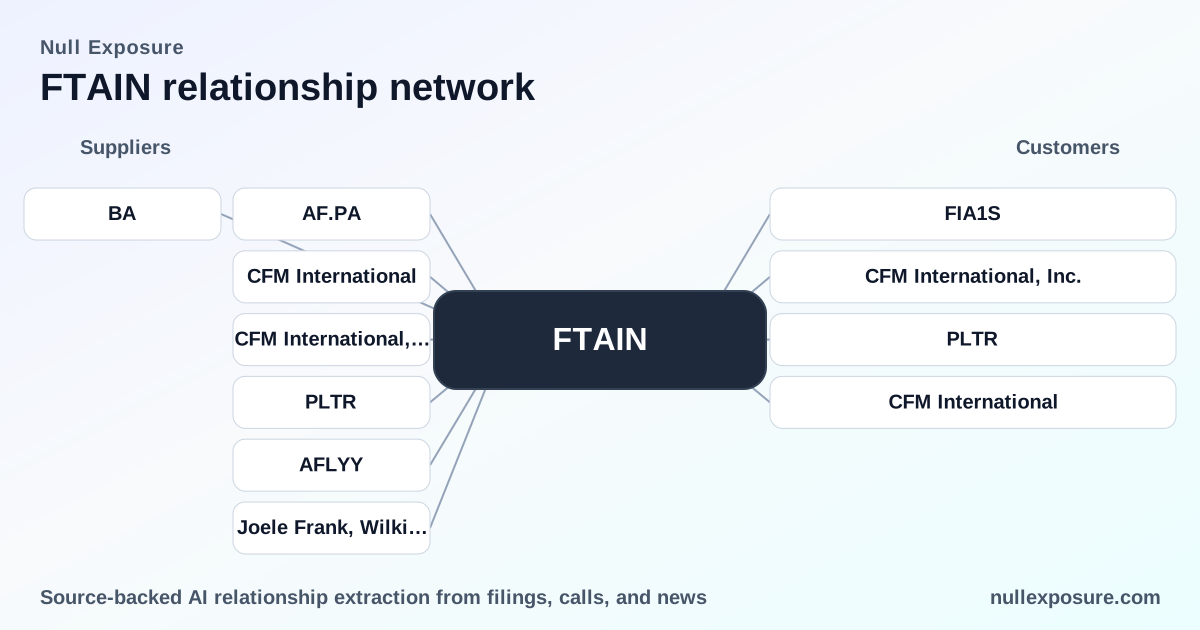
Below I list every relationship identified in recent coverage and summarize the commercial signal each conveys.
APOC Aviation — teardown buyer (LARA News, May 3, 2026)
APOC Aviation purchased MSN 4533 from FTAI for teardown, signaling active secondary‑market disposition of airframe/engine assets and execution of the company’s asset monetization strategy (https://www.laranews.net/apoc-aviation-acquires-a320-200-for-teardown/, May 3, 2026).
Finnair — multi‑year Perpetual Power Agreement for 36 CFM56‑5B engines (Intellectia.ai, Mar 9, 2026)
FTAI signed a multi‑year Perpetual Power Agreement with Finnair covering 36 CFM56‑5B engines to enable engine exchanges and improve fleet reliability and maintenance cost predictability, reflecting direct airline contracting for engine pool access (https://intellectia.ai/news/etf/is-now-the-time-to-look-at-buying-ftai-aviation-ltd-nasdaqftai, Mar 9, 2026).
FIA1S — duplicate report of the Finnair agreement (Intellectia.ai, Mar 9, 2026)
A second reference in the same article lists the counterparty as FIA1S while describing the same perpetual engine exchange agreement for 36 CFM56‑5B units, reinforcing the significance of the Finnair deal in market commentary (https://intellectia.ai/news/etf/is-now-the-time-to-look-at-buying-ftai-aviation-ltd-nasdaqftai, Mar 9, 2026).
CFM International, Inc. — multi‑year component and repair support (Yahoo Finance / SG, Mar 9, 2026)
FTAI executed a multi‑year agreement with CFM International to provide component and repair support for CFM56 engines — a strategic alignment with the OEM joint venture that leverages FTAI’s aftermarket capabilities across the largest commercial engine fleet (https://sg.finance.yahoo.com/news/ftai-aviation-announces-multi-materials-133000272.html, Mar 9, 2026).
Palantir — platform partnership referenced in earnings coverage (SimplyWall, Mar 9, 2026)
Company commentary around FTAI’s FTAI Power platform cites a new multi‑year agreement with Palantir that expands the company’s operating reach, suggesting data/technology partnerships are being used to scale operational efficiency or product offerings (https://simplywall.st/stocks/us/capital-goods/nasdaq-ftai/ftai-aviation/news/a-look-at-ftai-aviation-ftai-valuation-after-earnings-beat-a, Mar 9, 2026).
PLTR — duplicate reference to Palantir partnership (SimplyWall, Mar 9, 2026)
A duplicate listing identifies PLTR (Palantir’s ticker) in coverage of FTAI’s platform and multi‑year agreements, reiterating that software or analytics partnerships are part of FTAI’s go‑to‑market expansion (https://simplywall.st/stocks/us/capital-goods/nasdaq-ftai/ftai-aviation/news/a-look-at-ftai-aviation-ftai-valuation-after-earnings-beat-a, Mar 9, 2026).
CFM International — additional coverage of the same OEM agreement (SimplyWall, Mar 9, 2026)
A secondary reference to CFM International in the same earnings‑focused coverage underscores that the OEM relationship is a public, market‑moving commercial agreement for CFM56 component and repair support (https://simplywall.st/stocks/us/capital-goods/nasdaq-ftai/ftai-aviation/news/a-look-at-ftai-aviation-ftai-valuation-after-earnings-beat-a, Mar 9, 2026).
What these relationships imply for growth and risk
- Revenue durability and optionality. Long‑term leases and perpetual power/engine exchange agreements (e.g., Finnair) lock in recurring cash flows while enabling higher aftermarket capture through service agreements.
- OEM alignment matters. The CFM International agreement is strategically material: CFM56 is the largest engine population, and OEM cooperation gives FTAI access to parts, technical pathways and a large customer base. This raises the company’s addressable aftermarket opportunity.
- Platform and analytics tie‑ins. Agreements cited with Palantir position FTAI to extract operating efficiencies and productize services (FTAI Power), which can improve margins and asset utilization.
- Asset disposition channels are active. The APOC teardown transaction demonstrates the company’s ability to monetize end‑of‑life assets and realize residual value.
Key takeaways for investors
- FTAI’s earnings profile combines predictable lease cash flow with scalable aftermarket margins; recent multi‑year deals with CFM and airline counterparties accelerate that dynamic.
- Geographic and customer diversification limits concentration risk, while OEM and technology partnerships increase operational leverage.
- Monitor OEM execution, utilization metrics on engine pools, and incremental margin from platform contracts as early indicators of earnings conversion.
If you want ongoing tracking of FTAI’s customer relationships and commercial disclosures, visit https://nullexposure.com/ for curated signals and source links.