Frontdoor (FTDR): Customer Relationships and Commercial Signals Investors Should Price In
Frontdoor monetizes a large, subscription-based home warranty and services franchise: the company sells annual service plans that cover repair and replacement of home systems and appliances, supplements warranty income with non-warranty services and new-home structural warranties, and drives profitability through scale, renewals and partnerships that feed distribution and aftermarket revenue. With roughly $2.12 billion in trailing revenue and a leading U.S. position, Frontdoor’s economics are driven by recurring, short-term contracts that convert into high renewal rates and growing ancillary services. For a concise view of Frontdoor’s offering and partner activity, visit https://nullexposure.com/.
How Frontdoor’s customer relationships define the operating model
Frontdoor’s customer-facing model is structured around several clear commercial characteristics that matter to investors:
- Contracting posture — short-duration, subscription revenue: Frontdoor’s core product is an annual home warranty plan. This creates predictable but short-term exposure to churn and retention dynamics; investors should model volatility at renewal windows rather than long-term locked-in contracts. The company itself notes that “home warranty contracts are typically one year in duration.”
- Recurring revenue and renewal-driven predictability: The firm reports that a large majority of revenue is renewal-derived — 78% of 2024 revenue came from existing customer renewals, which underpins margin stability and predictable cash flow.
- Geographic concentration — U.S. centric: Frontdoor operates primarily in the United States and reported approximately 2.1 million active home warranties as of December 31, 2024, indicating national scale but limited geographic diversification.
- Customer concentration and materiality: New-home builder relationships are numerous but individually immaterial; the company disclosed roughly 19,000 builder customers with no single builder representing more than 5% of new-home structural-warranty revenue. This reduces counterparty concentration risk in that segment.
- Seller and services orientation: Frontdoor is the seller of warranties and an increasingly active provider of non-warranty home services through its app and partnerships, signaling an expanding addressable market beyond pure warranty premiums.
- Maturity and scale: As the leading U.S. home-warranty provider by revenue, Frontdoor’s scale supports contractor networks, marketing, and SEO-driven distribution that partnerships can amplify.
These constraints are company-level signals drawn from Frontdoor’s disclosures and public commentary as of late 2024 and early 2026.
The partners on record and what they mean for growth
Below are the customer-side relationships that Frontdoor publicly highlighted in recent company commentary and reporting.
SkySlope — an expanding integration that feeds distribution
Frontdoor described SkySlope as an existing partner whose relationship was recently expanded, implying deeper distribution or transactional routing from SkySlope’s real-estate workflow into Frontdoor’s offering. According to the company’s Q1 2026 earnings call transcript published on Investing.com, management noted: “SkySlope, we’ve had an ongoing relationship with them, the announcement you saw was an expansion of that relationship.” (Investing.com, Q1 2026 earnings call transcript).
Two Ten — SEO and product integration driving new demand
Frontdoor reported that integrating Two Ten onto its platform has improved SEO performance and user experience, which is already translating into increased demand through digital channels. Management referenced this uplift on the Q1 2026 earnings call: “we have started to see increased demand from the integration of Two Ten onto our platform with better SEO performance and an improved user experience.” (Investing.com, Q1 2026 earnings call transcript).
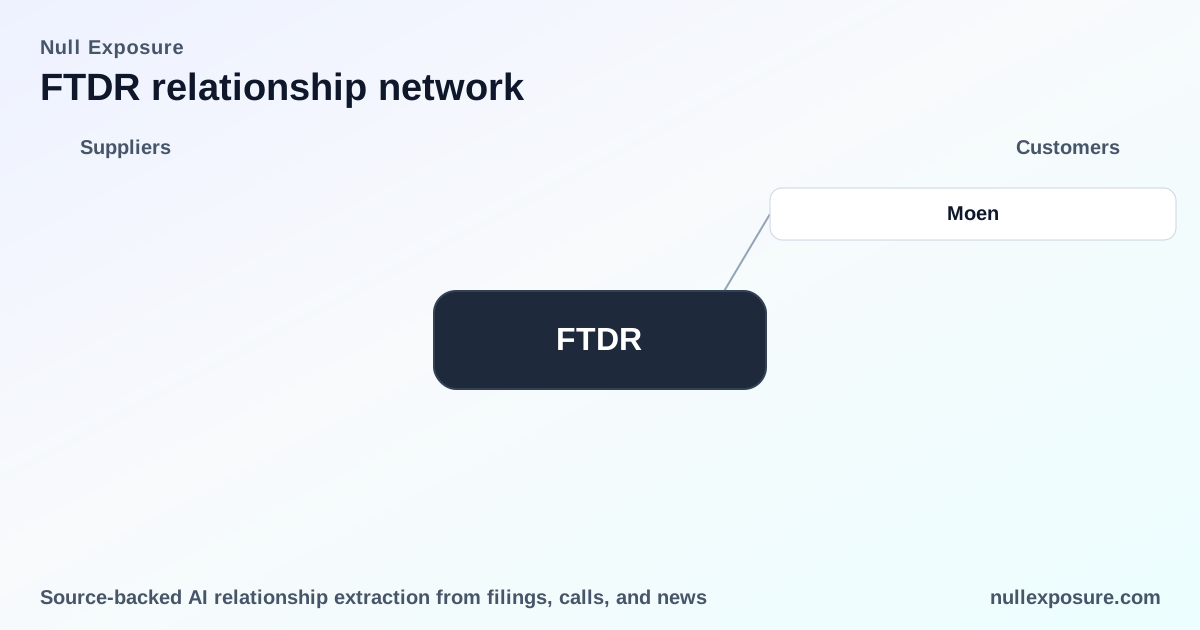
Moen — a non-warranty program contributing to revenue expansion
Moen is cited as a driver of Frontdoor’s non-warranty and other revenue growth, which increased materially year-over-year; the company attributes part of a 66% rise in non-warranty revenue to new HVAC and Moen programs as well as expansion in new-home warranty revenue. That detail was noted in Frontdoor’s FY2025 results coverage. (TradingView news report, March 9, 2026).
Why these relationships matter for valuation and risk
The trio of relationships—SkySlope, Two Ten and Moen—illustrates Frontdoor’s dual strategy: protect core warranty revenue through renewal economics while scaling adjacent revenue channels via partnerships and digital integrations.
- Customer acquisition and margin mix: Integrations like Two Ten improve organic search and UX, lowering customer acquisition cost and improving conversion funnels; if sustained, this supports higher lifetime value per customer.
- Revenue diversification: Moen and other non-warranty programs are already contributing to faster-growing revenue lines, increasing the share of higher-margin services over time. Frontdoor reported a 66% increase in non-warranty and other revenue attributable in part to Moen and HVAC programs (FY2025 commentary).
- Low counterparty concentration: The disclosed immateriality of any single builder customer suggests Frontdoor’s new-home warranty book is broadly distributed, limiting single-counterparty risk.
- Short contract tenor but high renewals: Annual contracts create renewal risk concentration at each contract anniversary, yet the 78% renewal-derived revenue figure points to durable customer economics — a critical underwriting anchor for investors modeling recurring cash flows.
Risks and what to watch next
Investors should monitor a handful of forward-looking indicators:
- Renewal rates and any secular shifts in churn at the annual renewal window.
- Contribution of non-warranty services to overall gross profit and whether partnerships like Moen scale profitably.
- The effectiveness and sustainability of digital integrations (e.g., Two Ten) in lowering acquisition costs and improving lifetime value.
- Any contract shifts toward multi-year arrangements or significant changes in builder concentration that would alter current risk profiles.
Key takeaway: Frontdoor’s business blends short-term, subscription-style contracts with high renewal rates and growing services revenue; partners like SkySlope, Two Ten and Moen are tactical accelerants to distribution and margin expansion and should be modeled as growth levers rather than fundamental re-writes of the warranty economics.
For a focused primer on partner-driven customer signals and how they influence enterprise valuation, see more at https://nullexposure.com/.
Bottom line
Frontdoor is a scale leader in U.S. home warranties with a subscription-based, renewal-heavy revenue base and expanding non-warranty services anchored by strategic partnerships. Investors should value the business for predictable renewal economics while pricing in renewal-window sensitivity and the upside from partnership-driven distribution and services monetization.