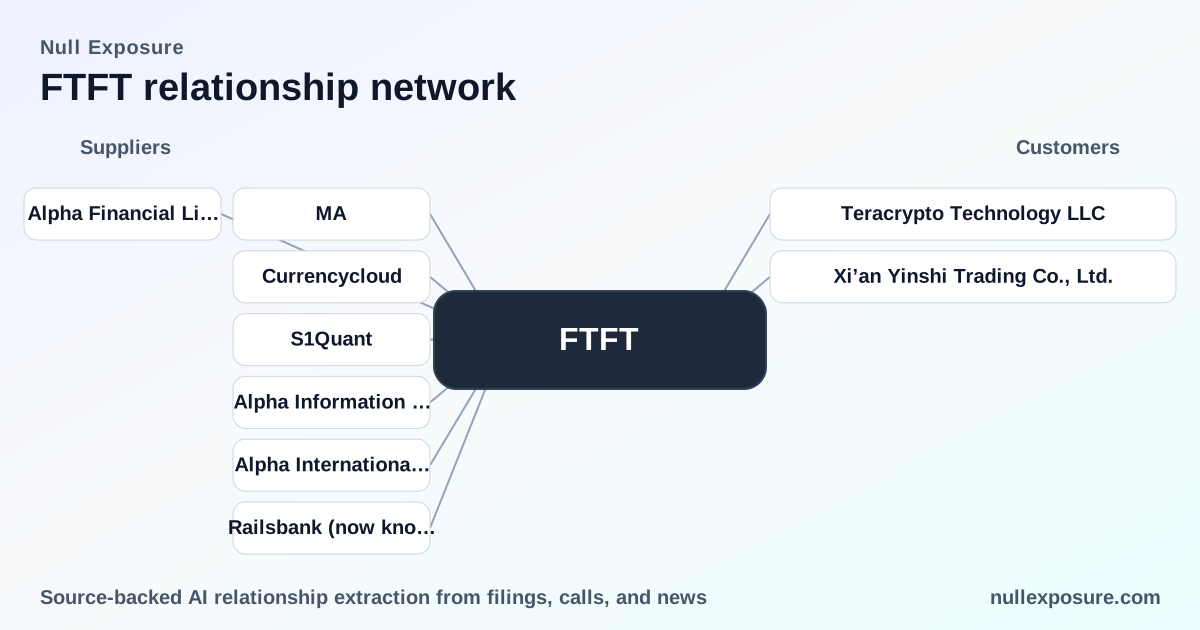
Future FinTech Group (FTFT): Customer Relationships That Define Concentration and Service Scope
Future FinTech Group operates a real-name blockchain e‑commerce platform and a diversified commercial services business that monetizes through transaction sales, supply‑chain financing, asset management services and, increasingly, hosted infrastructure via its FTFT SuperComputing subsidiary. Revenue is generated both as principal on commodity trading and as a service provider for financing and logistics; the company also recognizes agent-style fees where it does not take control of goods. This mix creates a hybrid operating model where trading volatility and financing credit cycles directly affect cash flow while service contracts and hosting can create recurring revenue. For a concise company overview and product positioning, see the company homepage: https://nullexposure.com/.
How FTFT actually makes money — single sentence thesis
FTFT combines commodity distribution and supply‑chain finance (where it sometimes books gross trade revenue and sometimes fees as an agent) with asset management and infrastructure hosting, converting trade flows into interest, fees and transaction margins.
Recent customer relationships investors should track
Below I summarize each customer relationship disclosed in the coverage set and cite the public source for verification.
-
Teracrypto Technology LLC
FTFT’s wholly‑owned subsidiary, FTFT SuperComputing Inc., signed a bitcoin mining hosting agreement to provide hosting services for Teracrypto’s bitcoin miners at FTFT’s cryptocurrency farm in Norwalk, Ohio. This is a service contract that expands FTFT into infrastructure hosting outside China and is documented in a PR Newswire release in March 2026. (PR Newswire, March 2026) -
Xi’an Yinshi Trading Co., Ltd.
FTFT completed the sale of a non‑core asset—its equity interest in Future Commercial Management (Hainan) Co., Ltd.—to Xi’an Yinshi Trading Co., Ltd., an unaffiliated third party, as disclosed in a press release reported by The Globe and Mail in March 2026. This transaction reflects active portfolio management and disposal of non‑strategic holdings. (The Globe and Mail press release, March 2026)
What these relationships reveal about FTFT’s operating posture
The two disclosed interactions are meaningfully different: one is an active service contract (hosting) that diversifies revenue into infrastructure hosting in the U.S., and the other is a one‑off disposal of a non‑core asset to an unaffiliated third party in China. Together they indicate a company pursuing both capital redeployment and new service revenue streams.
Constraints and company‑level signals that matter for investors
Company disclosures and filings imply several persistent characteristics that shape counterparty risk and revenue durability. Presenting these as operating signals rather than isolated metrics:
-
High customer concentration, shifting but material. For year‑end 2023 one customer represented 85.84% of revenues, and in 2024 two customers represented 35.86% and 13.57% respectively; this is a concentration dynamic that materially affects revenue volatility and negotiation leverage. Treat revenue swings as correlated to a small set of counterparties rather than broad retail demand.
-
Large‑enterprise counterparty focus. The company targets large state‑owned or listed corporate customers for core services, focusing on bulk commodities (coal, steel, sand, aluminum). This contracting posture implies long procurement cycles, formal credit processes and potentially stable volume when relationships endure.
-
Geographic concentration in APAC for core trade and finance. The firm’s main supply‑chain financing and trading business operates in China, so macro, regulatory and credit conditions in APAC drive the majority of operating risk for the trading and finance segments.
-
Mixed role exposure: principal and agent economics. FTFT recognizes revenue both as a seller (booking gross revenue when it takes control) and as an agent (net revenue for pure facilitation). This creates variability in gross margins and working capital intensity depending on whether transactions are balance‑sheeted.
-
Service orientation with supply‑chain finance as a core offering. The company classifies segments into asset management, supply‑chain financing and trading; supply‑chain finance accelerates turnover for industrial customers but brings credit risk and capital requirements.
-
Segment mix: distribution and services. The business still exhibits distribution revenue (e.g., commodity sales) alongside services (financing, hosting), meaning operating leverage and capital needs differ by segment and require separate risk management approaches.
Financial context that frames the customer risks
FTFT’s most recent public figures show small market capitalization, negative EBITDA, and tight liquidity dynamics consistent with a company transitioning business lines. Market capitalization is listed near US$8.1 million, trailing profitability metrics are negative (EBITDA and EPS) and revenue TTM is approximately US$3.83 million. These indicators make large customer losses or receivable deterioration an outsized risk to valuation. Use caution when modeling recovery schedules — changes in customer composition materially change enterprise cash flow.
Investment implications — what the relationships and constraints mean for valuation
-
Concentration amplifies both upside and downside. When one or two counterparties represent a large share of revenue, contract renewals or payment issues translate quickly to cash flow disruption or recovery. Assume higher revenue volatility in any valuation scenario.
-
Geographic and regulatory exposure is significant. With core trading and finance in China and new services in the U.S. (bitcoin miner hosting), investors must account for differing regulatory regimes and counterparty behaviors across jurisdictions.
-
Diversification into hosting reduces pure trading dependence but shifts capital use. The Teracrypto hosting deal shows FTFT is monetizing infrastructure; hosting contracts typically have longer tenor but require capital expenditure and ongoing maintenance. This is a strategic pivot toward recurring service revenue if FTFT scales hosting beyond one‑off arrangements.
-
Asset sales reflect active portfolio management and liquidity needs. The disposal to Xi’an Yinshi demonstrates management's willingness to crystallize value and potentially redeploy cash into higher‑return segments or to shore up balance sheet metrics.
Bottom line for operators and research investors
FTFT is a small, concentrated operator balancing commodity trading and supply‑chain finance with growing service initiatives, including infrastructure hosting. The company’s cash flow is highly sensitive to a small number of counterparties and to APAC trade conditions, but service contracts like the Teracrypto hosting agreement create a path to recurring revenue if scaled. For further context on FTFT’s business mix and competitive positioning visit the company overview page: https://nullexposure.com/.
If you want an investor‑focused dossier or ongoing monitoring setup that tracks FTFT’s counterparty concentration and commercial contracts, explore the platform for in‑depth customer relationship signals at https://nullexposure.com/.