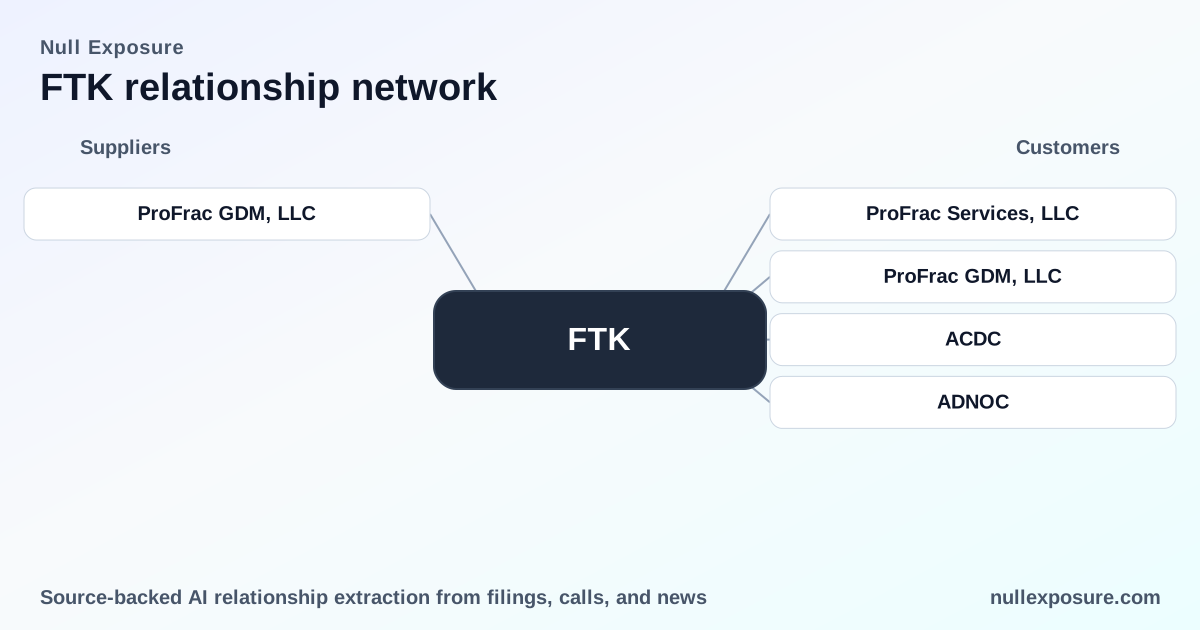
Flotek Industries (FTK): Customer Relationships Drive Revenue — and Risk
Flotek Industries monetizes a dual product set: specialty chemicals sold under supply agreements to oilfield services customers and hardware plus analytics sold as recurring services to industrial operators. The company’s operating model blends manufacturing and distribution for chemicals with field-deployable instrumentation and data subscriptions, generating a mix of spot sales, minimum‑purchase contract revenue and recurring service streams that feed gross margin expansion and cash flow. For investors, the key read is simple: Flotek’s revenue growth is highly correlated with a small number of large, related-party commercial relationships that both stabilize near-term cash flow and concentrate execution risk.
Visit NullExposure for more structured counterparty intelligence: https://nullexposure.com/
What the relationships look like in practice
Flotek’s public disclosures and press releases show a concentrated customer base with significant related-party activity, long-term supply commitments with minimum purchase requirements, and recent asset-lease transactions that convert equipment ownership into multi-year revenue backlog. These arrangements create predictable revenue corridors while tightening counterparty exposure.
-
ProFrac Services, LLC — Principal revenue engine. According to Flotek’s FY2024 10‑K, ProFrac Services, LLC accounted for 62% of revenue in 2024 (65% in 2023) and is subject to a supply agreement with minimum purchase obligations; the 10‑K further documents contractual minimums tied to ProFrac’s fleet utilization. Source: Flotek 2024 10‑K filing (FY2024).
-
ProFrac Holdings, LLC / related ownership stake — governance and concentration angle. The FY2024 10‑K discloses that ProFrac Holdings, LLC or affiliates owned roughly 51% of Flotek’s common stock as of December 31, 2024, creating a related‑party dynamic that aligns incentives but concentrates control. Source: Flotek 2024 10‑K (FY2024).
-
ProFrac GDM, LLC — lease counterparty and equity linkage. Flotek’s March 2026 press release details a six‑year dry lease of mobile power-generation assets to ProFrac GDM, LLC, and also notes a warrant issued to ProFrac GDM to purchase 6 million Flotek shares as part of the transaction, tying future equity dilution to the lease. Source: PR Newswire release on Flotek asset acquisition and lease (March 2026).
-
ACDC / ProFrac Holding Corp. — transaction economics and EBITDA contribution. Media reporting around the asset‑sale/lease transaction quantified incremental EBITDA: outlets noted the deal would generate about $14 million in EBITDA in the first year and $20 million in 2026, with 22 units already leased to ProFrac and remaining units to be deployed in 2025. Source: The Globe and Mail coverage and related press reporting (March 2026).
-
ProFrac (general mentions across earnings and press) — strategic customer across segments. Company commentary and analyst write‑ups consistently identify ProFrac as a related‑party strategic customer buying both Chemistry and PowerTech products and driving some of Flotek’s highest quarterly revenue in its supply‑agreement history. Source: FTK earnings releases and third‑party coverage (Q4 2025 / early 2026).
-
ProFrac Services, LLC — contract mechanics and order shortfall adjustments. Flotek’s March 2026 press materials disclose a $17.6 million funded offset tied to a 2024 order shortfall payment due from ProFrac Services, LLC, highlighting how minimum‑purchase mechanics and shortfall settlements flow through near‑term cash. Source: PR Newswire release on asset acquisition and related settlements (March 2026).
-
ProFrac Services, LLC — minimum purchase revenue recognized. In the company’s April/May 2026 earnings release, Flotek reported that fourth‑quarter and full‑year 2025 revenues included $3.4 million and $27.4 million, respectively, attributable to minimum purchase requirements under its long‑term supply agreement with ProFrac Services, LLC. Source: Flotek earnings release on FY2025 results (May 2026).
-
ACDC (earnings call / ownership context) — pro forma equity control. An ACDC earnings call transcript noted that a particular transaction produced approximately 60% of pro forma fully diluted equity ownership of Flotek, underlining how corporate restructuring and related transactions impacted control and counterparty economics. Source: ACDC 2025 Q3 earnings call transcript (March 2025).
-
ADNOC — market access signal. Coverage of Flotek’s commercial traction referenced approved supplier status with ADNOC and penetration into Saudi frac fleets, signaling access to capitalized national oil companies and potential international growth corridors beyond North America. Source: The Globe and Mail / press coverage (March 2026).
-
ProFrac Holdings LLC (historical supply-agreement context). Market transcripts and historical call coverage document prior investor calls discussing Flotek’s long‑term supply agreement with ProFrac Holdings LLC, establishing a documented multi‑year commercial history between the parties. Source: Call transcript archive and GuruFocus reference (historical).
-
Analyst and sell‑side commentary (SahmCapital, InsiderMonkey, Motley Fool) — concentration and margin signals. Multiple independent write‑ups flagged the commercial concentration risk tied to large ProFrac quarters (including gross‑margin pressure in specific quarters) and noted that Data Analytics revenue is becoming a growing, diversifying contributor. Source: SahmCapital, InsiderMonkey, The Globe and Mail / Motley Fool coverage (Q1–Q2 2026).
Operating model constraints and what they mean for investors
Flotek’s disclosures surface several company‑level signals that define how relationships are structured and how sensitive FTK is to counterparty moves:
-
Contracting posture: Flotek operates a mix of long‑term supply agreements with minimum purchase requirements and subscription‑style arrangements for recurring services; payment terms are generally short‑term (settlements within one year), so working capital and order timing directly influence revenue recognition and cash flow. (Company filing language on revenue recognition and payment terms.)
-
Concentration: The business exhibits high customer concentration, with one related customer representing well over half of revenue in recent years, which creates predictability now but high execution risk if the counterparty reduces volumes. (FY2024 revenue disclosure.)
-
Counterparty profile and criticality: Customers range from large enterprises and national oil companies to oilfield services platforms, meaning Flotek’s products are mission‑critical to hydraulic fracturing and on‑site power generation activities; loss of a major account would have outsized P&L impact.
-
Maturity and structure of contracts: Contracts include multi‑year leases and long‑term chemical supply pacts, alongside short‑term service obligations; recent transactions converting asset ownership into lease revenue demonstrate management’s willingness to optimize balance‑sheet exposure through structured deals.
-
Geography: Revenue is North America‑centric today, with targeted expansion into the Middle East and Latin America; ADNOC supplier status is a strategic validation for international growth but does not erase domestic concentration.
Investment implications — what to watch
-
Upside: Minimum‑purchase obligations and the asset lease backlog convert capital investments into multi‑year revenue visibility and immediate EBITDA accretion; Data Analytics growth offers margin diversification. These are positive structural drivers for free cash flow and multiple expansion.
-
Downside: Related‑party concentration and majority ownership by ProFrac affiliates are the principal corporate governance and earnings‑concentration risks. Watch quarterly order volumes against minimums and any changes in related‑party arrangements.
-
Catalysts and monitors: Track quarterly disclosures of ProFrac volumes and shortfall settlements, the deployment schedule for leased power units, Data Analytics revenue trajectory, and any change in ownership percentages that would alter governance dynamics.
For a consolidated view of counterparty concentration and to benchmark Flotek’s customer contracts relative to peers, see our platform: https://nullexposure.com/
Bold takeaway: Flotek’s near‑term upside is tied to a small set of large, related‑party arrangements that deliver predictable revenue but concentrate downside risk — active monitoring of ProFrac volumes and contractual settlements is essential for any investor in FTK.