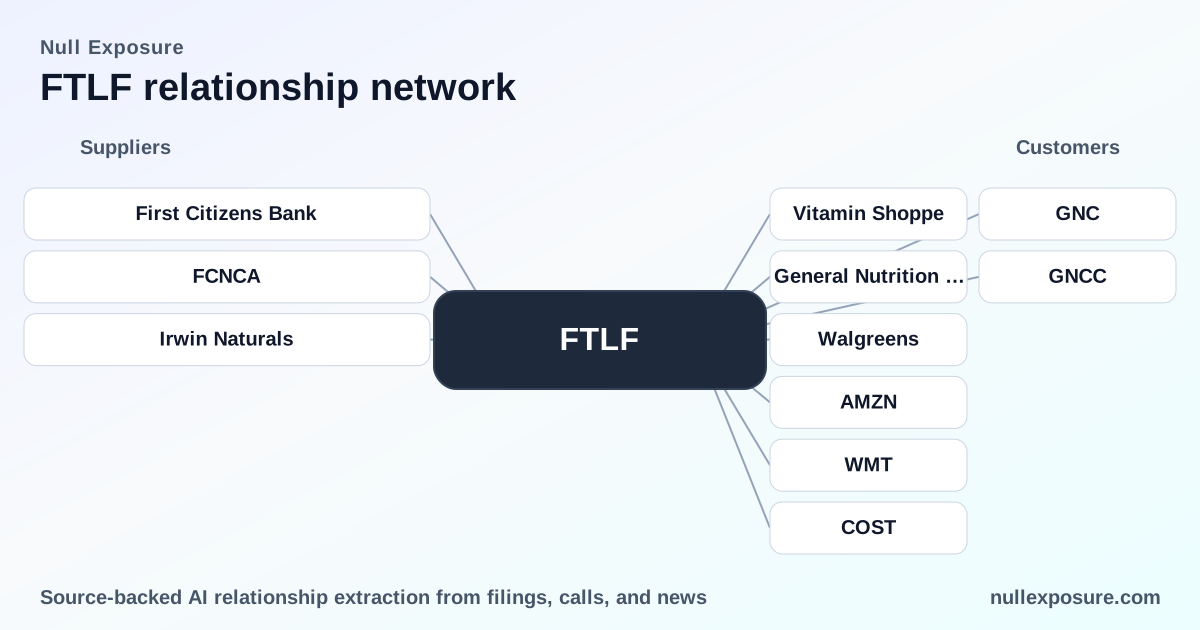
FitLife Brands (FTLF): Distribution relationships that drive growth and concentration risk
FitLife Brands sells proprietary and acquired nutritional-supplement brands through a mix of wholesale retail partners and direct online channels, monetizing primarily via spot product sales to retailers and consumers and margin capture on owned brands. Revenue is driven by retail distribution (franchise and wholesale) and fast-ramping online sales—not long-term contract flows—making channel access and retail placement the key operational levers. For more structured relationship data, see https://nullexposure.com/.
What investors need to know up front
FitLife operates as a seller of packaged nutrition products, with sales recognized at shipment; the company’s go-to-market is a retail-first model that relies on franchise distribution (notably GNC), national chains, club stores and Amazon. That model creates high top-line optionality when retail placement scales but also concentration and channel risk where major customers can materially influence revenue.
- Primary monetization: product sales to retailers and consumers, supplemented by online advertising and platform optimization.
- Contracting posture: sales are predominantly spot—control transfers on shipment—so the company lacks long-term purchase commitments that would stabilize revenue.
- Geography: revenue is highly North America–centric (roughly 95% U.S.), concentrating sales and market risk in the U.S. retail environment.
- Concentration signal: GNC historically accounted for a material share of sales (mid‑20% of total in 2024), creating tangible sensitivity to that relationship.
- Returns and product liability: FitLife reports product returns are immaterial, reducing revenue reversal risk from returns as a company-level signal.
If you evaluate distribution exposure as part of an investment thesis, the relationship map below is the practical ledger of where FitLife sells product and the sources that document those channels. For a deeper relationship extraction and client-facing view, visit https://nullexposure.com/.
How the operating model shapes risk and upside
FitLife’s model behaves like a branded consumer packaged-goods company that is still dependent on retail shelf and e-commerce algorithms rather than recurring contracted revenue. That creates several operational characteristics investors should weigh:
- Spot sales and working-capital sensitivity. Because revenue is recognized at shipment, inventory, promotion timing and retailer ordering cadence create earnings volatility.
- Channel concentration. The company-level disclosure calls out a material dependence on GNC, which compressed from ~33% in 2023 to ~23% in 2024—an explicit signal that a single partner can swing results.
- Consumer-facing counterparties. Large part of revenue ultimately originates from individual consumers shopping online or at retail—FitLife sells to retail intermediaries but the demand driver is consumer purchases.
- Maturity and stage. Several relationships are active and operational (GNC franchises, Amazon listings, Vitamin Shoppe pilots); others reflect attempts to restore distribution from prior bankruptcies (MusclePharm channels).
Below is a concise, source-linked run-through of every relationship record the company has disclosed or reported in public filings and press coverage.
Detailed relationship map (one-sentence summaries with sources)
General Nutrition Centers, Inc.
FitLife distributes NDS products principally through franchised GNC stores domestically and internationally, making GNC a core wholesale channel; this is documented in FitLife’s FY2024 10‑K. According to the company’s FY2024 10‑K filing, GNC franchise locations are a principal distribution channel.
Walgreens
Walgreens is cited as a major customer of FitLife’s iSatori brand group, representing a national retail placement for select SKUs; this appears in FitLife’s FY2024 10‑K disclosures listing major iSatori customers.
Vitamin Shoppe
FitLife piloted the premium MusclePharm Pro Series in high‑volume Vitamin Shoppe stores (about 60% of the chain) as part of a rollout strategy to restore wholesale distribution; this deployment is described in the company’s first-quarter 2025 press materials and FY2023 acquisition filings.
Amazon
FitLife has actively scaled Amazon as a direct online channel—beginning Irwin sales in mid‑October 2025 and ramping to meaningful monthly revenue—making Amazon a high‑velocity e‑commerce outlet for acquired brands; see the Aug 5, 2025 FitLife press release about the Irwin acquisition and subsequent Q3/Q4 2025 results.
AMZN (alternate mention)
Public reporting reiterates the Amazon ramp: management noted first Irwin sales on Amazon on October 11, 2025 and reported accelerating daily/annualized run‑rates in Q3/Q4 2025 results and investor materials (see QuiverQuant and FitLife Q3 2025 disclosures).
Costco U.S.
Management reports Irwin historically generated a significant portion of revenue through Costco in the U.S., indicating club-store distribution was a meaningful channel for that brand prior to FitLife’s acquisition; note the earnings call transcript for Q4 2025.
Costco / COST (ticker variant)
Prior MusclePharm assets also had established Costco distribution, and FitLife has stated intent to work with prior retail partners (including Costco) to restore product placement—this is disclosed in the MusclePharm acquisition announcement (FY2023) and subsequent investor commentary.
Costco Canada
FitLife management confirmed continued sales in Costco Canada after the Irwin acquisition, noting no loss of Canadian Costco SKUs since purchase; see the Q4 2025 earnings call transcript.
Rite Aid
Rite Aid had been a major customer for Irwin prior to its bankruptcy and liquidation, which removed a wholesale outlet for the brand before FitLife’s acquisition; management discussed Rite Aid’s prior role and its bankruptcy during the Q4 2025 earnings call.
GNC (brand/franchise channel)
GNC is repeatedly referenced as FitLife’s largest customer and a primary wholesale distribution hub (franchise network and centralized distribution), and FitLife disclosed a commercial dispute that led to rejection of GNC purchase orders beginning Dec 1, 2024—see FitLife’s March 27, 2025 results press release and related investor communications.
GNCC / GNC (ticker variants and press variants)
Company press releases and earnings materials use GNCC/GNCC ticker variants when referring to GNC distribution; the substance is consistent: franchise and centralized distribution are central to FitLife’s wholesale strategy (multiple Globenewswire and investor-call entries in FY2025).
Walmart
FitLife’s acquisition playbook includes restoring MusclePharm’s prior retail placements, which historically included Walmart; FitLife stated intent to work with retail partners such as Walmart in the MusclePharm asset announcement (FY2023).
CVS
FitLife sells topical CBD products through CVS as a major retailer outlet for that category, according to the Q4 2025 earnings call transcript where management outlined placement of topical CBDs.
MRC (MRCC)
Management noted that revenue at MRC declined (~15% over the year) while other brand groups grew, indicating MRC is a measurable channel/partner in FitLife’s reporting—see the Q4 2025 results coverage and BayelsaWatch recap.
The Vitamin Shoppe (alternate naming)
Investor transcripts confirm The Vitamin Shoppe carried FitLife’s Pro Series pilot SKUs and delivered initial retail feedback; see the Q4 2025 earnings transcript and prior press releases documenting the pilot.
Investment implications and risk checklist
- Concentration risk is real and quantifiable: FitLife’s disclosures explicitly note GNC accounted for ~23% of sales in 2024 and could materially impact revenue if purchases decline. Treat GNC dependence as the largest single counterparty risk.
- Channel diversification is underway but nascent. Management is expanding Amazon and restoring club-store and national retailer placements; Amazon ramp in late 2025 materially accelerated online revenue, but online growth does not yet offset wholesale sensitivity.
- Spot contracting increases volatility. With sales recognized at shipment and largely spot in nature, inventory timing and retailer order rhythm will show through quarterly variability in revenue and working capital.
- Geographic concentration elevates U.S. retail cycle exposure. Roughly 95% of revenue is U.S.-based, focusing macro and retail-cycle risk on North America.
Bottom line
FitLife monetizes brands through a mixed wholesale/online approach where retail distribution (franchises, national chains, club stores) and Amazon execution are the operational drivers. Investors should weight the demonstrated ability to ramp Amazon and restore retail placements against the explicit concentration with GNC and the spot nature of retail orders. For a structured view of FitLife’s counterparties and relationship-level sources, visit https://nullexposure.com/.