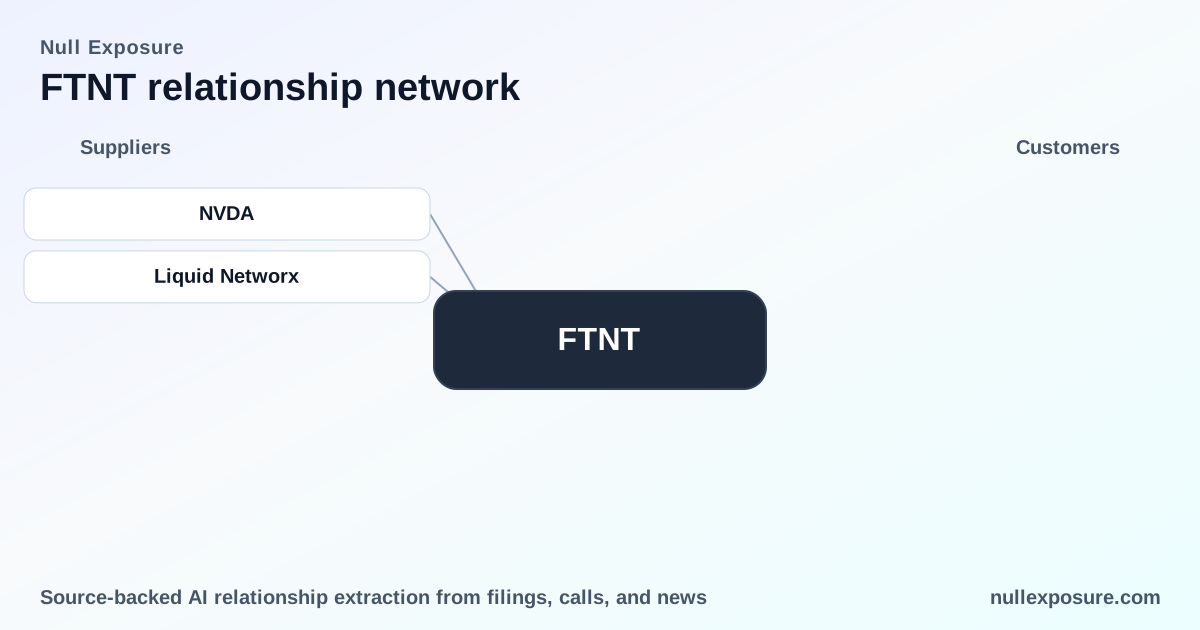
Fortinet’s customer map: channel momentum, subscription economics, and concentration risks
Fortinet (Nasdaq: FTNT) sells high-performance security appliances, software licenses and recurring security subscriptions to enterprises and service providers worldwide. The company monetizes through a mix of up-front hardware and license sales and recurring FortiGuard/FortiCare subscriptions (typically one- to five-year terms), with services recognized ratably and term-based licenses recognized at transfer of control. This hybrid revenue model drives strong gross margins and predictable billings while keeping the business sensitive to channel concentration and execution on partner-led routes to market. Learn more at https://nullexposure.com/.
Why the customer signals matter for investors
Fortinet’s operating model combines product-led sales with sticky recurring revenue. The company’s contracting posture is subscription-first for managed services and support, with term licensing and spot product shipments for hardware. Global scale is real: Fortinet reports sales across Americas, EMEA and APAC, and counts a very large enterprise customer base (including roughly 80% of the Fortune 100). At the same time, channel concentration is material — six distributor customers represented roughly 69–70% of net accounts receivable in recent years — which elevates counterparty and receivables risk relative to a pure direct-sales SaaS company.
Key company-level operating signals:
- Contracting: service/subscription contracts (1–5 years) drive recurring, ratable revenue; licensing recognized upfront; product revenue often recognized on shipment.
- Geography: truly global — Americas ~41%, EMEA ~40%, APAC ~19% of 2024 revenue, so macro and FX across regions matter.
- Customer base and concentration: broad end-customer penetration (Fortune/Global 2000) but distributor concentration is a clear financial exposure.
- Go-to-market structure: two-tier distribution model (distributors → resellers/MSSPs → end-customers), making channel partnerships and distributor health central to revenue flow.
Customer relationships on the record
Below are the specific customer/partner relationships surfaced in public reporting and media, summarized for investment diligence.
Climb Global Solutions (CLMB)
Climb Global announced a partnership with Fortinet that launched in December; the reseller expects Fortinet to become a top-three vendor for its security portfolio and to ramp to a meaningful share of a $2.5 billion U.S. addressable market within roughly 18 months. This view is drawn from Climb Global’s Q4 2025 earnings commentary and its April 2026 quarterly report where management highlighted Fortinet as a prioritized onboarding partner. (Sources: Climb Global Q4 2025 earnings transcript published by The Globe and Mail, May 2026; Climb Global press release, April 29, 2026; company 8-K disclosures, March 2026.)
Google Cloud
Fortinet received Google Cloud’s 2026 Partner of the Year Award for Workload Security for its FortiCNAPP offering, strengthening Fortinet’s positioning in hybrid and multi-cloud workload protection and validating product fit with a hyperscaler’s security channel. (Source: coverage of the award reported by Simply Wall St in May 2026.)
BPOP / Evertec mention
A filing from a financial services company noted that threat actors exploited a zero-day vulnerability in Fortinet’s enterprise management server software used by Evertec during 2024, a public example of operational security exposure that can affect customer trust and remediation cost. This incident is recorded in the FY2024 10-K of the reporting bank. (Source: BPOP FY2024 10‑K, referenced in public filings, 2024.)
Equinix
Fortinet is partnering with Equinix to deploy Fortinet Secure SD‑WAN on Equinix’s Network Edge, broadening network-edge deployment options for enterprise customers and accelerating on-ramp to cloud connectivity via an interconnection-focused partner. This is a distribution/edge-channel play that complements Fortinet’s cloud workload and SD‑WAN strategies. (Source: InvestingNews coverage, 2026.)
What these relationships imply for growth and risk
Collectively, the relationships reveal a deliberate channel expansion strategy: enterprise reseller deals (Climb Global) expand market reach, hyperscaler recognition (Google Cloud award) validates product fit in cloud-native contexts, and edge partnerships (Equinix) push deployments closer to customer network egress points. At the same time, operational incidents like the Evertec zero‑day exploit are concrete reputational and remediation risks that increase customer due diligence friction.
Investor implications:
- Revenue durability: The mix of multi-year subscriptions and support contracts provides recurring revenue stability; this underwriting favors companies with predictable renewal patterns.
- Channel leverage: Growth is levered to distributor and reseller execution; a successful Climb Global rollout can accelerate billings in specific verticals, but channel success is binary — onboarding and enablement execution are decisive.
- Concentration risk: Large receivables tied to a small set of distributors create single-counterparty exposure that can amplify downside in distributor stress scenarios.
- Security posture sensitivity: High-profile vulnerability exploitation raises the cost of trust — procurement cycles for large customers will penalize any perception of weak operational hygiene.
Practical checklist for analysts and operators
- Validate renewal cohorts for FortiGuard/FortiCare and the mix of term-based licensing versus ratable service revenue; recurring revenue is the valuation anchor.
- Monitor receivables aging and distributor concentration disclosures quarterly; six distributors account for a disproportionate share of AR and are a material credit risk.
- Track partner ramp metrics where disclosed (e.g., Climb Global gross billings targets) and hyperscaler certifications/awards as leading indicators of cloud adoption.
- Watch for public remediation and patching timelines following security incidents; time to containment and transparency are critical to limit customer churn.
Bold takeaway: Fortinet combines durable subscription economics with high channel leverage, but the company’s valuation premium is contingent on continued partner execution and contained counterparty concentration risk.
For a concise view of how these customer signals are collected and tracked for investment use cases, visit https://nullexposure.com/ for methodology and company pages.
Bottom line
Fortinet’s customer footprint is large and strategically diversified across direct enterprise penetration and partner-led routes to market. The business benefits from sticky subscription revenue and strong product endorsement from cloud partners, but investors must price in distributor concentration and operational-security incidents as tangible risk factors. Continuous monitoring of partner ramp performance and receivables concentration is essential to gauge whether Fortinet’s channel-driven growth sustainably converts into margin-accretive recurring revenue.