FUL customer relationships: what investors need to know about distribution, geography and concentration
HB Fuller (ticker FUL) operates as a global specialty-chemicals manufacturer that monetizes through product sales to industrial customers and distributors, with core revenues driven by industrial adhesives and related specialty products sold directly from manufacturing sites and through authorized distributors. For investors and operating partners, the customer base combines large-enterprise accounts and long-term distributor relationships, with regional sales footprints that are explicitly global and concentrated across APAC and EIMEA markets. For an actionable commercial due diligence view, review HB Fuller’s public disclosures and partner announcements alongside on-the-ground channel checks. For more context on the platform that produced this relationship map, visit https://nullexposure.com/.
H2: How to read the customer map — the essentials that matter to portfolio risk HB Fuller’s operating model is rooted in selling high-value industrial adhesives that integrate into customers’ manufacturing processes. That positioning creates four investment-relevant characteristics:
- Contracting posture: The company sells both direct and through distributors under formal agreements or purchase orders; distributor contracts often disallow returns, producing predictability in revenue recognition and working capital profiles. This is a company-level signal drawn from sales and distribution disclosures.
- Customer concentration and maturity: The business emphasizes long-term, collaborative relationships with a diversified base; no single customer historically accounts for more than 10% of consolidated net revenue, supporting revenue resilience and low single-counterparty concentration.
- Criticality to customers: Industrial adhesives are core inputs for customers’ manufacturing performance, which elevates stickiness and increases switching costs. The company explicitly calls industrial adhesives its core product offering.
- Geographic footprint and exposure: Sales operations span North America, Europe, Latin America, Asia Pacific, India, the Middle East and Africa, with reported regional figures showing material scale in APAC and EIMEA—an important signal for foreign-exchange and geopolitical exposure management.
H2: The relationships identified — direct partner evidence
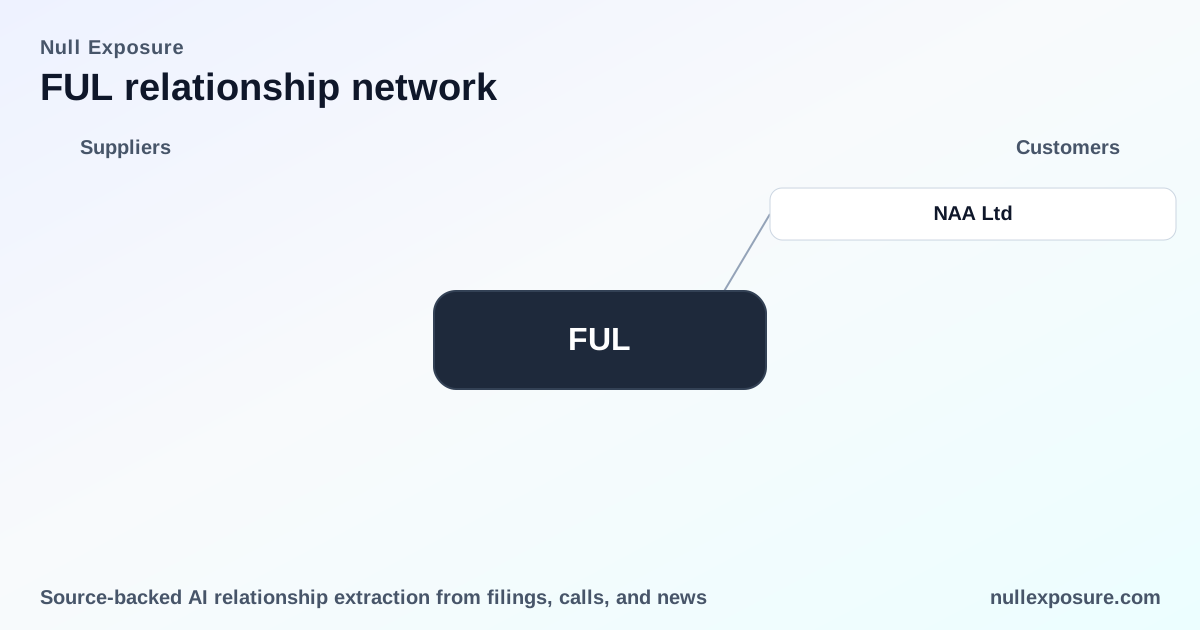
H3: NAA Ltd — exclusive Ireland partner NAA Ltd is reported as the exclusive partner for HB Fuller adhesives in Ireland, indicating a formal distributor or exclusive reseller arrangement that centralizes the company’s Irish channel through a single counterparty. This relationship was noted in a March 9, 2026 news report on BusinessPlus covering regional commercial partnerships. (BusinessPlus, 2026-03-09.)
H2: What the constraints tell investors about commercial risk and runway The disclosed constraints in HB Fuller’s relationship profile read as company-level signals that clarify how revenue is generated and where operational risk concentrates.
- Large-enterprise counterparty mix: Company disclosures position customers among technology and market leaders in consumer goods, construction and industrial markets, indicating a bias toward large-enterprise buyers that demand scale, compliance and predictable supply chains. This profile supports stable order volumes and higher contractual discipline.
- Regional concentration and FX exposure: The firm’s reported regional breakdown highlights substantive revenue in Asia Pacific and EIMEA; the public excerpts show APAC and EIMEA line items and aggregated global operations across 34 countries. According to company filings, international operations expose earnings and cash flows to foreign-currency fluctuations, which is a persistent earnings-volatility vector for investors.
- Distributor role and contracting mechanics: HB Fuller’s statements on distributors note that sales to distributors require distribution agreements or purchase orders and that distributors typically do not have rights of return. That contracting posture reduces revenue reversal risk but shifts credit and inventory risk into distributor balance sheets.
- Role mix — seller and manufacturer: The company presents itself both as seller and manufacturer of adhesives and specialty products, implying ownership of manufacturing assets and direct-delivery capability. This structure supports margin capture but insures the company to raw-material, energy and manufacturing overhead exposures.
- Mature, integrated customer relationships: The firm frames its customer base as mature and long-term, arguing that relationships are collaborative and that the customer portfolio is diversified—this is a signal of low transactional churn and high historical retention.
H3: What these signals mean for valuation and operational vigilance Combine the relationship evidence and the constraints and you get a clear risk-return profile:
- Revenue resilience: Long-term distributor and direct-sell relationships, plus product criticality, support predictable revenue, underpinning cash-flow-based valuation approaches.
- Working-capital nuance: Distributor contracts without returns reduce sales reversals but can concentrate receivables and inventory financing into distributors, so monitor days sales outstanding and distributor-credit trends.
- Currency and regional risk premium: Significant APAC and EIMEA exposure demands an explicit FX and geopolitical discount in valuation models; operating margins should be stress-tested under currency swings and regional demand slowdowns.
- Concentration considerations: Although no single customer exceeds 10% of consolidated revenue historically, exclusive distributorships such as the Irish agreement with NAA Ltd create localized supplier concentration that can be operationally meaningful.
H2: Practical takeaways for investors and operators For investors and operating partners evaluating FUL customer risk and upside, focus on these priorities:
- Validate distributor credit and contract terms. Where exclusivity exists (Ireland / NAA Ltd), confirm termination rights, minimum purchase obligations and inventory title to assess revenue continuity risk.
- Stress-test FX and regional demand. Use scenario analysis for APAC and EIMEA revenue lines and incorporate currency sensitivity into free cash flow models.
- Monitor supplier and raw-material dynamics. Manufacturing ownership raises margin upside but also exposure to raw-material price cycles and energy costs; factor in pass-through mechanisms where present.
- Track customer diversification metrics quarter-over-quarter. Even with a historically diversified base, exclusive local partnerships can create micro-concentration; operational monitoring should be granular by country and distributor.
H2: Closing synthesis and next steps HB Fuller’s customer network is built on a hybrid model of direct manufacture-and-sell plus authorized distributors, anchored by long-term customer relationships and significant regional scale in APAC and EIMEA. The NAA Ltd exclusivity in Ireland is a concrete instance of the company’s distributor strategy: it centralizes local go-to-market execution but introduces single-counterparty operational dependence at the national level. For deeper due diligence on counterparty contracts and distribution economics, consult the company’s most recent filings and partner announcements, and consider engaging local channel checks.
For a concise mapping of FUL’s visible customer relationships and their commercial implications, visit https://nullexposure.com/ for the underlying partner intelligence and relationship signals.
Bold recap: predictable revenue from critical industrial products, global geographic exposure with FX risk, distributor-driven local concentration points such as NAA Ltd in Ireland, and mature customer relationships that support long-term cash flows.