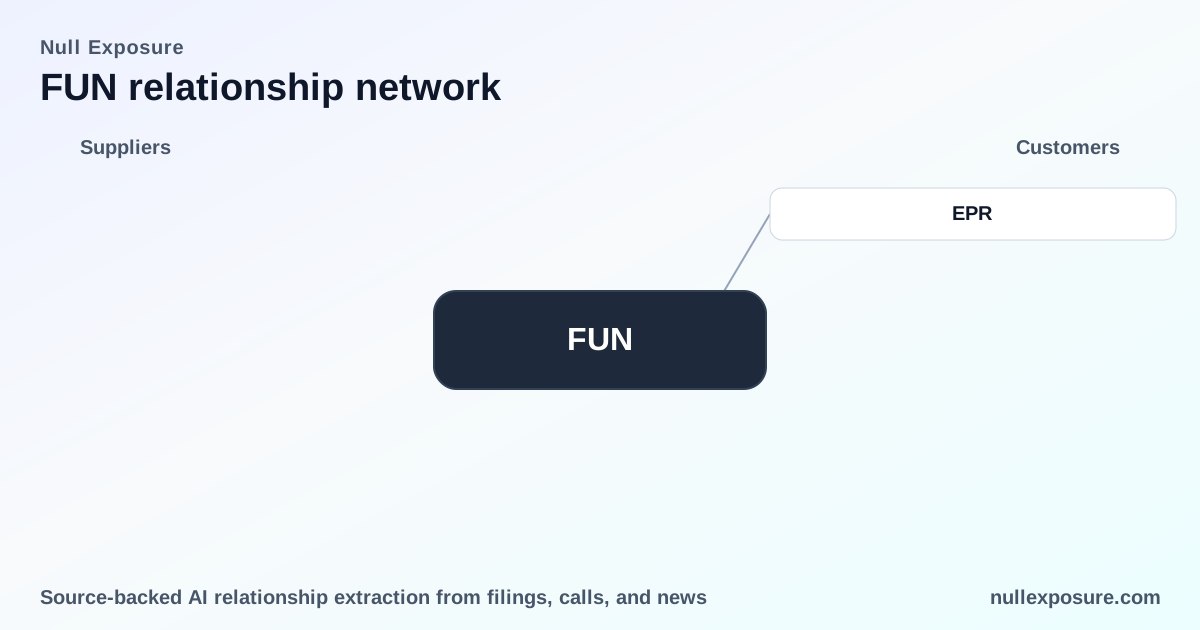
Six Flags (FUN) — Customer relationships and partner signal map
Six Flags Entertainment Corp. (NYSE: FUN) operates and monetizes through admission-driven park operations, ancillary on-site sales (food, merchandise, games), and membership/season products, recognizing revenues both per-use and over time for multi-use products. The company’s customer base is overwhelmingly individual consumers visiting North American parks, and recent transaction activity shows portfolio reshaping through asset sales to real estate investor EPR. For investors, the combination of steady consumer-facing revenues and active portfolio optimization creates a mixed profile of recurring operational cashflow and balance-sheet flexibility.
If you want a concise feed of relationship-level signals and sources, visit https://nullexposure.com/ for the full platform intelligence.
Quick investment takeaways
Six Flags generates the bulk of cash from park admissions and on-site spend, with membership and season products introduced to smooth revenue recognition across periods. Recent park divestitures to EPR are explicit portfolio management moves that unlock capital and reduce operating exposure to lower-performing assets. Operational constraints point to a consumer-facing, North America-concentrated services business whose revenue recognition and contract posture reflect mixed single-use and subscription-like products.
Business model and operating constraints — what matters to investors
- Contracting posture: Revenue recognition language shows a hybrid model — per-visit cash sales for individual guests and multi-use/membership products that are recognized over expected uses or on a straight-line basis after the first 12 months. This implies a mix of volatile daily receipts and some predictable recurring revenue.
- Customer concentration and counterparty: The primary counterparty is the individual consumer, not large enterprise buyers. This increases sensitivity to consumer spending cycles but spreads counterparty risk across many small transactions.
- Geographic concentration: Parks are predominantly North America, with a small presence in Mexico and Canada; this regional concentration informs exposure to NA economic conditions and tourism trends.
- Revenue mix and maturity: The company’s classification under services — admissions, food, merchandise, accommodations, and extra-charge products — signals a mature, asset-heavy operator where on-site spend is a core margin driver. Season products and memberships are used tactically to stabilize cash flow.
For an expanded view of partner and customer signals, see https://nullexposure.com/.
Customer and partner relationships observed (each result, with source)
-
Six Flags announced the sale of Michigan’s Adventure and six other amusement parks to EPR Properties for $331 million; this is reported as part of a March 2026 transaction to pare the portfolio. Source: The Detroit News, March 5, 2026 — https://www.detroitnews.com/story/business/2026/03/05/michigans-adventure-6-other-amusement-parks-being-sold-by-six-flags/88998843007/
-
The same Detroit News item reiterates that the buyer is EPR Properties, confirming the $331 million package and naming Michigan’s Adventure among the parks divested. Source: The Detroit News, March 5, 2026 — https://www.detroitnews.com/story/business/2026/03/05/michigans-adventure-6-other-amusement-parks-being-sold-by-six-flags/88998843007/
-
TradingView published a headline noting Six Flags’ completion of the sale of six U.S. parks to EPR as part of portfolio optimization, signaling transaction close and strategic intent. Source: TradingView news item, May 2026 — https://www.tradingview.com/news/tradingview:6d1906a259ab5:0-six-flags-completes-sale-of-six-u-s-parks-to-epr-as-part-of-portfolio-optimization/
-
KSDK reported that Six Flags agreed to sell seven parks to EPR Properties for $331 million in cash, subject to adjustments; this local coverage confirms deal scope and terms. Source: KSDK, March 5, 2026 — https://www.ksdk.com/article/news/local/business-journal/six-flags-st-louis-being-sold-to-kansas-city-based-real-estate-business/63-4cbb00c3-983f-4ecc-8407-7677dbf5e3be
-
KSDK’s item also explicitly names EPR Properties as the buyer, restating the $331 million consideration and the parks included in the divestiture. Source: KSDK, March 5, 2026 — https://www.ksdk.com/article/news/local/business-journal/six-flags-st-louis-being-sold-to-kansas-city-based-real-estate-business/63-4cbb00c3-983f-4ecc-8407-7677dbf5e3be
-
USA Today covered the announcement that Six Flags is selling seven amusement and water parks to EPR Properties, reinforcing national press attention and public-market signaling. Source: USA Today, March 5, 2026 — https://www.usatoday.com/story/travel/experience/theme-parks/2026/03/05/six-flags-sell-parks/89004407007/
-
Fox Business reported Six Flags will sell seven U.S. and Canadian amusement parks to EPR Properties, confirming corporate-level divestment and market messaging. Source: Fox Business, March 2026 — https://www.foxbusiness.com/lifestyle/six-flags-sell-7-amusement-parks-deal-worth-more-than-330m
-
The Freep (Detroit Free Press) noted that Michigan’s Adventure and Cedar Point were bought by Six Flags following a prior merger with Cedar Fair, placing the recent divestiture in a broader M&A context and highlighting portfolio churn since 2024. Source: Detroit Free Press, January 14, 2026 — https://www.freep.com/story/news/local/michigan/2026/01/14/michigans-adventure-amusement-theme-park-six-flags-enchanted-parks-holdings/88175825007/
-
USA Today appears again in the feed reiterating EPR as buyer of seven parks, underscoring consistent coverage across outlets and the transactional nature of the relationship. Source: USA Today, March 5, 2026 — https://www.usatoday.com/story/travel/experience/theme-parks/2026/03/05/six-flags-sell-parks/89004407007/
-
Finviz aggregated a Business Wire notice that Six Flags completed sale of six U.S. parks to EPR Properties, adding a market-data angle and noting FUN share movements on the news. Source: Finviz/Business Wire, April–May 2026 — https://finviz.com/news/265663/six-flags-qiddiya-city-six-flags-entertainment-corporations-first-destination-outside-north-america-is-now-officially-open
-
The Progress-Index relayed Six Flags’ March 5 statement that seven of 42 attractions were sold to EPR Enterprises for $331 million, underlining the scale relative to the company’s park base. Source: The Progress-Index, March 2026 — https://www.progress-index.com/story/business/travel/2026/03/05/kings-dominion-va-six-flags-amusement-park-sale/89000425007/
-
TipRanks/The Fly summarized analyst notes that Six Flags will divest seven parks to EPR, a point that factored into analyst coverage and price-target adjustments in early May 2026. Source: TipRanks/The Fly, May 2026 — https://www.tipranks.com/news/the-fly/epr-properties-price-target-raised-to-58-from-54-at-ubs-thefly-news
-
An entry labeled EPR-P-E (preferred ticker slice) reported completion of the sale of six U.S. parks to EPR Properties, reflecting market linkage to EPR’s capital structure and the impact on REIT portfolios. Source: Trading/Market news, May 2026 — https://www.tradingview.com/news/tradingview:6d1906a259ab5:0-six-flags-completes-sale-of-six-u-s-parks-to-epr-as-part-of-portfolio-optimization/
-
A PR Newswire release for Dave & Buster’s noted several new premium arcade games, including Funko Funcade, which will be available exclusively at Dave & Buster’s through a limited period — signaling a commercial placement relationship between Funko content and the PLAY operator. Source: PR Newswire, Spring 2025 (news release) — https://www.prnewswire.com/news-releases/dave--busters-supercharges-spring-break-2025-with-exclusive-games-jaw-dropping-attractions--unlimited-play-with-the-eat--play-combo-302392148.html
-
An additional EPR mention in USA Today confirms the buyer role and deal size, reinforcing the transaction narrative across outlets and capturing national market attention. Source: USA Today, March 5, 2026 — https://www.usatoday.com/story/travel/experience/theme-parks/2026/03/05/six-flags-sell-parks/89004407007/
Risks and capital allocation signals investors should prioritize
- Operational exposure to individual consumers makes Six Flags sensitive to discretionary-spend cycles and weather/tourism variability; membership products provide partial smoothing but do not eliminate cyclicality.
- Portfolio optimization through asset sales reduces near-term operating footprint and raises questions about long-term park-level growth vs. balance-sheet repair priorities. The EPR divestiture is a clear example of monetizing real estate value to improve capital structure.
- Geographic concentration in North America concentrates macro and regulatory risk in a single region, which demands monitoring of regional tourism trends and competition.
Bottom line
Six Flags combines a consumer-facing services model with active balance-sheet management; the recent string of press on park sales to EPR Properties constitutes a strategic pivot towards capital recycling and reduced operating exposure at selected sites. For ongoing monitoring of customer and partner signals, the NullExposure platform aggregates these relationship touchpoints into an investor-ready view: https://nullexposure.com/.