FUTU’s customer relationships: IPO distribution, moomoo retail reach, and what investors should price in
Futu Holdings operates as an integrated retail brokerage and securities firm whose core monetization comes from transactional brokerage fees, securities underwriting and distribution fees, and value-added services on its moomoo retail platform and Futu Securities entities. The company converts retail engagement into fee revenue by acting as a distribution channel and underwriting partner for issuers—using both traditional bookrunner roles and moomoo’s direct retail subscription mechanics to capture allocations and trading volume.
For a concise intelligence briefing on how those issuer relationships translate into recurring and episodic revenue, see our model hub at https://nullexposure.com/.
Why the recent deals matter to investors
FUTU’s visible deal flow over FY2025–FY2026 shows the firm executing two interlocking commercial strategies: (1) participate as a professional capital-markets intermediary (co-manager, joint bookrunner, overall coordinator) for Hong Kong and US listings; and (2) leverage moomoo to deliver retail allocations and distribution reach—including non-traditional share offerings. Those roles create fee income from underwriting and placement as well as incremental retail trading and custody flows when newly listed securities begin trading on clients’ accounts.
Key takeaway: FUTU is migrating from pure retail brokerage toward a hybrid model that captures both underwriting fees and downstream trading/custody revenues through retail distribution. This amplifies revenue per transaction when moomoo converts IPO allocations into active customers.
If you want a deeper read on how these customer roles feed FUTU’s revenue lines, our research portal aggregates issuer relationships and disclosed allocations at https://nullexposure.com/.
How FUTU’s operating model looks in practice
- Contracting posture: transactional and fee-for-service, with clearly delineated roles (co-manager, joint bookrunner, overall coordinator, retail distribution partner). These engagements are contract-driven and episodic, generating one-time underwriting fees plus follow-on trading revenue.
- Customer concentration: low per-deal concentration—FUTU participates in syndicates alongside global banks—but high strategic concentration on retail distribution through moomoo, which gives FUTU differentiated access to retail order flow.
- Criticality to customers: medium to high for issuers targeting retail. Issuers seeking broad retail participation value moomoo’s user base and distribution mechanics; for traditional fixed-income or pure institutional deals, FUTU is a supplementary syndicate partner.
- Maturity of capability: emerging but strengthening. The frequency of roles as co-manager and bookrunner indicates institutionalizing of capital-markets capabilities within Futu Securities International and its Hong Kong affiliates.
Deal-by-deal customer relationships (documented items)
- EM — MarketBeat reported that FUTU acted as a co-manager on EM’s IPO, joining Goldman Sachs, Citigroup and China Renaissance on the underwriting team, which positions FUTU as a recognized syndicate participant on cross-border listings. Source: MarketBeat instant alert on EM IPO (Dec 24, 2025).
- BZ — In the KanZhun share offer, Futu Securities International (Hong Kong) Limited was listed among joint bookrunners and joint lead managers, reflecting an institutional bookrunning role for a Hong Kong share offer. Source: StockTitan coverage of KanZhun pricing (March 2026).
- Xiao Noodles — Futu’s FY2026 disclosure highlighted that the firm acted as overall coordinator for Xiao Noodles’ Hong Kong IPO in Q4, demonstrating the company’s capacity to lead listings and manage allocation logistics. Source: FY2026 company results summary as reported by QuiverQuant (May 2026).
- Xunce Technology — The same FY2026 company update recorded that FUTU served as overall coordinator for Xunce Technology’s IPO, reinforcing a pattern of coordinating multiple Hong Kong listings in the quarter. Source: FY2026 company results summary as reported by QuiverQuant (May 2026).
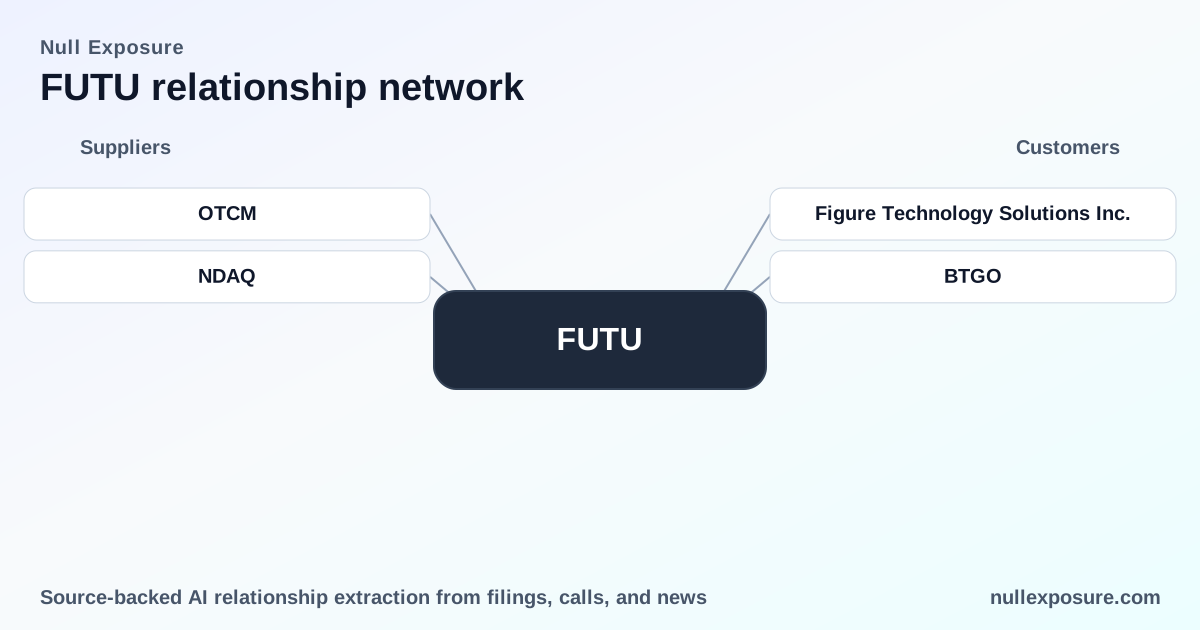
- Figure Technology Solutions Inc. — Industry reporting noted that moomoo served as the first brokerage platform to give retail clients access to Figure’s blockchain-native share offering, indicating FUTU’s willingness to distribute non-traditional, blockchain-related securities to its retail base. Source: Finviz coverage of Figure Technology offering (March 2026).
- BTGO (BitGo) — SimplyWall.St documented that moomoo materially expanded retail participation in BitGo’s IPO, capturing just under 10% of the total offering, which translated retail appetite into a measurable share of IPO allocations. Source: SimplyWall.St analysis of Futu after moomoo’s role in BitGo (March 2026).
- BitGo — Trade and financial press reported that moomoo expanded retail access to BitGo’s IPO with broad subscriber participation, confirming moomoo’s role as an important retail distribution channel for high-profile listings. Source: Finviz market commentary on Futu and the BitGo offering (March 2026).
(Note: the results set includes multiple entries reporting the same underlying BitGo/BTGO coverage and repeated QuiverQuant mention of the FY2026 coordinator roles; each source corroborates FUTU’s multi-channel distribution activity.)
What investors should watch next
- Underwriting cadence and fee capture: If FUTU continues to secure co-manager, bookrunner, or coordinator roles, expect episodic fee spikes; the sustainability question is whether those engagements convert into long-term trading and custody revenue from new retail clients.
- Retail allocation share in IPOs: The BitGo outcome—just under 10% of an IPO allocated to moomoo users—is a useful benchmark for how much distribution value FUTU can capture in crypto- or tech-focused deals. Replication of that share across multiple IPOs materially boosts incremental revenue.
- Regulatory and product risk: Distributing blockchain-native or crypto-adjacent securities elevates regulatory scrutiny and operational complexity; investors should price in execution and compliance costs as part of underwriting margins.
- Syndicate positioning: FUTU’s repeated inclusion as a co-manager and joint bookrunner signals growing credibility with issuers, but global banks retain lead underwriting control on the largest transactions—FUTU’s earnings sensitivity will follow its share of fees and the retention of downstream trading clients.
Bottom line
FUTU is executing a deliberate strategy to monetize retail engagement through capital-markets participation: acting as a syndicate partner and as a retail distribution engine via moomoo. That dual role creates both one-time fee opportunities and a pipeline for recurring trading revenues, but it also introduces issuer-execution, regulatory, and concentration dynamics investors must stress-test in scenarios. For a structured view of how these relationships map to revenue and risk, visit our research center at https://nullexposure.com/.
Investment implication: companies that convert IPO distribution into sustained retail trading volumes will expand lifetime customer value; FUTU’s documented bookrunning and retail allocation wins indicate it is on that path, but the degree of repeatable success and regulatory overhead will determine how durable the incremental margins are.