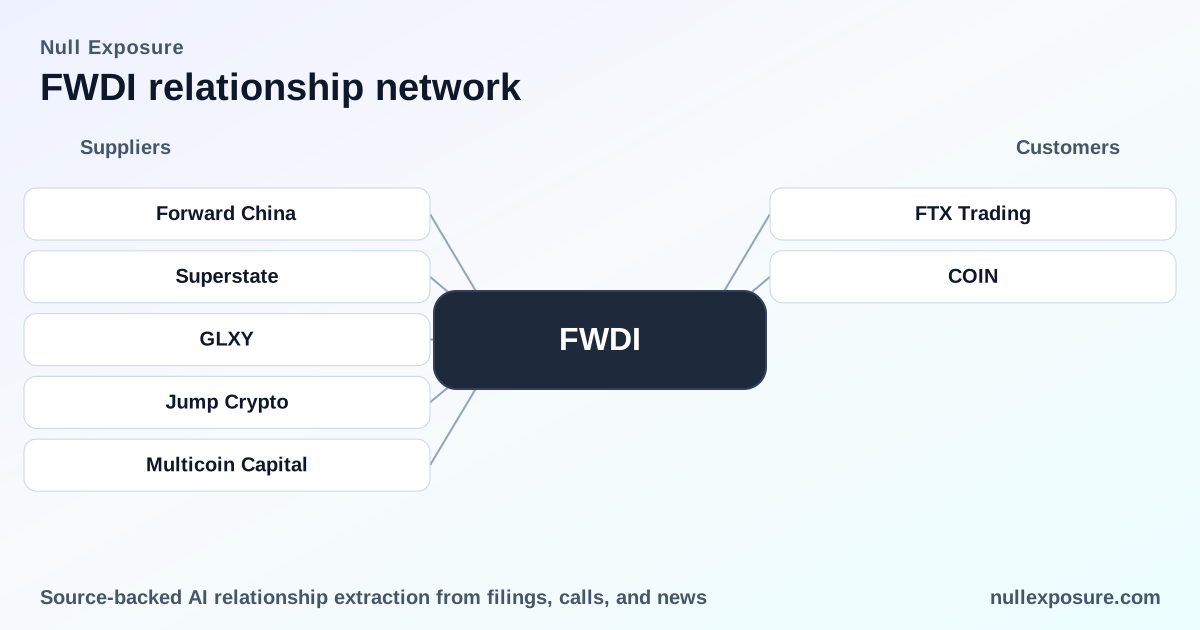
FWDI Customer Map: Who pays Forward Industries and what that means for investors
Forward Industries (FWDI) is a design and engineering services company that monetizes by selling hardware and software product design, engineering and development services to primarily U.S.-based technology and medical customers. Revenue recognition is project-driven and contract-based, with visible examples of mid-sized customer engagements (one customer generated $523,000 of revenue in FY2024), and periodic capital-market activity that connects the company to crypto-native investors. For detailed sourcing and relationship intelligence, visit https://nullexposure.com/.
Why customers define valuation more than products here
Forward’s business model is services-led rather than product-led: the firm invoices for engineering and design work on a per-project or contract basis, which produces revenue that is inherently tied to customer wins, scope expansion, and renewal cadence. That structure creates a few investment-relevant traits:
- Contracting posture: relationship-driven, fee-for-service engagements that favor clarity in scope and cadence of billings rather than recurring subscription economics.
- Concentration and counterparty profile: the company reports serving top-tier, large-enterprise customers primarily in North America, which concentrates commercial risk in a relatively narrow geography and buyer cohort.
- Revenue scale and customer materiality: at least one individual customer produced roughly half a million dollars of revenue in FY2024, placing some accounts in the $100k–$1m spend band; this implies reliance on a mix of mid-size projects rather than a broad base of low-value retainer contracts.
- Lifecycle and maturity signals: Forward’s filings indicate at least one terminated customer relationship with no FY2025 revenues or outstanding receivables, signaling normal churn in project-based services.
- Operational criticality: as a seller/service provider of engineering services, Forward’s growth is driven by winning discrete engagements and expanding per-customer wallet share, not by platform lock-in.
These characteristics mean investors should value FWDI with a focus on contract pipeline, customer concentration risk, and geographic exposure rather than on recurring margin profiles.
Customer-by-customer: the relationships recorded in public sources
Below are each of the relationships surfaced in the public record, listed with a concise one- to two-sentence plain-English summary and the source reference.
FTX Trading
Forward’s FY2025 10‑K references the November 2022 FTX Trading incident—noting that hackers exploited security weaknesses and reportedly stole over $400 million from customers—used as an industry example of exchange vulnerabilities. This citation appears in Forward’s risk discussion in the FY2025 filing and is relevant as an example of operational risk in fintech counterparties (FY2025 10‑K).
Source: Forward Industries FY2025 10‑K (risk discussion referencing the November 2022 FTX Trading security incident).
Galaxy Digital (GLXY)
A May 2026 press release covering Forward’s financing noted that Galaxy Digital took a leading role in a $1.65 billion private placement alongside other crypto investors, linking Galaxy Digital as a financial backer in the transaction. This places Galaxy Digital among the institutional investors underwriting Forward’s recent capital raise (USA Today press release, May 3, 2026).
Source: USA Today press release on Forward Industries financing, May 3, 2026.
Jump Crypto
The same May 2026 press release lists Jump Crypto as a co-lead participant in the $1.65 billion private placement, identifying Jump Crypto as a strategic investor in Forward’s equity raise. Jump Crypto’s involvement signals engagement from high-profile crypto trading firms in Forward’s financing round (USA Today press release, May 3, 2026).
Source: USA Today press release on Forward Industries financing, May 3, 2026.
Multicoin Capital
Multicoin Capital is named as a lead investor alongside Galaxy Digital and Jump Crypto in Forward’s $1.65 billion private placement per public reporting, indicating institutional crypto investment interest in the company’s capital structure. Multicoin’s participation highlights the appeal of Forward’s strategic narrative to crypto-focused venture and growth investors (USA Today press release, May 3, 2026).
Source: USA Today press release on Forward Industries financing, May 3, 2026.
COIN (ticker COIN)
Forward’s FY2025 10‑K cites a historical Coinbase account-recovery flaw from October 2021—where attackers exploited a recovery process resulting in theft from roughly 6,000 customer accounts—cited in the filing’s discussion of cybersecurity incidents affecting digital-asset platforms. The citation is used as an example of systemic exchange risks (FY2025 10‑K).
Source: Forward Industries FY2025 10‑K (discussion referencing October 2021 Coinbase security incident).
Coinbase (duplicate mention)
The filing repeats the Coinbase example in the FY2025 narrative, noting that the account-recovery flaw was subsequently fixed and affected customers were reimbursed; Forward uses this episode to frame potential industry losses and remediation expectations. This duplicate record confirms the company’s use of Coinbase’s 2021 incident as a benchmark in its risk disclosures (FY2025 10‑K).
Source: Forward Industries FY2025 10‑K (discussion referencing October 2021 Coinbase security incident).
If you want a consolidated view of how these counterparties and investors map onto Forward’s risk and capital profile, explore the company dossier at https://nullexposure.com/.
What investors should watch next
- Pipeline and contract mix: Because Forward is fundamentally a services provider, revenue growth depends on project wins and upsells; the mix between repeat business from large enterprise clients and one-off projects will drive margin stability.
- Concentration and geography: Revenue is concentrated in North America and among large enterprise buyers; this concentrates demand risk and exposes the firm to cyclicality in U.S. tech and medical capital spending.
- Customer churn and renewal: The company disclosed at least one terminated relationship with no FY2025 revenue; monitoring renewals and replacement rates is essential for forecasting near-term cash flow.
- Investor base and capital strategy: Participation by Galaxy Digital, Jump Crypto and Multicoin Capital in the private placement signals non-traditional institutional investor interest, which could influence strategic direction and access to capital markets.
- Operational risk references: Forward’s FY2025 10‑K uses high-profile cyber incidents at digital-asset platforms as risk comparators; while these are illustrative, they highlight management’s attention to counterparty operational risks in adjacent sectors.
Bottom line
Forward Industries operates as a U.S.-focused, services-oriented design and engineering firm with a customer base skewing toward large enterprise accounts and project-level revenues in the $100k–$1m band for some clients. Investors should underwrite FWDI using a customer- and contract-centric lens: evaluate pipeline health, customer concentration, renewal dynamics, and the implications of new capital injections from non-traditional investors on strategy and governance. For investor intelligence and relationship detail, go to https://nullexposure.com/.